 Algeria Agency
Retail & E-commerce
You ship.
We bring
orders
delivered and paid.
We bring orders to online shops and judge them on what you actually collect: delivery fees by wilaya, a measured refusal rate, product pages that stand alone, and ads switched off the moment a product runs out. Two of the three figures that matter arrive after the click.
No commitment. We reply within one working day, and we also tell you what we would refuse to do.
The terms
100%
Of the accounts and the shop in your name
0
Products advertised while out of stock
100%
Of product pages carrying price and availability
0 DA
Exit fee. You leave with everything.
These four figures are written into the contract. A 6-month minimum term on our digital marketing plans (Starter has none), then cancel any month with 30 days’ notice.
What you can try for yourself
Demonstrations
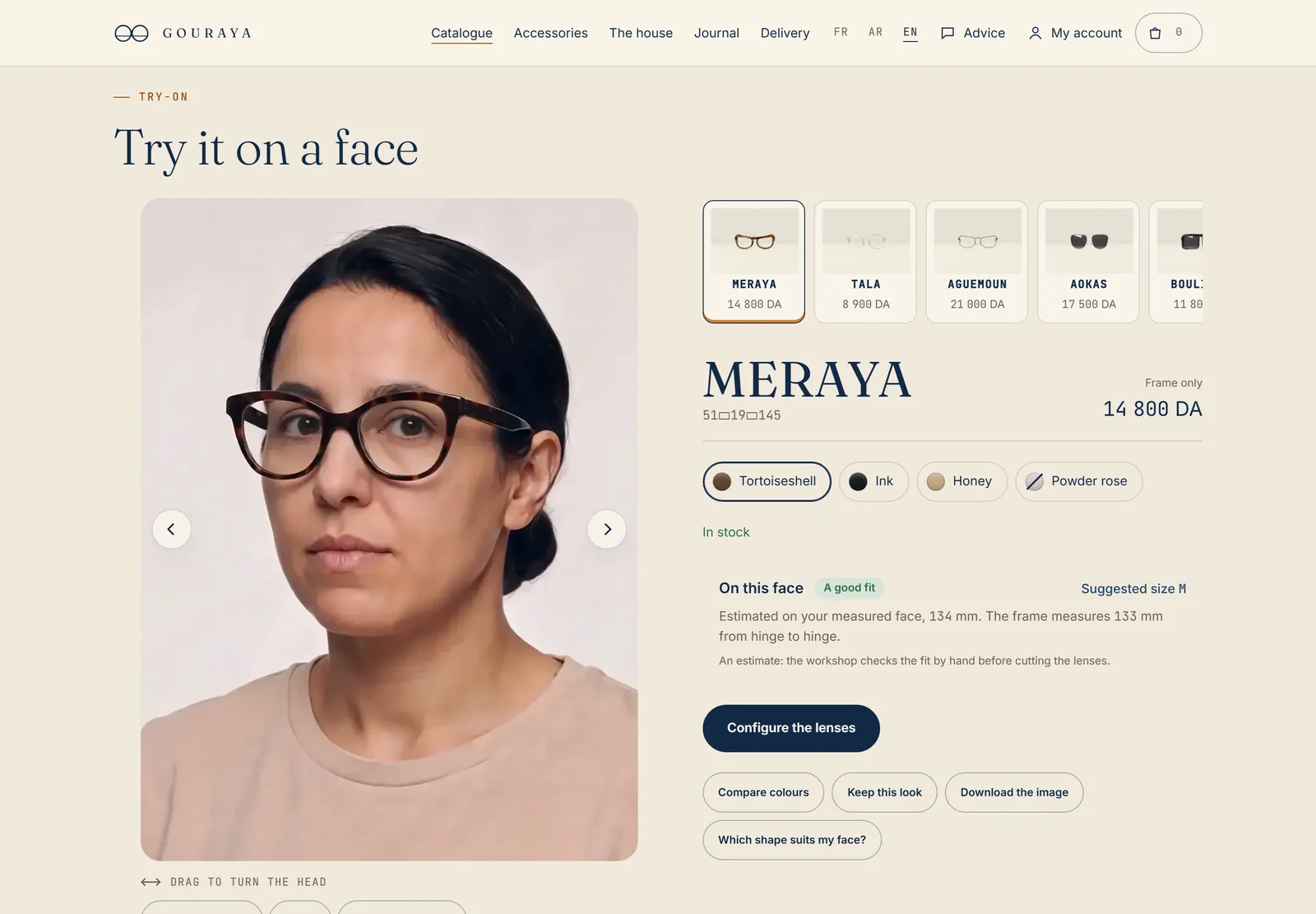
Frames tried on screen, and a basket that counts in dinars.
A complete eyewear shop: turn a model to see a frame on a face, fill a basket, and arrive at a checkout that behaves the way an Algerian order actually behaves — shipping priced by province, cash on delivery, and the card button shown switched off with its reason beside it.
See the demonstration (Gouraya Optical)The shop, the frames and the prices are invented. The order flow is not: it stops on a province the workshop cannot reach, strikes a sold-out line through instead of hiding it, and marks every order number as a demonstration.
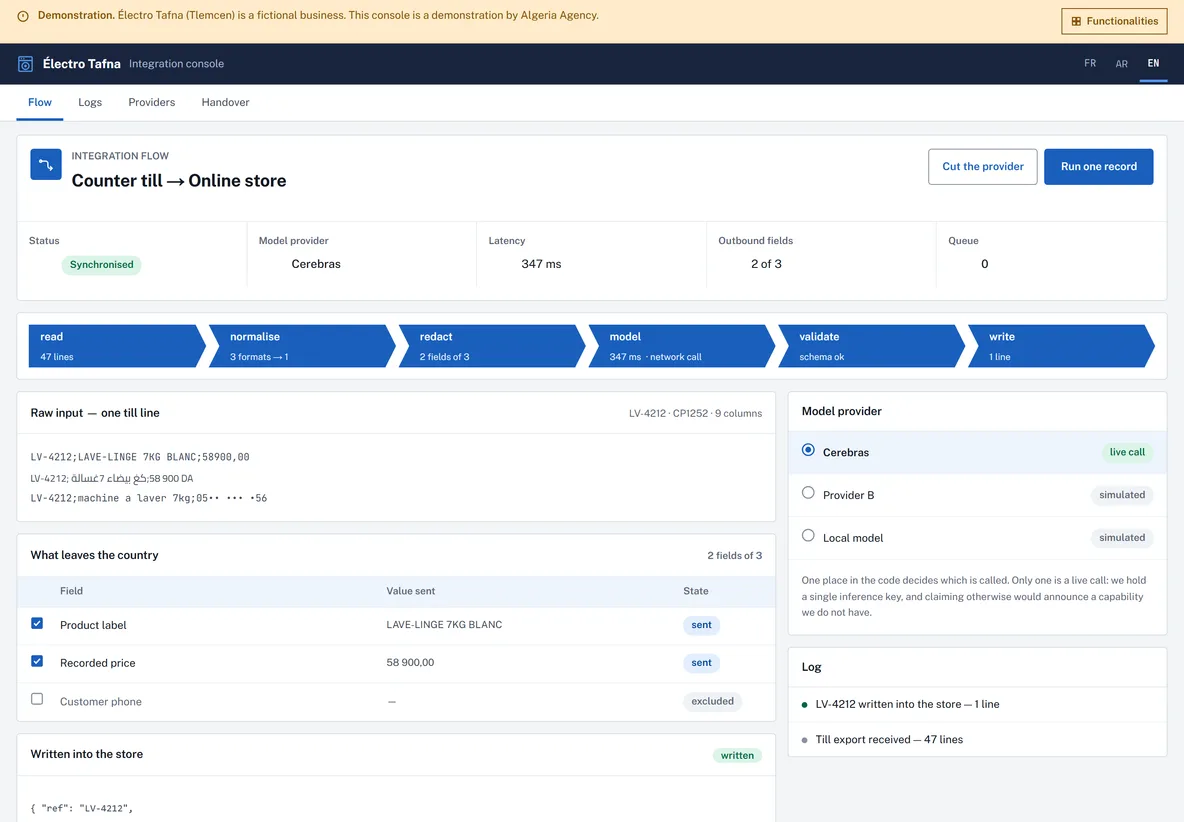
A till and a shop that never quite agree.
A fictional appliance shop in Tlemcen whose till and online store never quite agree. You take the operator's seat: run the flow, switch the model provider, drop a field from what leaves the country, and cut the connection to see what happens.
See the demonstration (Électro Tafna)A fictional business: nothing you run here reaches a real shop.
The problem
What we usually find
- Your delivery charges are the same everywhere and you lose on distant wilayas.
- Some of your orders are refused on delivery, and nobody counts them.
- You advertise products that are no longer in stock.
- Your basket is abandoned at the moment the delivery charge appears.
A shop judging its campaigns on orders placed believes itself profitable. The refusal on the doorstep, the return and the round trip are all paid for by the time it notices.
Where we stand
Delivery decides your profitability before the product and before the advertising.
Online retail in Algeria is almost never decided on technology. It is decided on three numbers: the real delivery cost per wilaya, the refusal rate on arrival, and the cost of acquiring a customer. A shop that ignores the first two displays revenue it does not collect.
Cash on delivery is the dominant reality, and it changes everything. It implies a refusal rate, a return cost, and a telephone confirmation before dispatch that absorbs time. A campaign judged on orders placed rather than orders delivered and paid for is lying about its profitability.
The third point is stock. Sending traffic to unavailable products produces cancelled orders, disappointed customers and negative reviews — three costs against a budget already spent. Availability is therefore an advertising constraint as much as a logistical one.
So our work is to surface those numbers before spending, correct the checkout, and only push what you can genuinely deliver.
And it is decided per wilaya, not by a single national rate.
The engine
The acquisition engine, in nine stages
Nine stages, and in this trade three of them happen after the click has been paid for: the telephone confirmation, the shipment, and the possible refusal. Which is why nothing here is measured on the order — everything is measured on what is collected, and a shop that does not draw that distinction spends blind while believing itself steered.
Stage 00 — Measurement
Carrier, dockets, shop
Three figures before spending: cost per wilaya, refusal rate, cost of acquisition.
The first two are missing in almost every shop, and they are what decide whether a campaign makes or loses money. They can be reconstructed from your carrier dockets and your returns, without waiting for a new tool.
You do
Nothing. Approve one access request.
We do
We reconstruct the real cost per zone and the refusal rate per basket size.
You get
A map of what you lose, before deciding where you want to sell.
Stage 01 — Attention
Social, search, paid placement
Push only what you can deliver, where the refusal rate is bearable.
Sending traffic to an out-of-stock product costs three times: the budget, the cancelled order and the review. And some zones combine a long trip with a high refusal rate, which makes a sale there structurally loss-making whatever the product.
You do
Nothing. Approve the creative if you want to.
We do
We wire the delivery to availability and exclude the loss-making zones.
You get
A budget that no longer funds orders you did not want.
Stage 02 — Intent
Social, search, product page
Nobody searches for your shop. They arrive at a product.
Most visitors land straight on a product page from a social feed, without passing the home page and without knowing who you are. The intention is one precise product, usually seen thirty seconds earlier, and it is lost if the page sends them elsewhere.
You do
Nothing. Tell us once where you do not deliver.
We do
We treat every product page as a landing page in its own right.
You get
Arrivals that convert without having to explore the site.
Stage 03 — The landing
Product page, shop
The product page must stand alone: price, stock, estimated fee, how to order.
Four pieces of information, on one screen, with no navigation. The estimated fee for the visitor’s wilaya is the one missing nearly everywhere, and it is exactly the question that closes the tab — because the price shown is not the price paid.
You do
Nothing. Send us the catalogue once; we keep it current after that.
We do
We show the estimated fee on the product page, before the basket.
You get
Fewer abandonments at the moment delivery appears.
Stage 04 — Conversion
Checkout, CIB, Edahabia
Give a reason to pay in advance, without removing cash on delivery.
Cash on delivery remains the dominant reality and there is no question of refusing it. But cards are widely held, including prepaid ones for people with no bank account, and that is the only lever that removes the refusal, the return and the wasted trip. So it needs a clear reason to be chosen.
You do
Nothing.
We do
We put both routes side by side, with the advantage written on the first.
You get
A share of orders already collected before the parcel moves.
Stage 05 — The reply
WhatsApp, telephone, SMS
The confirmation call is a selling step, not a formality.
Part of the refusal is decided there. The assistant confirms the exact address, the wilaya and availability before a parcel leaves, and flags what does not add up — an imprecise address costs a full round trip, and nobody invoices the customer for it.
You do
Nothing. Pack the orders it takes for you.
We do
We confirm by message first and keep the call for the doubtful cases only.
You get
Fewer parcels shipped to an address where nobody will answer.
Stage 06 — The follow-up
WhatsApp, SMS, email
An abandoned basket and a refused order are not the same problem.
The first cost nothing and is recovered with the missing information, almost always the delivery fee. The second has already cost a trip, and the right follow-up is not a discount: it is an offer to prepay, or nothing at all.
You do
Nothing.
We do
We separate the two lists and never send the same thing to both.
You get
Follow-ups that recover without cutting the margin at random.
Stage 07 — Reputation
Reviews, product page, messaging
Reviews in this trade are about the parcel, not the product.
The time taken, the state it arrived in, who delivered it, what happens when something goes wrong. Publishing the grid and the real times per zone honestly prevents half of those reviews, because disappointment comes from the gap rather than from the duration.
You do
Nothing.
We do
We publish them as they are, and answer delivery reviews ourselves.
You get
Expectations set against the carrier you actually have.
Stage 08 — Proof
Shop, product page, delivery page
Proof is the published grid and the stock position.
Two pieces of information almost no shop displays, and which settle the two questions a buyer asks before ordering. Publishing them costs honesty about the distant zones and earns the confidence of everybody else.
You do
Read one page a month. Make one decision.
We do
We publish the grid per zone and wire availability through live.
You get
Orders that convert, because nothing new appears on the last screen.
What we do
What you get
A real delivery grid
By wilaya and weight, with the areas you do not serve switched off rather than endured.
Charges shown early
On the product page where possible, because a cost discovered on the last screen causes abandonment.
Tracking through to collection
Orders delivered and paid for measured separately from orders placed, the only usable figure.
Advertising tied to stock
Unavailable products drop out of campaigns, so you do not pay for orders that will be cancelled.
Self-sufficient product pages
Price, availability, estimated charges and a way to order on the page, which is often the landing page.
Who arrives
Who is looking for you, and where they pass
Five arrivals, and three of them turn on a figure you are not yet showing: the fee to reach their door.
Who arrives
Somebody who has just seen the product in a feed
First
The product page alone
Then
Estimated fee for their wilaya
Why
They will not go looking elsewhere on the site: they close the tab and the feed continues.
Who arrives
Somebody comparing two shops on the same item
First
The delivery grid
Then
The stated transit time
Why
The product is identical, so the decision turns on what you add to the price.
Who arrives
A customer who has refused an order before
First
Confirmation by message
Then
An offer to prepay
Why
A second refusal costs two trips, and a discount does not repair the cause.
Who arrives
A happy customer coming back
First
Their usual product page
Then
Reorder in one gesture
Why
It is the only order on this list that costs nothing to acquire.
Who arrives
A customer waiting for a parcel
First
Tracking page
Then
Messaging
Why
Without an answer within hours, the worry becomes a refusal on the doorstep.
On the ground
How do you sell online in Algeria?
Delivery is the first driver of profitability, ahead of the product and ahead of the advertising. A single national rate loses money on distant shipments and makes the shop needlessly expensive for nearby customers. A grid by zone takes longer to prepare and pays from the first week.
Cash on delivery brings a refusal rate that should be measured rather than absorbed. Telephone confirmation, returns, the round trip: those costs exist, they concentrate on certain areas and certain baskets, and knowing them lets you decide where to deliver and at what price.
Finally, most visitors arrive straight onto a product page from a social platform. That page therefore has to stand alone: price, availability, estimated charges and a way to order. A page forcing someone to navigate elsewhere loses a buyer who was ready.
Getting started
How we work
Establish the real numbers
Delivery cost by zone, refusal rate, return cost. Without them, no advertising decision is reliable.
Fix the grid
Charges by zone and weight, unserved areas closed, free-delivery thresholds calculated on margin.
Repair the checkout
Charges stated early, a shorter form, a messaging route kept alongside the basket.
Connect the stock
Campaigns follow real availability, which avoids paying for orders you will have to cancel.
Measure what is collected
The report covers orders delivered and paid for. Everything else is an intermediate indicator.
The result
What changes
A margin that survives by wilaya
Charges calculated by zone and weight, which stops the silent loss on distant shipments.
Numbers that match the till
Measured on orders delivered and paid for, not orders placed, which overstate everything.
A checkout that does not surprise
Charges and lead times stated early, because late discovery is the leading cause of abandonment.
Who this is for
Is this the right fit for you?
We work well with
- You sell physical products and already deliver.
- You know, or will measure, your refusal rate on delivery.
- You can keep stock current on whatever you promote.
We are the wrong choice if
- You want advertising before fixing delivery charges. It will amplify the loss.
- Your stock changes with nothing reflecting it online. Cancelled orders will cost more than the budget.
- You want to judge on orders placed. We measure on orders paid for, and the number will be lower.
Questions
Frequently asked questions
Should we wait for card payment before launching?
No. Cash on delivery remains how the majority buys. Open with it, and add the card when your bank application succeeds.
How do we reduce refusals on delivery?
Telephone confirmation before dispatch, charges stated clearly up front, and realistic lead times. Most refusals come from a surprise, not a change of mind.
Should we offer free delivery?
Only above a threshold calculated on your real margin by zone. Uniform free delivery is the fastest way to sell at a loss on distant wilayas.
Which indicator should we track?
Cost per order delivered and paid for. Orders placed flatter the reports and lead to increasing a budget that was losing money.
Do we need a website or are social platforms enough?
Social is enough to start and becomes a limit as volume rises: orders copied by hand, unsynchronised stock, no customer data. That is the moment to move.
What about out-of-stock products?
Remove them from campaigns automatically. It is a simple technical setting that avoids paying for orders you will have to cancel.
Let's talk
How to start
Send us your current delivery grid, your refusal rate if you know it, and your catalogue.
We come back with what you actually lose by zone, what needs fixing in the checkout, and the measurement on collected revenue without which advertising is judged blind.
- We measure on what is collected
- No advertising on an unavailable product
- Logistics before budget