 Algeria Agency
Entertainment & Events
You run events.
We bring
the audience
before the date.
We bring the audience in where it actually decides — in the last week, as a group: a phase calendar counted back from the date, the venue, real start time and price in every post, a seat that can be held without paying online, and a report in tickets sold, not views.
No commitment. We reply within one working day, and we also tell you what we would refuse to do.
The terms
100%
Of the accounts and visuals in your name
0
Posts without the place, time and price on them
100%
Of events bookable without paying online
0 DA
Exit fee. You leave with everything.
These four figures are written into the contract. A 6-month minimum term on our digital marketing plans (Starter has none), then cancel any month with 30 days’ notice. On a dated event, a promise is confirmed or contradicted that same evening, by a hall everybody can see.
What you can try for yourself
A demonstration
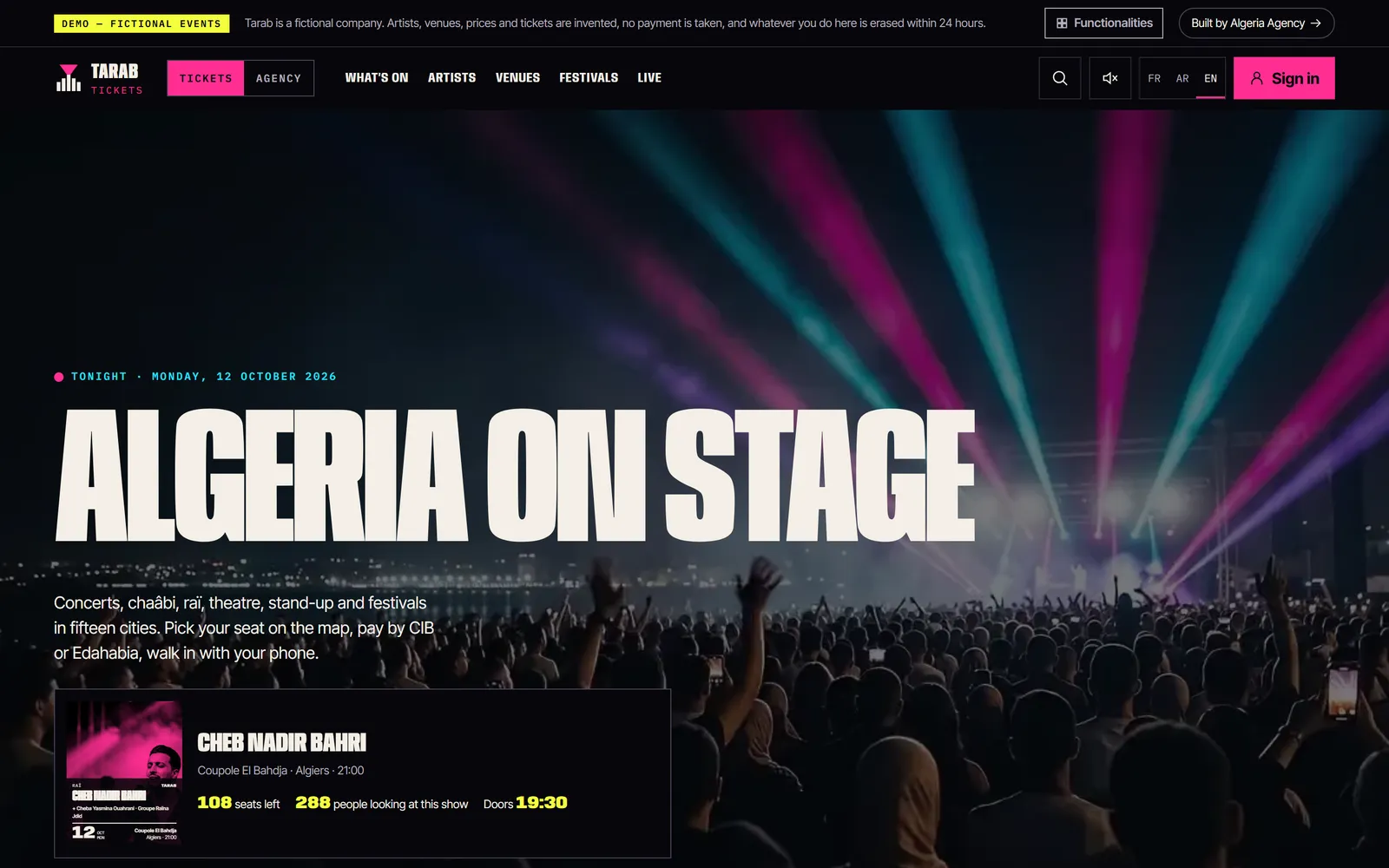
A ticketing platform and an events agency, on one platform with seven trade workspaces.
A complete entertainment company, built rather than rented: a multi-promoter ticketing platform with seat maps, a waiting room and fraud-proof tickets, an events agency with quotes, invitations and seating plans, an offline door-scanning app and a dashboard for every trade. An AI planner designs your event, in writing or by voice.
See the demonstrationThe artists, venues and events do not exist, and payment is simulated. What is real: the seat map shared live, offline door control, each role’s workspace and the assistant that never quotes a price it has not found.
The problem
What we usually find
- You start communicating three weeks before the event.
- Your posts get plenty of views and few tickets.
- The venue, time and price are not in the post.
- You do not know which channel sold what.
What decides is not the poster. It is the person who sends the poster to their friends, because almost nobody goes out alone.
Where we stand
There is a date, and after it nothing has any value.
Events have a characteristic few sectors share: there is a date, and after it nothing has value. A budget spent too late is lost entirely, and one spent too early reaches people who cannot decide yet.
That makes measurement unusually honest. You know how many tickets sold, when, and through which channel. There is no attribution debate, which is rare, and it should organise the whole of the work.
The second reality is that the decision is social. Few people come alone, which means your message has to be shareable, not only convincing. What decides is often not the poster but the person who sends the poster to their friends.
So our work is to align the phases with the real decision calendar, produce what gets shared, and measure on tickets sold rather than on engagement.
That is what makes the measurement honest and the budget split decisive.
The engine
The acquisition engine, in nine stages
Nine stages, compressed into a countdown. A budget spent too late is lost entirely; spent too early it reaches people who cannot yet decide. And because you know exactly how many tickets sold, when and through which channel, there is no attribution argument here — which is rare, and which should organise all the work.
Stage 00 — Measurement
Ticketing, box office, till
Tickets sold, not engagement.
This is the one sector where measurement is not up for discussion: a ticket sold is a ticket sold, with its timestamp and its channel. Every intermediate indicator — views, shares, intentions — is a distraction while the real figure is available in real time.
You do
Nothing. Approve one access request.
We do
We wire the measurement to sales and ignore everything else.
You get
A sales curve updated every morning, read for you, and a decision to take only when it matters.
Stage 01 — Attention
Listings, ticketing platforms, social
Exist where people look for “what’s on this weekend”.
Part of the audience is not searching for your name: they are browsing a listing, by wilaya and by date, on a platform that is not yours. Appearing there costs nothing and almost no organiser does it — it is the one free channel in this trade, and it is empty.
You do
Nothing. Send us the season’s programme once.
We do
We register you on the listings and ticketing platforms and keep the entry current.
You get
Sales from people who did not know your name this morning.
Stage 02 — Intent
Social, listings, paid placement
Three phases counted back from the date, and the last is the heaviest.
The decision is taken late and in groups, so the last week concentrates a large share of sales. A budget spent entirely at launch misses exactly the moment people decide, and it cannot be recovered, because the date does not move.
You do
Nothing. Tell us once what time it actually starts.
We do
We cut the phases back from the date and hold the reserve.
You get
Budget still in hand at the one moment it converts.
Stage 03 — The landing
Social, listings, event page
Missing practical information is the leading cause of lost tickets.
Exact place, the real start time — not the poster’s — the price, the access, parking, minimum age. Their absence cuts an intention that had already formed, and correcting it is free. A post without them asks somebody to do the research for you; they will not.
You do
Nothing. Send us the venue, the capacity and the final price once.
We do
We put those in every post, not only on the page.
You get
Intentions that reach a booking instead of stopping on the way.
Stage 04 — Conversion
Ticketing, box office, WhatsApp
A booking that does not require paying online.
Online payment is not universal here, and a path offering only that loses part of the audience — often the part that would have come as a group. A physical collection point, or a booking payable on site, widens the real audience more than any targeting.
You do
Nothing.
We do
We present both paths as equals, without treating the second as an exception.
You get
A wider audience without having widened the advertising by a metre.
Stage 05 — The reply
WhatsApp, messaging, page
Answer the practical questions, immediately, right up to the night before.
The questions are always the same: are there tickets left, what time, where exactly, how do I pay, can children come. The assistant handles them, including on the preceding night, and holds nothing it cannot confirm against the seating plan.
You do
Nothing. Welcome the groups it has sent to the box office.
We do
We write it onto those questions and stop it before any firm booking.
You get
Answers at eleven the night before, when groups make up their minds.
Stage 06 — The follow-up
Social, messaging
Produce what gets shared, not what gets looked at.
Few people come alone, so the message has to be forwardable to three friends unchanged and still make sense out of context. A visual that needs explaining does not travel, however good it is, and it is the sharing that sells rather than the display.
You do
Nothing.
We do
We produce formats that stand up when they arrive with no comment attached.
You get
Distribution your audience does for you, at no cost.
Stage 07 — Reputation
Social, page, reviews
Reputation is built that same evening, and it serves the next time.
What happened during the event decides the next edition far more than any campaign. Photographs taken on the night and published the next day are the best argument the following edition has — and they exist only if somebody was given the job of taking them.
You do
Nothing. Let us photograph during the event, not after it.
We do
We publish within twenty-four hours and keep the material for next year.
You get
A next announcement with nothing left to promise, only to show.
Stage 08 — Proof
Social, event page
Proof is the previous edition, as it actually went.
The real hall, the real crowd, the real running order. A borrowed image or a render is paid for on the night, in front of an audience comparing — and that audience writes in the moment, from inside the room. There is no sector where the gap shows this quickly.
You do
Read one page a month. Make one decision.
We do
We publish only your images, dated, from the edition they show.
You get
An audience that arrives knowing what it will find, and comes back.
What we do
What you get
Phase plan
Aligned with your audience’s real decision calendar, not an arbitrary duration.
Short-form video
The format that circulates in this sector, and the only one that conveys an atmosphere.
Practical information
Venue, time, price, access and parking, in the post itself and not only on the website.
Clear ticketing
A short purchase path, because every extra step costs tickets in the days before the date.
Channel tracking
Which tickets come from where, measured at the sale and not at engagement.
Who arrives
Who is looking for you, and where they pass
Five arrivals, all of them dated. Two of them decide inside the final seven days.
Who arrives
Somebody looking for what is on this weekend
First
A listing that is not yours
Then
Your page
Why
They are not searching your name, and appearing on that listing costs nothing.
Who arrives
The one who sends the poster to their friends
First
A format that stands up out of context
Then
The group decides
Why
They are not the biggest buyer: they are the reason the other four buy.
Who arrives
A group deciding two days before
First
Tickets left and the real start time
Then
Booking
Why
The last week concentrates sales, and that is where the budget is usually gone.
Who arrives
Somebody who does not pay online
First
The collection point or payment on arrival
Then
A seat held
Why
Without that route they do not come, and they rarely come alone.
Who arrives
Somebody who was at the previous edition
First
Your photographs from the next morning
Then
They return, with others
Why
It is the only audience you already own, and it is lost if nothing is published.
On the ground
How is a night out decided in Algeria?
The decision is made late and in groups. That means the final week concentrates a significant share of sales, and a budget spent entirely at launch misses the moment people actually decide.
Practical information is almost always missing. Exact venue, real start time, price, access: their absence is the first cause of unconverted intent, and it is free to fix.
Online payment is not universally adopted, and a path offering only that option loses part of the audience. Providing a physical sales point or a reservation with payment on site widens the real audience more than any targeting does.
Getting started
How we work
Set the calendar
Backwards from the date, with phases and their budgets. It is the structuring decision.
Produce early
Visuals and video ready before the first phase, because producing under pressure costs more and returns less.
Put the essentials everywhere
Venue, time, price. Their absence is the most frequent cause of a good score and zero sales.
Shorten the purchase
As few steps as possible between the post and the paid ticket.
Measure sales
By channel and by phase, which gives you the plan for the next event.
The result
What changes
A phase calendar
Announcement, reminder, last chance. Each phase has its message, which avoids spending at the wrong moment.
Content that gets shared
Formats built to be forwarded to a friend, because the decision to come is almost always collective.
Clean attribution
Tickets sold attached to their channel, which is possible here and rarely done.
Who this is for
Is this the right fit for you?
We work well with
- You organise events with dates set in advance.
- You can produce or supply visual content.
- You sell tickets or measure admissions.
We are the wrong choice if
- You start communicating two weeks out. The calendar is already lost.
- You want reach rather than sales. We will measure sales, and the ratio will disappoint.
- You cannot supply any visuals of past events. This sector does not sell in text.
Questions
Frequently asked questions
When should we start?
Early enough to establish the event, with a significant share of budget held for the final week, where decisions concentrate.
Which format works best?
Short-form video, because it conveys an atmosphere and gets shared. A static poster informs but does not circulate.
What must be in the post?
Venue, time and price. Their absence explains most much-viewed campaigns that do not sell.
Should we sell online?
Useful, but not exclusively. Providing a physical sales point or payment on site avoids losing part of the audience.
How do we measure?
In tickets sold by channel and by phase. Engagement says nothing about the room on the night.
What do we do with the content afterwards?
It becomes the proof for the next one. Filming and photographing every edition is the most profitable investment in the sector.
Let's talk
How to start
Tell us the date of your next event, your capacity, and what visuals you have from previous editions.
We come back with the phase calendar worked backwards, the budget split, and the post format that carries the essentials.
- The calendar before the creative
- Venue, time and price in every post
- Reported in tickets, not views