 Algeria Agency
Insurance
You insure.
We bring you
clients who
read the limits.
We bring you quote requests from people who already know what is covered — and what is not: one page per situation with the cover and its limit in the same paragraph, a quote form cut to what is needed, and a claims procedure findable in ten seconds. Your compliance team approves every price in writing before it appears.
No commitment. We reply within one working day, and we also tell you what we would refuse to do.
The terms
0
Cover stated without its limit beside it
100%
Of figures signed off by your compliance function
100%
Of the accounts and the listing in your name
0 DA
Exit fee. You leave with everything.
These four figures are written into the contract. A 6-month minimum term on our digital marketing plans (Starter has none), then cancel any month with 30 days’ notice. On this product, a promise pitched too widely becomes a dispute on the day of the claim.
What you can try for yourself
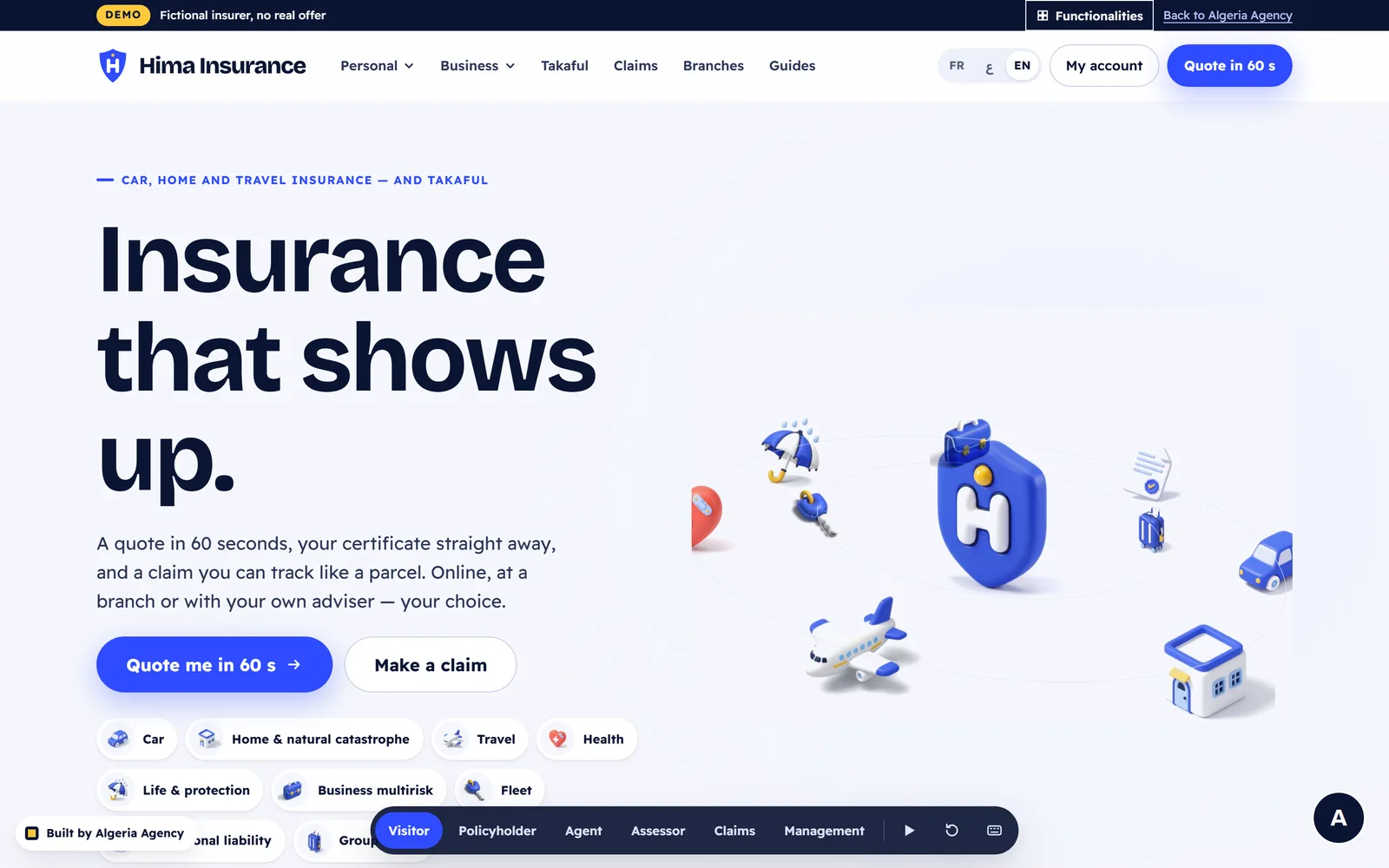
A demonstration
A whole insurance company: the site, the 60-second quote, claims and five back offices.
A complete insurance company, invented end to end: website, online quotes and sign-up, claims, agents, assessors, handlers and management — six roles, one platform.
See the demonstrationA fictional company: made-up prices, no real policies, nothing is charged.
The problem
What we usually find
- Your customers discover an exclusion at the moment of a claim.
- Your cover is described in vocabulary nobody understands.
- The claims procedure cannot be found on your website.
- Your policy comparisons only compare what suits you.
Your product is judged once, and not on the day it is sold. Everything written beforehand is reread at that moment, by somebody looking for what they were not told.
Where we stand
It is the exclusions that sell, not the cover.
Insurance is a regulated sector: what may be stated about cover and pricing depends on the product and the regulation, and an incautious phrasing commits the insurer or the broker. We check what is permitted before proposing, as with banking.
Then comes a difficulty specific to the product: nobody buys insurance with pleasure. The decision is made by comparison, and the comparison is made on what is not covered as much as on what is. A policy whose exclusions are clear sells better than one whose cover is enthusiastic.
The third reality is that the product is judged once, at the moment of a claim. All the communication that came before is evaluated retroactively at that point. A slightly wide promise, apparently honoured for two years, becomes a public dispute in a day.
So our work is to explain cover and exclusions in the same breath, make the claims procedure easy to find, and write content a customer can reread without feeling misled.
A contract with clean limits is signed more readily than an enthusiastic one.
The engine
The acquisition engine, in nine stages
Nine stages, the same everywhere. What belongs to insurance alone comes down to two rules: nothing numbered goes out without your compliance function, and the obligatory never travels through the page built for the chosen — compulsory cover is won on speed, chosen cover on explanation, and mixing them fails both.
Stage 00 — Measurement
Quotes, branch, telephone
Separate the obligatory from the chosen before counting anything.
Two products, two behaviours, and in most practices a single dashboard — so every average that comes out of it is wrong. Quote requests are counted on one side, renewals on the other, and claims apart from both.
You do
Nothing. Approve one access request.
We do
We separate the two flows at the measurement, so nothing averages together later.
You get
Two dated starting points instead of one that means nothing.
Stage 01 — Attention
Search, listing, paid placement
Be there when the obligation appears, not when the desire arrives.
Nobody wakes up wanting insurance. What exists are moments: a vehicle bought, a loan granted, premises leased, a renewal falling due. Motor carries most of the volume and is won almost entirely there.
You do
Nothing. Your compliance team approves the ad template once.
We do
We take up position at those moments rather than on the word “insurance”.
You get
Enquiries that arrive with a reason attached, rather than curious traffic.
Stage 02 — Intent
Search, pages by case
The question asked is never “which insurance”. It is “is this covered”.
People search for a case: water damage at the neighbour’s, a lent vehicle, a halted site. And lately they search for takaful by name, to understand how it differs — a category arriving faster than the pages explaining it.
You do
Nothing. Tell us once which risks you do not cover.
We do
We write one page per case, the limit in the same paragraph as the cover.
You get
Pages that answer the real question, and that a client rereads without reproach.
Stage 03 — The landing
Site, page per policy
People arrive to check one specific case, not to read a brochure.
The page has ten seconds to say what is covered, what is not, and what that changes. A policy described in contract vocabulary asks the visitor to translate it, and they do not translate: they leave to compare elsewhere.
You do
Nothing. Approve the wording of the limits once.
We do
We write each policy in readable language, never separating cover from its limit.
You get
A page a client can reread after a claim without feeling misled.
Stage 04 — Conversion
Quote form
Every needless field on the quote form costs an enquiry.
A long form turns an interested prospect into an abandonment, and the worst of it is that they abandon after giving you the hardest part. We keep what is needed to quote, and nothing that will be needed later — later, you will have them on the phone.
You do
Nothing.
We do
We remove the rest and measure abandonment before and after.
You get
More completed quotes, and no rate displayed without written approval.
Stage 05 — The reply
WhatsApp, messaging, site
Answer on procedure, never on whether a case is covered.
The assistant says which documents to gather, which deadline is running, who to call and where the file goes. It never says whether a loss is covered: that is reading a contract, it binds the insurer, and it belongs to a person.
You do
Nothing. Approve once what it may say, then price the quotes it brings you.
We do
We write it on that side of the line and restrain it on the other.
You get
Practical questions handled overnight, and no cover promised by a machine.
Stage 06 — The follow-up
SMS, email, branch
Remind about a renewal, which is the only legitimate chase here.
Renewal is a non-decision: it happens on its own or it is lost, depending on whether something arrived at the right time. On the obligatory product the date is real and a reminder is a service; on the rest it opens the conversation the claim will close.
You do
Nothing.
We do
We schedule a useful reminder — the date, what is needed, and nothing sold in the middle.
You get
Fewer contracts lost to forgetfulness, and no chase that reads as harassment.
Stage 07 — Reputation
Reviews, listing, correspondence
Your reputation is not written at the sale. It is written during a claim.
Reviews in this sector are composed across two difficult weeks, by somebody discovering a clause. The only lever available before that moment is having stated the limit, and being able to show where it was written.
You do
Nothing.
We do
We write your limits at the top of every page, where they are read rather than where they hide.
You get
Disputes that go back to being disagreements, because the sentence existed beforehand.
Stage 08 — Proof
Claims page, site
Proof is the claims procedure, written for somebody in a panic.
It is the most useful page on the site and almost always the worst placed. It is tested by having somebody who does not know the contract read it, standing up, on a phone — because that is exactly the situation.
You do
Read one page a month. Make one decision.
We do
We write it in numbered steps and have somebody outside the business read it.
You get
Fewer calls at the worst moment, and a page your policyholders find on their own.
What we do
What you get
Compliance check
What may be stated about cover and pricing, verified before any production.
Cover and exclusions together
Never one without the other. It is the only way to write a page a customer will reread without reproach.
Claims journey
How to claim, what documents, what timelines, who to contact — written to be read under pressure.
Explanatory content
What each policy covers and in what circumstances, in comprehensible language rather than contract vocabulary.
Quote forms
Reduced to what is strictly needed, because a long form turns an interested prospect into an abandonment.
Who arrives
Who is looking for you, and where they pass
Five arrivals, five first expenses. Two of them are not purchases at all: one is an obligation and one is a claim.
Who arrives
Somebody who has just bought a vehicle
First
Local search, listing
Then
The obligatory policy page
Why
It is a dated formality: won on speed, not on argument.
Who arrives
A policyholder approaching renewal
First
Renewal reminder
Then
A page comparing your policies
Why
Renewal is a non-decision, and nothing triggers it if nothing arrives.
Who arrives
Somebody searching for takaful by name
First
A page explaining the difference
Then
Quote
Why
The category is arriving faster than the pages explaining it, and demand is already there.
Who arrives
The relative being asked for advice
First
The exclusions page
Then
Page by case
Why
Comparison happens offline: you have to arm whoever advises, not only whoever signs.
Who arrives
A policyholder at the moment of a claim
First
Claims page
Then
Direct contact
Why
That is where the product is judged, and where the reviews others will read come from.
On the ground
What holds online insurance back in Algeria?
Distrust is the starting point, and it concerns settlement more than price. An insurer that explains precisely how a claim proceeds — stages, timelines, documents, appeals — answers the only question that genuinely matters, and almost nobody does it.
Comparison often happens offline, through a relative or an intermediary. Clear content therefore serves to equip the person advising as much as to convince the person buying, and that changes how it should be written.
Finally, compulsory insurance and chosen insurance have nothing in common. The first is a formality decided on speed; the second is a decision settled by explanation. Mixing them in one piece of communication misses both.
Getting started
How we work
Frame what is permitted
With your compliance function, before producing. Cover and pricing are the most closely watched ground.
Write the exclusions
First, not last. They are what decides the sale and what avoids the dispute.
Make claims findable
The most useful page on the site, and almost always the worst placed.
Shorten the quote form
Every non-essential field costs enquiries. Keep what is needed to reply.
Track real enquiries
What arrives, what converts, what is declined. That is what directs the next content.
The result
What changes
Fewer disputes at claim time
Exclusions stated clearly before signature turn a predictable dispute into an informed decision.
Better qualified enquiries
Content that explains frankly turns away the profiles you would have declined, and attracts the ones you want.
A simpler claim
A findable, comprehensible procedure reduces calls and exasperation at the worst possible moment.
Who this is for
Is this the right fit for you?
We work well with
- You are a licensed insurer, broker or agent.
- You accept writing exclusions as clearly as cover.
- You can have content approved.
We are the wrong choice if
- You want to lead with cover and omit the limits. That produces disputes, not customers.
- You want to advertise pricing without approval. We will refuse.
- You do not want to simplify the quote form. Traffic will not offset the abandonment.
Questions
Frequently asked questions
Can we communicate about pricing?
Depending on the product and the wording, and after approval. We publish no figure without written sign-off from your compliance function.
Do exclusions really need detailing?
Yes, and it is what sells. A customer who discovers an exclusion at claim time becomes a public dispute; a forewarned customer stays a customer.
How should compulsory insurance be handled?
As a formality: speed, documents, price, procedure. It does not sell on the same arguments as chosen cover.
Should the quote form be short?
As short as it can be while still allowing you to reply. Every extra field costs enquiries, and the rest can be asked on the phone.
What belongs on the home page?
The claims procedure and the customer area, ahead of the products. Those are the two reasons your customers come.
Do reviews matter in this sector?
Enormously, and they concern settlement almost without exception. It is the process that produces the reviews, not the communication.
Let's talk
How to start
Tell us which disputes recur most often at claim time, and how many fields your quote form has.
We come back with the exclusions to state explicitly, the claims page to rebuild, and the shortened form.
- Never a cover without its limit
- No figures without approval
- Claims written for pressure