 Algeria Agency
Food & Beverage
You produce.
We bring
the buyers
here and abroad.
We bring stockists, distributors and importers to Algerian producers: a spec sheet that answers a trade buyer, a supplier page in their language, trade fairs prepared like campaigns, and packaging whose mandatory statements are checked before the print run.
No commitment. We reply within one working day, and we also tell you what we would refuse to do.
The terms
100%
Of mandatory statements checked before the print run
0
Artwork approved without your printer’s agreement
100%
Of source files delivered in your name
0 DA
Exit fee. You leave with everything.
These four figures are written into the contract. A 6-month minimum term on our digital marketing plans (Starter has none), then cancel any month with 30 days’ notice.
What you can try for yourself
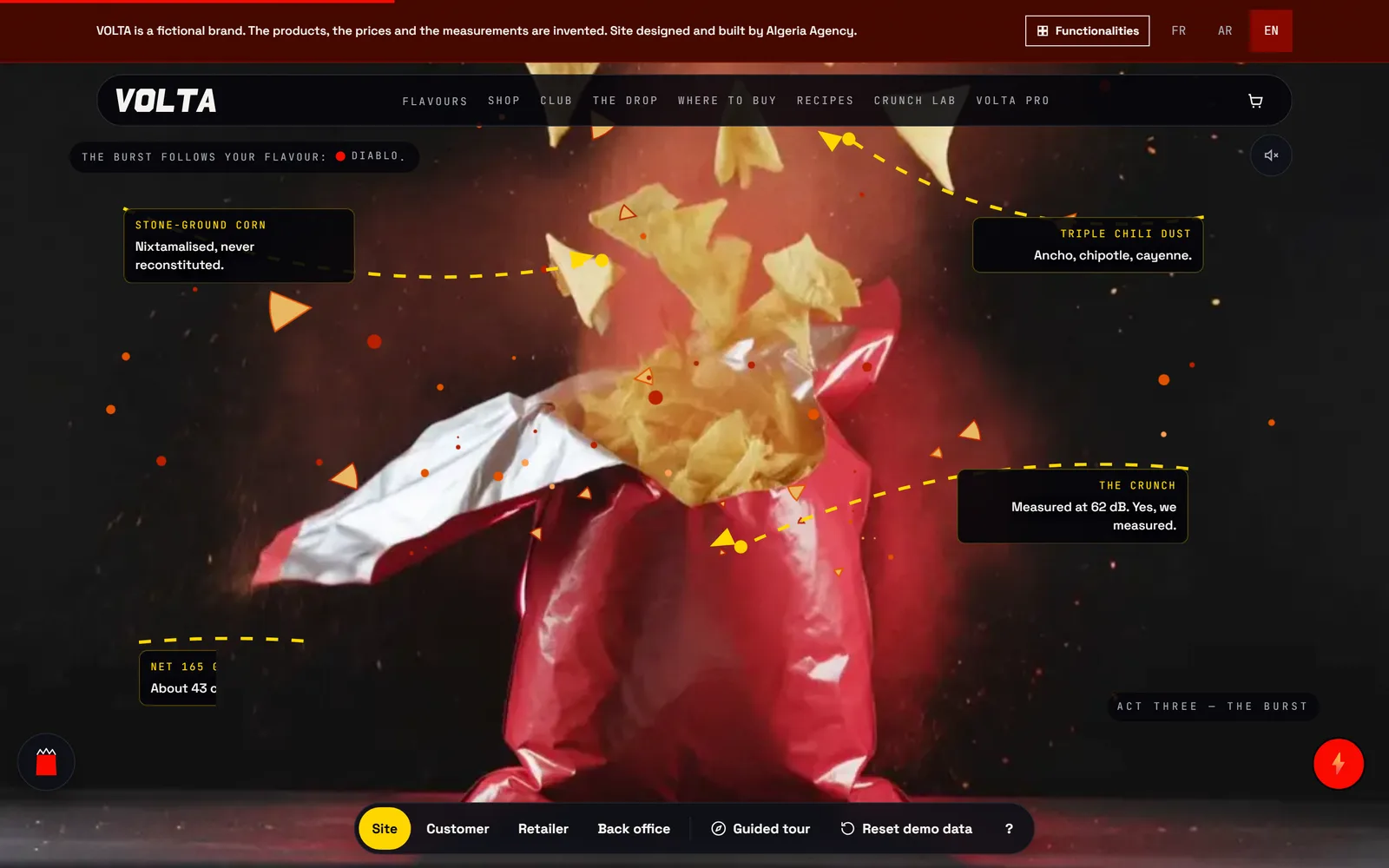
A demonstration
A chips brand launched in seven acts, driven by your own wheel.
An Algerian chips brand that does not exist, launched as though it did: seven acts that scroll, two sequences driven frame by frame by your own wheel, and an aisle where you pick a flavour. This is what a brand site can do when it is built rather than assembled.
See the demonstrationAll of it is invented — the brand, the bags, the measurements. What is not invented is the way the page moves, and that is the one thing a screenshot cannot show you.
The problem
What we usually find
- Your packaging had to be reprinted because a mandatory item was missing.
- Your product disappears on the shelf beside competitors.
- Your colours come out differently on every run.
- You communicate the same way to consumers and to distributors.
The most expensive mistake in this trade is invisible on screen. It shows up when the print run is delivered, a statement is missing, and the whole pallet has to be done again.
Where we stand
Packaging is not the last step. It is the product being sold.
In food and drink, packaging makes the sale. It is seen on a shelf, in one second, beside competitors established for longer than you. What it has to achieve comes down to three things: being legible from a distance, saying what it is, and inspiring confidence in something people will eat.
The regulatory constraint is not a detail: composition, weight, dates, origin, producer details. Beautiful packaging that omits a mandatory item is packaging to be reprinted, and it is the sector’s most expensive mistake because it is discovered after the print run.
The third point is distribution. Your end customer is not always the decision-maker: there is the distributor, the wholesaler, the shop manager. Part of your communication addresses them, and it looks nothing like what is aimed at the consumer.
So our work is to bring you stockists and importers: packaging that passes the printer and the regulations, a spec sheet that answers a distributor, and a supplier page in the buyer’s language.
And it is also what decides whether a foreign market is open to you.
The engine
The acquisition engine, in nine stages
Nine stages, serving three audiences here that look nothing alike: the person buying the jar, the person deciding to stock it, and the person importing it. One object addresses all three, which is the difficulty of this trade — and the reason printing and labelling constraints enter at the design stage rather than at proofing.
Stage 00 — Measurement
Distributors, outlets
You cannot measure a shelf. You measure what the distributor reorders.
The final sale escapes you, so the useful figure is elsewhere: how many outlets stock you, which of them reorder, which formats turn and which come back. Those four are knowable, and almost nobody tracks them.
You do
Nothing. Approve one access request.
We do
We build tracking per line and per format rather than one overall figure.
You get
A clear picture of what turns, before redrawing anything at all.
Stage 01 — Attention
Shelf, trade fair, distributors
The shelf is your advertising. The trade fair is your one window onto distribution.
The people who decide stocking are reachable by neither an advert nor a page: they are in an aisle, four days a year, with a notebook. A fair is prepared like a campaign — target, materials, follow-up — and it is wasted by turning up without all three.
You do
Nothing. Approve the creative if you want to.
We do
We prepare the distribution materials beforehand, and what goes out after the handshake.
You get
Meetings that produce a follow-up rather than a pile of cards.
Stage 02 — Intent
Search, directories, trade fair
Two searches, and the second one is not in your language.
A consumer looks for a type of product; an importer looks for a supplier, with a capacity, a pack format and a conformity. That second query often runs in English or Gulf Arabic, and it lands on Algerian sites with no page at all to answer it.
You do
Nothing. Tell us once which markets you do not serve.
We do
We write the supplier page in the language of the buyer you are aiming at.
You get
Sample requests, which are the only serious signal from that side.
Stage 03 — The landing
Site, spec sheet
For a distributor, the landing page is a spec sheet.
They are not reading your brand story. They look at the format, the case pack, the shelf life, the margin and the expected turn. A page opening with anything else closes the tab, and those are the figures that decide stocking.
You do
Nothing. Approve the product sheet once: it commits your production.
We do
We put the sheet before the story, and the story on another page.
You get
Distributors who come back with a precise question.
Stage 04 — Conversion
Form, email
The conversion is a sample request, not a purchase.
Nobody stocks a food product without having held it. So the form asks for the market, the volume envisaged and the delivery address — and nothing else, because the rest is discussed once the box has arrived.
You do
Nothing.
We do
The form asks for market, volume and address, so no sample is ever shipped at a loss.
You get
Samples going to people actually able to order.
Stage 05 — The reply
Email, WhatsApp, site
Answer a professional the same day, with the figures.
The assistant gives formats, case packs, shelf life and the certifications you hold. It gives no price per kilo and commits to no production lead time: both depend on volume, and both are negotiated with you.
You do
Nothing. Reply to the buyers it brings you.
We do
We write it around the spec sheet and stop it before the price.
You get
Replies the same day, figures included, to professionals who rarely get any.
Stage 06 — The follow-up
Email, telephone, trade fair
Ordering is seasonal, and the trade-fair calendar carries dates.
Reorders follow consumption periods, and professional events fall on fixed dates. A useful follow-up is set against both calendars — a reorder arriving before the stockout, an invitation arriving before the fair — and against nothing else.
You do
Nothing.
We do
We set the follow-ups against those, and write nothing in between.
You get
Fewer stockouts at your distributors, and fairs that were prepared for.
Stage 07 — Reputation
Label, spec sheet, social
In food, reputation is a question of consistency.
The same product in every batch, the same complete label, a producer who can be identified and reached. A consumer who finds a difference between two jars does not complain: they change brand, and they mention it once to the people around them.
You do
Nothing. Tell us when a recipe or a format changes.
We do
We carry the change through to the label and the sheet the same day.
You get
A brand saying the same thing as the jar, batch after batch.
Stage 08 — Proof
Printer, artwork, label
Proof is packaging that survives both the printer and the regulations.
Composition, weight, dates, origin, producer contact — and a design that holds on the paper actually available for the second run. We certify no packaging for an export market: we design to the constraint you give us, and validating it belongs to a competent body.
You do
Read one page a month. Make one decision.
We do
We check tolerances, inks and stock with them, and we write it down.
You get
A run that resembles the artwork, and a second that resembles the first.
What we do
What you get
Packaging design
Cutting, folding, distance legibility and mandatory information built in from the first layout.
Printing constraints
Stocks, processes and tolerances checked with your printer before drawing.
Range extension
A system that allows a new line to be added without redrawing the whole range.
Trade materials
Product sheets, arguments and display stands aimed at the network rather than the consumer.
Consumer content
Photographs, recipes and short video that give a reason to try something new.
Who arrives
Who is looking for you, and where they pass
Five arrivals, and three of them will never eat your product: they resell it, stock it or import it.
Who arrives
A consumer standing at the shelf
First
The packaging itself
Then
A name legible at two metres
Why
They compare in one second, under lighting that erases subtle shades.
Who arrives
A distributor assessing whether to stock you
First
Spec sheet
Then
Margin, format, turn
Why
They decide on four figures, and your brand story is not among them.
Who arrives
An importer looking for a supplier
First
Supplier page, in their language
Then
Sample request
Why
They land on sites with no page for them at all, which makes yours easy to find.
Who arrives
A buyer met in a trade-fair aisle
First
What goes out after the handshake
Then
Sample
Why
They go home with forty cards, and deal first with whoever wrote to them first.
Who arrives
A consumer checking a statement
First
The label
Then
The product page
Why
Allergen, origin, date: the question is closed, and a missing answer closes the sale.
On the ground
How do you produce and distribute a food product in Algeria?
Local printing constraints decide a large part of the design. Available stocks, cutting tolerances, inks and processes vary between printers and between periods. Packaging designed without checking them degrades on the second run, when the intended material is unavailable.
Shelf space is contested and often badly lit. Packaging resting on subtle gradations or fine text disappears, while a strong contrast and a name legible at two metres holds. That is a design criterion, not an aesthetic preference.
Finally, distribution runs through intermediaries who decide whether a product is listed. Convincing them takes different arguments — margin, turnover, format, case size — and materials that look nothing like those aimed at consumers.
Getting started
How we work
Gather the obligations
Mandatory items, formats and regulatory information listed before any layout.
Check the printing
Process, stock and tolerances at your printer, because they change the drawing.
Design for the shelf
Tested at a distance and beside real competitors, not in isolation on a screen.
Approve on a proof
On a test print where volume justifies it, because colours shift in printing.
Separate the audiences
A consumer set and a trade set, which share almost nothing.
The result
What changes
Packaging that shows on the shelf
Legible at a distance and on a crowded shelf, which is the only test that matters for a food product.
Correct labelling first time
Obligations handled at design time rather than on return from the printer, which saves a whole run.
Two separate messages
What speaks to a consumer and what speaks to a distributor are neither the same message nor the same material.
Who this is for
Is this the right fit for you?
We work well with
- You produce something sold on a shelf or distributed to resellers.
- You are launching a range or adding a line to one.
- You accept dealing with mandatory labelling before the design.
We are the wrong choice if
- You want packaging with no printing or regulatory constraints. It will have to be redone.
- You sell only direct with no packaging. The subject is elsewhere.
- You want to copy a competitor’s packaging. That is a legal and commercial risk.
Questions
Frequently asked questions
Which labelling is mandatory?
It depends on the product and its category. We list it with you before design, because discovering it after the print run costs a complete reprint.
Why do colours change in print?
Because a screen and an ink do not produce colour the same way. We design for the chosen process and approve on a proof where the stakes justify it.
Does each line need different packaging?
A shared system with variants, rather than unrelated packs. That makes the range recognisable and lets a line be added without redoing everything.
How do we convince a distributor?
With arguments that concern them: margin, turnover, format, case size. It is not the same document as the one for consumers.
Should we communicate in Arabic or French?
Both, generally, with a hierarchy decided by your audience. We handle bilingualism at design time rather than adding text afterwards.
Does a food product need a website?
Usually a modest one: what matters is existing, being findable and giving product information. The bulk of the work stays with the packaging and the shelf.
Let's talk
How to start
Send us your current packaging, the list of your lines, and the name of your printer.
We come back with the constraints checked with them, the labelling to include, and what we would change so the product shows on the shelf.
- Labelling before aesthetics
- Tested at shelf distance
- Designed to be reprinted