 Algeria Agency
Logistics & Transport
You deliver.
We bring you
contracts
that last.
We bring you companies looking for a reliable carrier, with what they compare: zones you genuinely serve, lead times you meet, capacity, insurance — and online tracking that makes the “where is my parcel” call disappear. Your file passes a tender’s first sift without being rewritten every time.
No commitment. We reply within one working day, and we also tell you what we would refuse to do.
The terms
100%
Of the accounts and documents in your name
0
Zones advertised that you do not serve yourself
100%
Of published lead times that you genuinely meet
0 DA
Exit fee. You leave with everything.
These four figures are written into the contract. A 6-month minimum term on our digital marketing plans (Starter has none), then cancel any month with 30 days’ notice. We publish no lead time you do not meet: in this trade a broken promise is observed by the customer themselves, to the hour.
What you can try for yourself
A demonstration
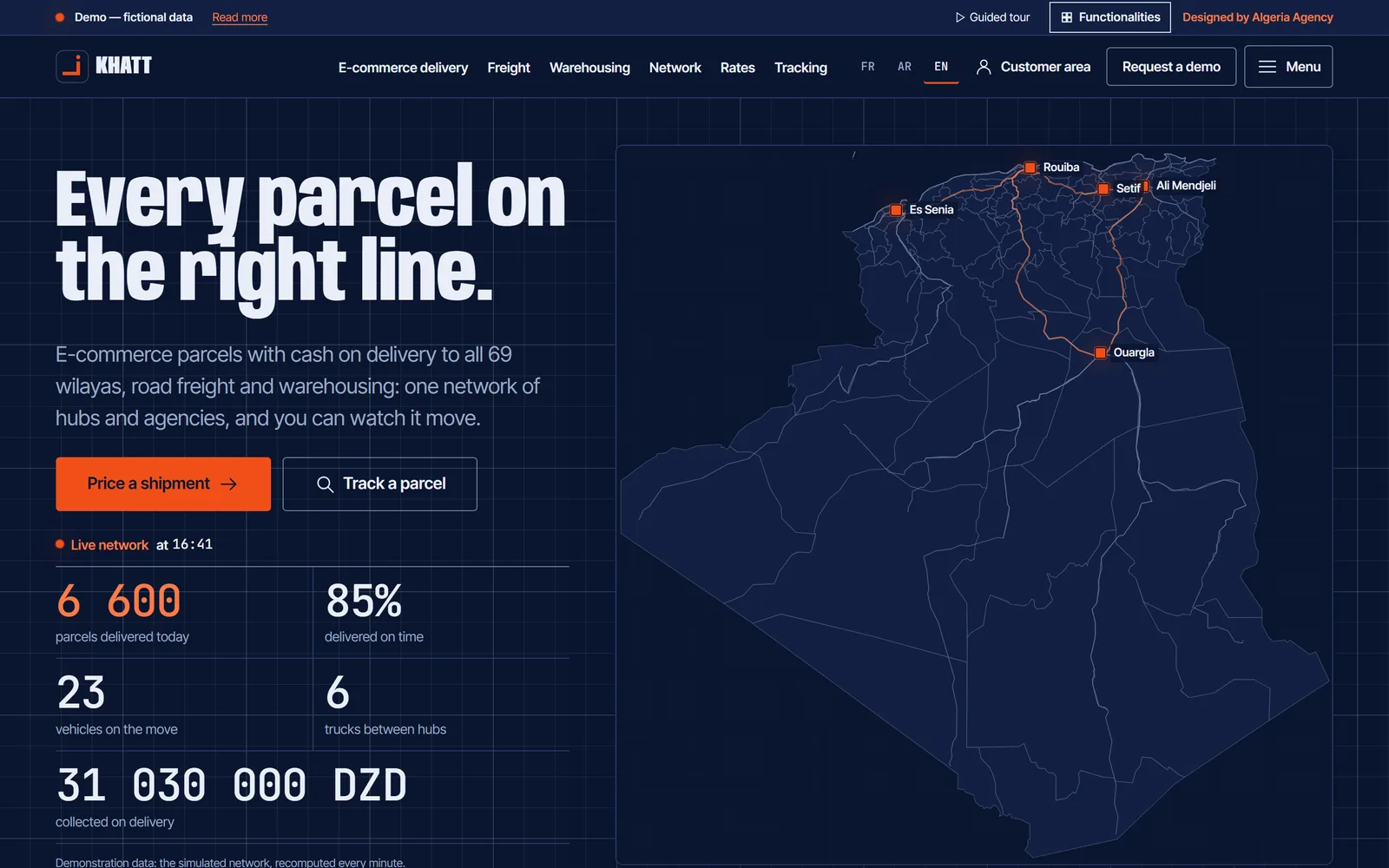
A whole delivery and freight carrier on one network: live tracking, cash on delivery, hubs, a warehouse and a control tower.
A delivery and transport company on one platform: a public site with live tracking and an instant price calculator, a seller space with cash on delivery and payouts, B2B shippers, an offline courier app, hub, agency and warehouse screens, a control tower and the back office.
See the demonstrationA fictional company; parcels, vehicles, positions and cash are simulated; tariffs are indicative.
The problem
What we usually find
- Your teams spend the day answering "where is my parcel".
- Your areas and lead times are written nowhere.
- You lose tenders for want of documentation.
- An unannounced delay becomes a complaint and then a review.
A large share of the calls you take are asking where a shipment is. Each one costs somebody’s time, and the person calling was already worried before they picked up.
Where we stand
You sell one thing: what leaves arrives, when you said it would.
Logistics sells on a single promise: what leaves arrives, when you said it would. Everything else — fleet, warehouses, coverage — exists only to make that promise credible, and a customer only judges it afterwards.
The first operational problem is also a communication problem. A significant share of the calls a carrier receives ask where a shipment is. Each call costs the time of somebody who could be doing something else, and the customer calling is already anxious.
The second reality is that the customer is a business, with a decision cycle, a comparison and often a tender. The criteria are explicit: areas covered, lead times, capacity, insurance, traceability. Not publishing them amounts to not competing.
So our work is to make capability comparable, give the customer a way to track without calling, and measure on contracts rather than on traffic.
The fleet, the warehouses and the coverage exist only to make that sentence credible.
The engine
The acquisition engine, in nine stages
Nine stages, serving a customer who is a company: they compare on explicit criteria, they often decide on a submission, and they can only judge your promise after buying it. Two consequences — what is not published does not compete, and the load on customer service is a communication problem before it is a headcount problem.
Stage 00 — Measurement
Switchboard, email, tenders
Measure contracts and tracking calls, in that order.
Traffic says nothing here: one customer is worth months of haulage. The second figure is the one nobody counts — how many calls a day simply ask where a shipment is — and it is the one that prices the largest gain available.
You do
Nothing. Approve one access request.
We do
We set that number against the cost of minimal tracking, and the comparison decides.
You get
Two figures that govern this trade, one of which you had never read.
Stage 01 — Attention
Site, documentation, tenders
Publish the zones you genuinely serve, and the ones that go through a partner.
Coverage is almost always announced wider than it is, which produces impossible enquiries and disappointed customers — two costs for one imprecision. Saying where you go yourself and where you subcontract turns away the first and avoids the second.
You do
Nothing. Tell us once which zones go through a partner.
We do
We publish it distinguishing the two, without softening the second column.
You get
Enquiries you can serve, and no promise made on your behalf.
Stage 02 — Intent
Search, documentation, trade fair
New corridors exist, and they create a customer you did not have.
An exporter looking for a route south is not comparing rates: they want to know whether the journey exists, where it passes and how long it takes. If you are connected to one of those routes it is checkable and worth saying; if you are not, implying it costs you a customer at the first quotation.
You do
Nothing. Tell us once which southern wilayas you already run to.
We do
We write the page for those journeys with the transit times you hold.
You get
An enquiry arriving on a precise need rather than on a price comparison.
Stage 03 — The landing
Site, documentation, submission
What is not published does not compete.
Zones, lead times, capacity, insurance, traceability: the criteria are explicit and often written into a tender. Not publishing them amounts to not turning up — and this documentation is prepared once, then serves every submission for years.
You do
Nothing. Send us your certificates and cover once.
We do
We turn them into a public dated dossier you attach without rewriting it.
You get
A first sift you pass regardless of who is writing that day.
Stage 04 — Conversion
Site, SMS, email
Tracking is the feature that sells, and it does not need to be sophisticated.
A status somebody can look up and a notification on arrival are enough to change the load on customer service more than any hiring. The customer stops calling because they have stopped worrying, and the commercial argument is the same object as the operational relief.
You do
Nothing.
We do
We build the tracking on those, and on no status you could not hold.
You get
Fewer calls every day, and an argument your competitors do not have.
Stage 05 — The reply
WhatsApp, telephone, site
Answer about a shipment, never about a time operations did not give.
The assistant gives the status, the zone, the standard lead time and what happens if there is a delay. It advances no arrival time the system does not carry: in this trade a time quoted lightly becomes a complaint the next day, and the complaint costs more than the call it avoided.
You do
Nothing. Take on the collections it has scheduled.
We do
We wire it to the real status and forbid it to estimate anything.
You get
A customer service handling exceptions instead of reading numbers out.
Stage 06 — The follow-up
Email, telephone, trade fair
A contract is won on a submission and lost in a silence.
The cycle is long and passes through comparisons. What sustains the relationship between two tenders is not a chase: it is a message carrying information — a zone opened, a lead time improved, a certification obtained. Three a year is enough, and they have to be true.
You do
Nothing.
We do
We reserve writing for those moments, and every fact published carries its date.
You get
A useful presence inside a decision taken without you.
Stage 07 — Reputation
Site, documentation, customer service
Your reputation turns on the exceptions, not on the deliveries that worked.
Nobody talks about a parcel that arrived on time. They talk about the one that vanished for three days, and about what you did during those three days. Publishing the procedure for a delay or damage — who is told, within what time, with what compensation — is worth more than ten testimonials.
You do
Nothing. Approve the claims procedure once.
We do
We write it before the contract and make it easy to find again.
You get
Incidents settled against a text instead of negotiated in the heat.
Stage 08 — Proof
Site, documentation, tracking
Proof is the lead times you meet, not the ones you display.
A customer can only judge your promise after buying it, which obliges you to make it checkable another way: published lead times you genuinely hold, zone by zone, with the gap admitted where it exists. Announcing wide and delivering short is the one thing this trade does not recover from.
You do
Read one page a month. Make one decision.
We do
We publish those, and round nothing in the comfortable direction.
You get
A promise the customer can confirm for themselves on the first shipment.
What we do
What you get
Areas and lead times published
Precisely, wilaya by wilaya if needed. It is the first comparison criterion.
Shipment tracking
Available to the customer without calling, which is the most immediate operational gain.
Automatic notifications
Departure, arrival, delay. Warning costs a message and avoids a complaint.
Documented capability
Fleet, volumes, goods types, insurance. What a professional buyer asks for first.
Structured quoting
A form capturing what is needed — origin, destination, volume, frequency — to reply without back-and-forth.
Who arrives
Who is looking for you, and where they pass
Five arrivals, and one of them buys nothing: it asks where its parcel is, and it costs you every day.
Who arrives
A buyer preparing a comparison
First
Zones, lead times, capacity, insurance
Then
Submission
Why
Their criteria are written down, and what is not published does not compete.
Who arrives
An exporter looking for a route south
First
The corridor page
Then
Request for a quotation
Why
Their question is whether the journey exists, and the price only comes after.
Who arrives
A customer whose shipment is in transit
First
The tracking
Then
Nothing — and that is the gain
Why
Every call avoided is time handed back to somebody who could be selling.
Who arrives
A customer whose shipment is late
First
The published procedure
Then
Customer service
Why
It is the only moment that produces a review, and it is prepared before it happens.
Who arrives
A company changing carrier
First
Your honest map
Then
A trial on one zone
Why
They left the last one over a badly served zone, and they check that one first.
On the ground
What decides a logistics customer in Algeria?
Real geographic coverage is the first criterion, and it is often claimed wider than it is. Publishing precisely which areas you serve directly and which go through a partner avoids impossible enquiries and disappointed customers.
Visibility over routing is scarce, and its absence produces a considerable call volume. Even rudimentary tracking — a consultable status and a notification on arrival — changes the customer service load more than any hiring would.
Finally, contracts are often won on file, against explicit criteria. Up-to-date documentation — capability, insurance, procedures, area references — is what gets you through the first selection, and it is prepared once and for all.
Getting started
How we work
Publish areas and lead times
The documentation that makes you comparable, and without which you do not enter the comparison.
Put tracking in place
Even a simple one. The gain on inbound calls is measurable from the first week.
Automate notifications
Above all the delay notification, the only one that avoids a complaint.
Structure the quote
So enquiries arrive quotable first time, rather than after three exchanges.
Track by contract
Value and duration, because a logistics customer is judged over months, not over one shipment.
The result
What changes
Fewer tracking calls
Self-service tracking removes dozens of calls a day from people who have other work to do.
Comparable enquiries
Areas, lead times, capacity and insurance published, which puts you in the comparison instead of excluding you from it.
Delays that do not escalate
An announced delay is an incident; a discovered delay is a complaint. The difference is a notification.
Who this is for
Is this the right fit for you?
We work well with
- You transport or store for businesses.
- You can document your areas, lead times and capacity.
- You accept notifying delays.
We are the wrong choice if
- You do not want to publish your lead times. A buyer who cannot compare does not consult you.
- You cannot track a shipment. The calls will remain, and tracking is the first gain.
- You want traffic. Here, ten good enquiries beat a thousand visits.
Questions
Frequently asked questions
Should we publish our lead times?
Yes, the ones you actually meet. A buyer who cannot compare moves to the competitor who published theirs.
Is online tracking essential?
It is the fastest gain. It removes calls from the first week and reassures without occupying anybody.
How should a delay be handled?
By notifying it before the customer discovers it. An announced delay is forgiven; a discovered one is complained about.
Which channel finds customers?
Search on precise needs and professional targeting. Consumer-scale volume has nothing to do with this trade.
Do we need a website or a tool?
Both are useful, but tracking comes before the brochure site if you must choose. Its operational effect is immediate.
How do we measure?
In contracts signed and calls avoided. Those are the two figures that genuinely reflect this trade.
Let's talk
How to start
Tell us your real coverage, the lead times you meet, and how many tracking calls your teams receive daily.
We come back with the documentation to publish, the minimum tracking to put in place, and an estimate of the calls it removes.
- No lead time claimed that you do not meet
- Delay notified before it is discovered
- The tracking is yours