 Algeria Agency
Artificial intelligence
AI search & recommendations: customers find what they came to buy
Site search that forgives typos and handles your customers’ three languages, plus recommendations drawn from your real sales.
What you can try for yourself
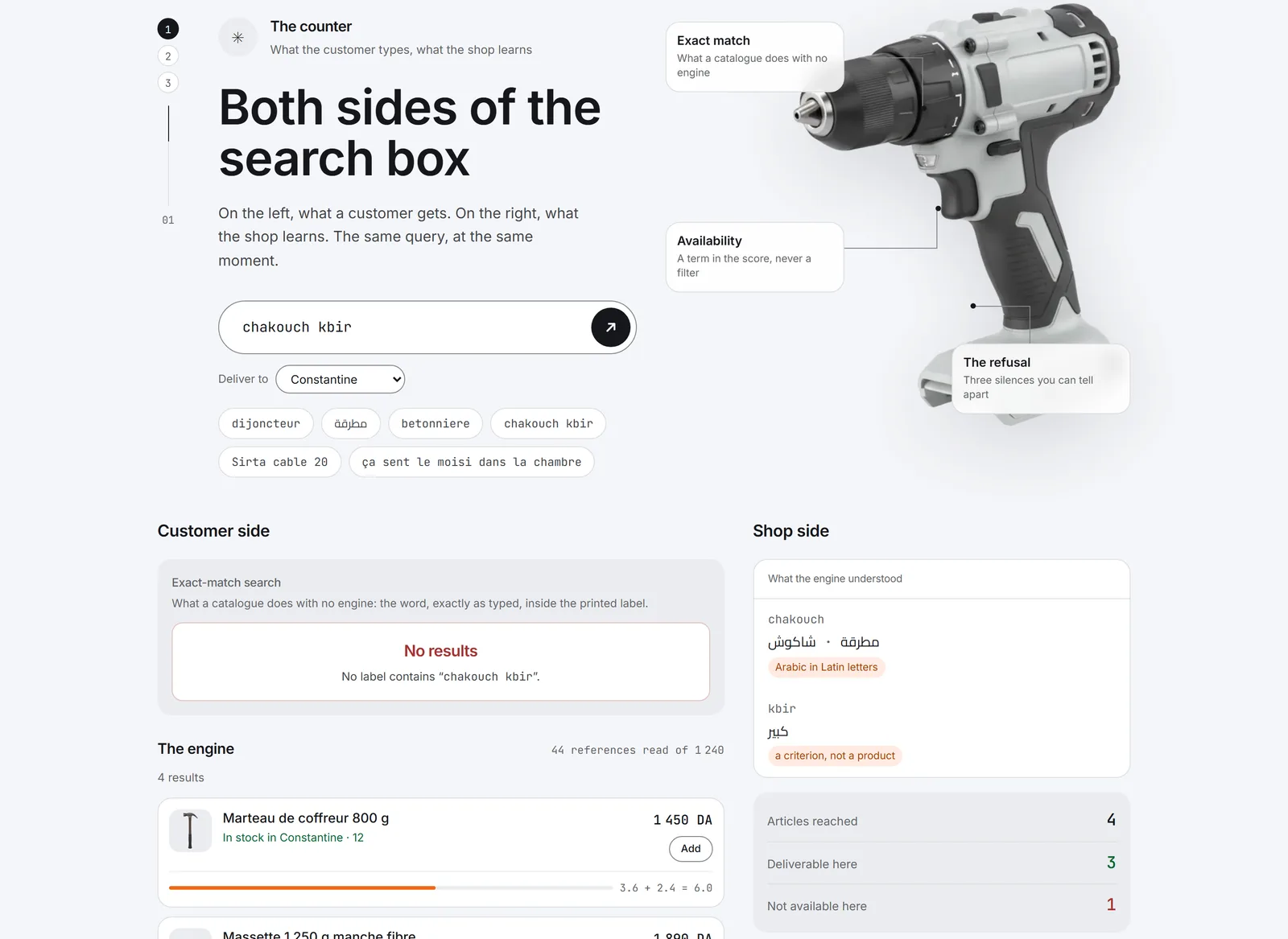
A demonstration
One search, from the customer’s side and the shopkeeper’s.
An imaginary hardware shop in Constantine, and its search box shown from both sides at once: on the left what a customer gets out of a typo or a word in Arabic, on the right what the shop learns from it.
See the demonstrationThe catalogue, the stock and the three months of searches that found nothing are invented. The normalisation, the ranking and the refusal to recommend on a history that is too thin are the real code.
A shop’s internal search is used by a minority of visitors, and that minority buys far more than the rest. Somebody typing a product name knows what they want; they are closer to a purchase than any visitor who landed on the home page. That is why a search returning nothing is the most expensive leak a shop has, and the one least often looked at.
So the first deliverable here is not an engine, it is the list of your zero-result searches. It reads in half an hour and contains almost always the same things: typos no spellchecker catches, French words against an Arabic catalogue or the reverse, brands you do not stock, and products you sell under a different name. Each of those categories has a different answer, and only one of them is technical.
Recommendations follow the same logic. "Customers who bought this also bought that" needs an order volume many catalogues do not yet have, and on a thin history it produces associations that are coincidence dressed up as advice. When that is the case, a hand-written selection by somebody who knows the products does better, and we say so.
Finally, we refuse to install a recommendation engine on a catalogue with empty product pages. A suggestion system works on whatever describes your products; if the description is three words and a photo, no model compensates for that, and filling in the pages is the project with the highest return.
What we usually find
- Some of your visitors search for a product you stock and leave without finding it.
- Your search forgives no typo and no missing accent.
- Your customers search in French against an Arabic catalogue, or the reverse, and get nothing.
- Your product suggestions offer items that are out of stock or already in the basket.
What changes
The zero-result search list
Ranked by volume, with what each group was looking for. It is the first deliverable and often the one that changes most, before any development.
Search that tolerates how people actually type
Typos, missing accents, transliterations, singular and plural, and switching language within a single query.
Recommendations that know when to stay quiet
When the history carries no reliable association, the block does not render rather than offering a coincidence.
What you get
Typo-tolerant search
A misspelled query still finds the product. It is the fastest-paying fix on this entire page.
French, Arabic and transliteration
The same product found whatever the language and alphabet of the query, including when the trade name is written in Latin script.
Synonyms drawn from your own queries
The words your customers actually use, mapped to the words in your catalogue. That list is built from your data, not a generic dictionary.
Filters on the attributes that decide
Size, compatibility, availability in store: the criteria a purchase turns on, rather than a tree of categories.
Stock-aware recommendations
Nothing suggested that is out of stock, already bought, or already in the basket. It is the commonest mistake and the most irritating to a customer.
A search monitoring board
What is searched, what finds nothing, what finds something but earns no click. As much a source of product ideas as a technical tool.
How we work
Extracting your queries
We pull several months of internal searches and classify the failures. Without that step you optimise for imaginary queries.
Separating engine problems from catalogue problems
A typo is an engine problem; a missing product is a range problem. The two answers have neither the same cost nor the same owner.
Putting the search live
The engine replaced and measured on the zero-result rate, before and after. Recommendations come second, if they are justified at all.
Evaluating recommendations before showing them
Associations are tested against past history. If they do not beat a hand-written selection, they do not go live.
Is this the right fit for you?
This is for you if
- You have a catalogue of reasonable size and an internal search people use.
- Your product pages carry at least a description and some attributes.
- You can retrieve the history of your internal queries.
This is not for you if
- Your catalogue holds a few dozen references — good navigation will do more.
- Your product pages are empty and you do not intend to fill them.
- You want personalised recommendations with no order history.
What we commit to
We measure before and after
The zero-result rate is recorded before we touch anything. It is the only figure that says whether this work achieved something.
No recommendations on a thin history
We will not publish associations drawn from a few dozen orders. A human selection is proposed instead.
Nothing that pushes an out-of-stock product
Availability outranks relevance. Suggesting an unavailable item turns a good recommendation into a disappointment.
What changes for an Algerian business
The query is rarely in one language. The same customer searches a brand in Latin script, a category in French and a qualifier in Arabic, sometimes in one sentence, and writes product names as they hear them. An engine configured for a single language fails on most of those queries with nothing to signal it.
Availability matters more than relevance when delivery is uncertain. A customer who discovers at checkout that a suggested item is not available in their wilaya often abandons the whole basket, not just the item. That is why stock and delivery zone enter the ranking rather than being shown afterwards.
Zero-result searches are commercial intelligence too. The list of what your customers look for and you do not sell is one of the few free, dated demand signals a shop has here, and it is almost always left unused.
Frequently asked questions
How many products make this worthwhile?
Below a few hundred references, clear navigation usually does better. We will tell you that rather than sell you an engine.
Do we have to change e-commerce platform?
Not in most cases. Search can be replaced without touching the rest of the shop, and that is how we do it.
How many orders do recommendations need?
Enough for an association to repeat other than by chance. We test against your history and show you the result before deciding.
Does search handle Arabic and French together?
Yes, including within one query and with transliterated names. It is the commonest case here and it is handled first.
How do we know it worked?
By the zero-result rate and the share of sessions with a search that convert, measured before and after.
What about products customers search for that we do not sell?
Show them as unavailable rather than returning an empty page, and give you the list. That is a range decision, not a technical one.
How to start
Write to us with your shop’s address; if your platform logs internal searches, attach the last three months’ export — if not, we show you where to find it.
We return the list of what finds nothing, ranked by volume, with what each group was looking for.
Let’s find where your next customers will come from
Tell us where things stand — your ads, your website, your Google listing — and what you are after. We reply within one working day, and the conversation commits you to nothing.
- We measure before and after
- No recommendations on a thin history
- Nothing that pushes an out-of-stock product