 Algeria Agency
Travel & Tourism
You run the trips.
We bring
the bookings
before the season.
We bring bookings to Algerian travel agencies: campaigns ready before each season, a page per destination with its price range, and every WhatsApp enquiry traced to the ad that produced it. Your licence and address are visible before the deposit — three weeks late costs a season.
No commitment. We reply within one working day, and we also tell you what we would refuse to do.
The terms
100%
Of the accounts and the listing in your name
0
Reviews bought, invented or written in a client’s place
100%
Of price ranges shown with what moves them
0 DA
Exit fee. You leave with everything.
These four figures are written into the contract. A 6-month minimum term on our digital marketing plans (Starter has none), then cancel any month with 30 days’ notice.
What you can try for yourself
Demonstrations
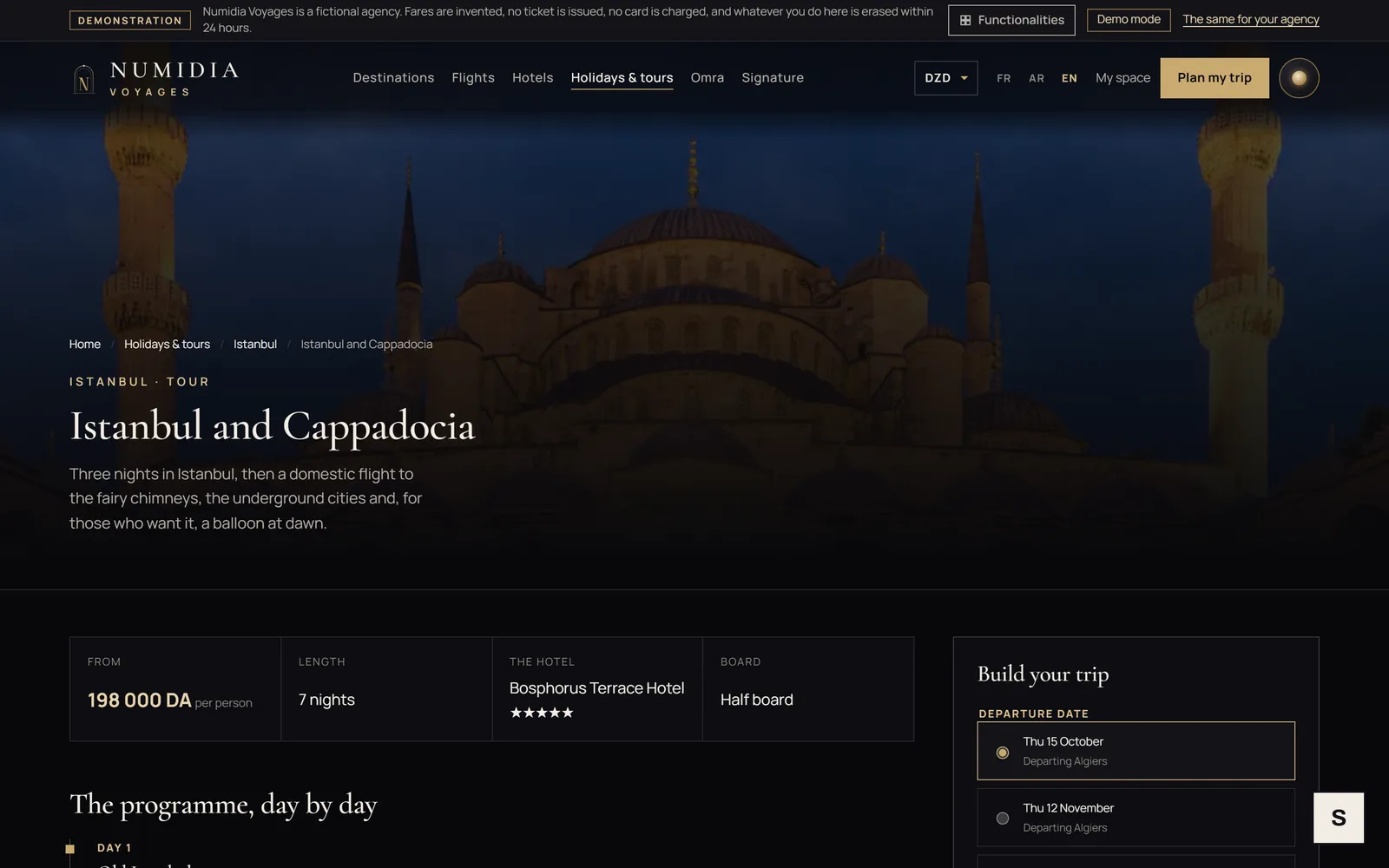
A whole travel agency: the site, the booking engine and both of its consoles.
A complete travel agency, built rather than rented: the site that makes people want to leave, the engine they book a flight, a hotel, a tour or an Omra on, the client space where the trip is prepared and the console the agency runs it from. A concierge can book for you, in writing or by voice.
See the demonstration (Numidia Voyages)The agency, its hotels and its airlines do not exist, and the payment is simulated. What is real: the booking engine, both dashboards, and a concierge that never quotes a price it did not find.
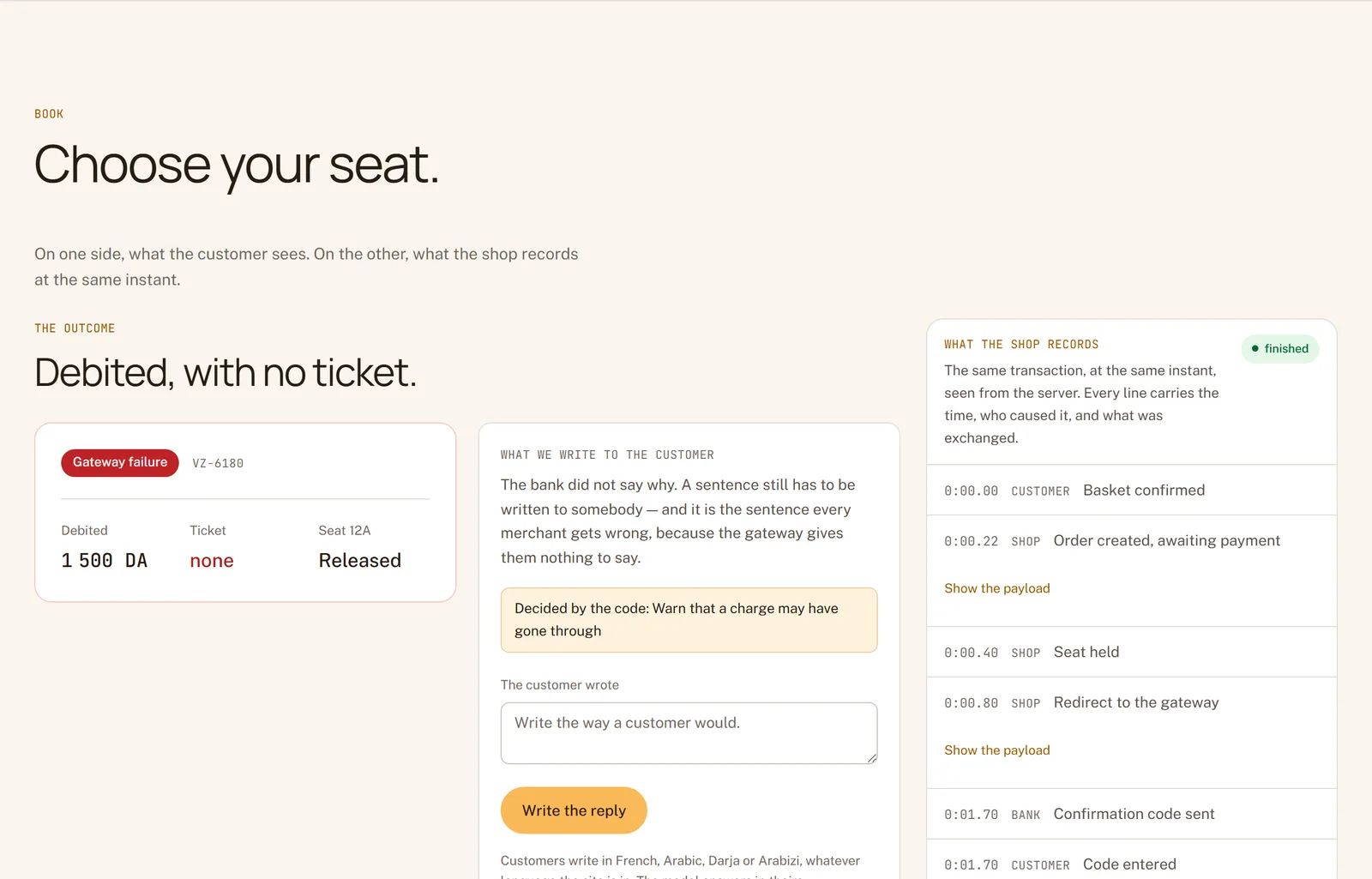
Nine cards, and eight ways a payment goes wrong.
An imaginary coach company, and card payment seen from both sides at once. Choose which customer you are — the refused card, the closed tab, the double click, the drop after the bank said yes — and watch the merchant’s console fill in while you pay. One button even comes back claiming it worked; nothing is issued.
See the demonstration (Voyages Ziban)The company does not exist and the gateway is simulated. What is real is the list of paths that break, and the fact that a ticket is never issued on the browser’s word.
The problem
What we usually find
- Your best weeks arrive and your campaigns were not ready.
- You receive dozens of "how much?" messages without knowing which ones convert.
- Your customers hesitate because nothing on your page proves you are an established agency.
- Your competitors advertise headline prices and you do not know how to position yourself.
The client is not comparing prices: they are working out whether you will still be there on the day of departure. Anything answering that question is worth more than one more photograph.
Where we stand
Trust is proved with things that can be checked.
Travel has a particularity few sectors share: demand is seasonal and concentrated. Umrah, summer holidays, Eid, student departures — most of the revenue is decided in a handful of periods, and a campaign launched three weeks late has missed the year.
The second particularity is trust. A customer hands you a deposit for a service they will not receive for months, often for a substantial amount. What decides is almost never the advertised price: it is the impression that the agency will still be there and will answer the phone.
The third is negotiation. The price of a trip depends on dates, group composition and what is included, which makes the quote conversational by nature. A page that refuses to give any order of magnitude loses people before the conversation; one that shows a fixed price loses the margin.
So our work is to prepare the wave before it arrives, to make trust visible on materials the customer can verify, and to instrument the conversation so you finally know where your bookings come from.
A licence, an address, an official list. The rest is scenery.
The engine
The acquisition engine, in nine stages
The engine is the same everywhere; in travel it is the clock that governs. Seasons are prepared before they arrive, verification runs through public registers your client can open personally, and negotiation happens in messaging — so stage 04 is not a basket, it is the opening of a conversation.
Stage 00 — Measurement
Messaging, telephone, office
Count by season, never by month.
An annual average means nothing when most of it lands in two or three windows. We count the window, what it cost, what it took, and above all where the enquiries came from — which almost nobody can currently say.
You do
Nothing. Approve one access request.
We do
We mark every enquiry with its origin, including the ones arriving as messages.
You get
A season decided on figures rather than on an impression.
Stage 01 — Attention
Search, social, listing
Prepare against the administrative calendar, which moves before demand does.
Lists of authorised agencies, filing dates, the school calendar: all of it falls before people start looking. A campaign ready on the day a list is published arrives on time; the same campaign three weeks later pays more for an audience that has already decided.
You do
Nothing. Approve the creative if you want to.
We do
We date the preparation backwards from those, not from the peak.
You get
Weeks of lead over agencies that start when the demand is already there.
Stage 02 — Intent
Search, pages per destination
People search for a destination, a date, a party size — and an authorisation.
Two intentions coexist and the second is invisible to most agencies: there is the person looking for a trip, and the person who already has a name and is checking whether it is authorised. That second query is won with a page, not with a budget.
You do
Nothing. Tell us once which destinations you do not sell.
We do
We write one page per destination and one page that answers the check.
You get
Both arrivals, one of which your competitors are not working at all.
Stage 03 — The landing
Site, page per trip
A page with no order of magnitude loses people before the conversation.
Refusing every figure drives away a share of enquiries; showing a fixed price removes the margin. An honest range with what moves it — the date, the party, what is included — converts better than either, and it prepares the negotiation instead of closing it.
You do
Nothing. Send us your licence number once.
We do
We write every price range with what moves it, and the licence on the same screen.
You get
Enquiries that arrive already knowing the order of magnitude.
Stage 04 — Conversion
Form, WhatsApp
This is not a basket. It is the opening of a conversation.
Quoting here is conversational by nature, so the form does not try to close: it tries to open, with what has to be known already — dates, how many people, what is essential. The rest is handled by message, and that is entirely fine.
You do
Nothing.
We do
The form asks only for dates and party size, then hands over to your WhatsApp.
You get
Conversations that start at the second message instead of the fifth.
Stage 05 — The reply
WhatsApp, messaging, site
Answer immediately on what is included, never on the final price.
The assistant says what the package covers, which documents to prepare, which deadlines are running, and gives the published range. It closes no price and takes no deposit: the margin is negotiated, and that belongs to somebody who knows the file.
You do
Nothing. Pick up the conversations it hands you.
We do
We write it around the range and forbid it to go beyond.
You get
Answers at night and on Friday, with no commitment made on your behalf.
Stage 06 — The follow-up
SMS, WhatsApp, email
Chase a file deadline, not an urge to travel.
Between deposit and departure there are months, documents to supply and balances to settle. A client who receives what they must prepare in good time arrives without incident; a client nobody contacted worries, and worry gets retold.
You do
Nothing.
We do
We schedule the useful reminders, with nothing sold between them.
You get
Fewer incomplete files the night before, and clients who speak well of the wait.
Stage 07 — Reputation
Listing, official lists, reviews
Your authorisation is public. Make it easy to find.
This sector has enough stories of agencies that disappeared for a displayed licence to weigh more than the quality of the photographs. The number, an address somebody can walk to, presence on the official lists, and recent reviews: four checkable things, each worth more than an argument.
You do
Nothing.
We do
We make the licence, address and reviews visible, and ask for reviews only from clients back from their trip.
You get
A check that ends at your name rather than in doubt.
Stage 08 — Proof
Written terms, site
Proof is what is written down before the money moves.
What is included, what is not, what happens on cancellation and when the balance falls due. An agency that writes that before the deposit stands out immediately, and protects itself from the one dispute that damages a reputation for good.
You do
Read one page a month. Make one decision.
We do
We write them in plain language and put them before the button, not after.
You get
Clients who know what they bought, and disputes with nothing left to feed on.
What we do
What you get
A calendar by season
Campaigns built around your real peaks, prepared several weeks ahead.
Pages by destination and package
One page per real offer rather than a general catalogue nobody browses.
Proof of standing
Licence, contact details, terms and reviews brought forward, because that is what decides when a deposit is involved.
Conversation measurement
Messaging enquiries counted and attributed, without which the report ignores most of the sales.
Prepared replies
Ready answers to price and date questions, so the volume is survivable during peaks.
Who arrives
Who is looking for you, and where they pass
Five arrivals, and two of them already know your name: they are not looking for an agency, they are checking the one they were given.
Who arrives
Somebody checking that you are authorised
First
Your licence and address page
Then
Messaging
Why
They have your name and want a reason not to worry. The page is written once.
Who arrives
A family starting to look for the summer
First
Destination page with a range
Then
Talking it through
Why
They look weeks before booking, and that is when reaching them is cheapest.
Who arrives
A message that only says "how much"
First
An answer carrying the range
Then
What moves it
Why
A figure opens the conversation; "contact us" closes it on the spot.
Who arrives
A client who paid a deposit four months ago
First
Deadline reminder
Then
Page of documents to supply
Why
Between deposit and departure, silence reads as risk rather than as calm.
Who arrives
A student or worker leaving for a long stay
First
Documents and formalities page
Then
Contact
Why
Their uncertainty is administrative before it is touristic, and nobody writes that page.
On the ground
What is particular about the Algerian travel market?
Peaks are extremely concentrated and predictable: pilgrimage periods, summer, the end of the school year. That makes the calendar more important than the total budget — the same sum spent three weeks earlier produces markedly more, because it reaches people as they begin searching rather than after they have booked.
Trust is built on concrete signals: a verifiable physical address, a displayed licence, recent reviews, and identifiable people. The sector has enough stories of agencies that vanished for those elements to weigh more than the quality of the visuals.
Finally, negotiating in messaging is the norm. Refusing to indicate any order of magnitude before the conversation drives away part of the demand; stating it too precisely removes the room to negotiate. An acknowledged range, with what moves it, is the compromise that converts best.
Getting started
How we work
Map the season
Your real peaks over the last two years, and when searching starts for each of them.
Prepare before the wave
Pages, visuals and campaigns ready in advance, because launching during the peak costs more and converts less.
Install measurement
Conversation and call tracking before spending, otherwise the season is judged on impressions.
Hold the peak
Responsiveness in messaging, prepared replies, and daily adjustment through the short period that matters.
Review while it is fresh
What produced, what it cost, and what to repeat next year — written immediately afterwards, not six months later.
The result
What changes
The season prepared before the season
Campaigns, content and pages ready before demand rises, which is half the result in a trade that runs in waves.
Visible trust
Licence, address, reviews and terms displayed where a hesitating customer looks for them before paying a deposit.
Traceable enquiries
You finally know which campaign produced which conversation, which makes next season’s budget a decision.
Who this is for
Is this the right fit for you?
We work well with
- You are a licensed agency with the necessary authorisations.
- You can absorb a rise in enquiries during your peaks.
- You sell trips of enough value to justify an acquisition cost.
We are the wrong choice if
- You cannot answer messages within 24 hours in high season. The budget will be wasted.
- You want to launch a campaign a fortnight before the peak. That is too late and we will say so.
- You compete only on the lowest price. Advertising will amplify a margin that cannot carry acquisition.
Questions
Frequently asked questions
When should campaigns launch?
Considerably earlier than people expect. Searching begins weeks before booking, and a campaign launched during the peak pays maximum competition for an audience that has already chosen.
Should we show prices?
A range, yes, with what moves it. Complete silence loses part of the demand, and a fixed price traps you in a trade where everything is negotiated.
How do we handle the volume during a peak?
With prepared answers to recurring questions and a clear split of who replies. Response time weighs more on conversion than price does in those weeks.
Do we need a website or is a page enough?
A page alone works for customers who already know you. A site becomes useful when you want to capture search and reassure somebody who does not.
What do we do out of season?
Prepare, and work on search. It is the period when content gets produced and positions get built, so that the next season does not depend on advertising budget alone.
Do reviews really matter here?
In a trade where a deposit is paid months ahead, enormously. A volume of recent reviews you have answered is worth more than any price argument.
Let's talk
How to start
Tell us your two or three peaks in the year, and what you spent and took on the last one.
We come back with the preparation calendar, what has to be ready and by when, and what we would measure so next season is decided on numbers.
- We prepare before, not during
- Conversations are measured
- Nothing promising what you do not control