 Algeria Agency
Groceries & Supermarkets
You run
a shop.
We bring
the street back.
We bring the neighbourhood back every week: new stock announced with its price and date, advertising limited to the streets people walk from, WhatsApp orders organised, and festival weeks prepared months ahead. We do the posting; you run the shop.
No commitment. We reply within one working day, and we also tell you what we would refuse to do.
The terms
100%
Of the accounts and the listing in your name
0
Deliveries announced that are not on the shelf
100%
Of posts carrying a price and a date
0 DA
Exit fee. You leave with everything.
These four figures are written into the contract. A 6-month minimum term on our digital marketing plans (Starter has none), then cancel any month with 30 days’ notice. In this trade, announcing a product that is not there costs the trust it takes months to build.
What you can try for yourself
A demonstration
Twenty years on software with no vendor, and the bench we run before quoting.
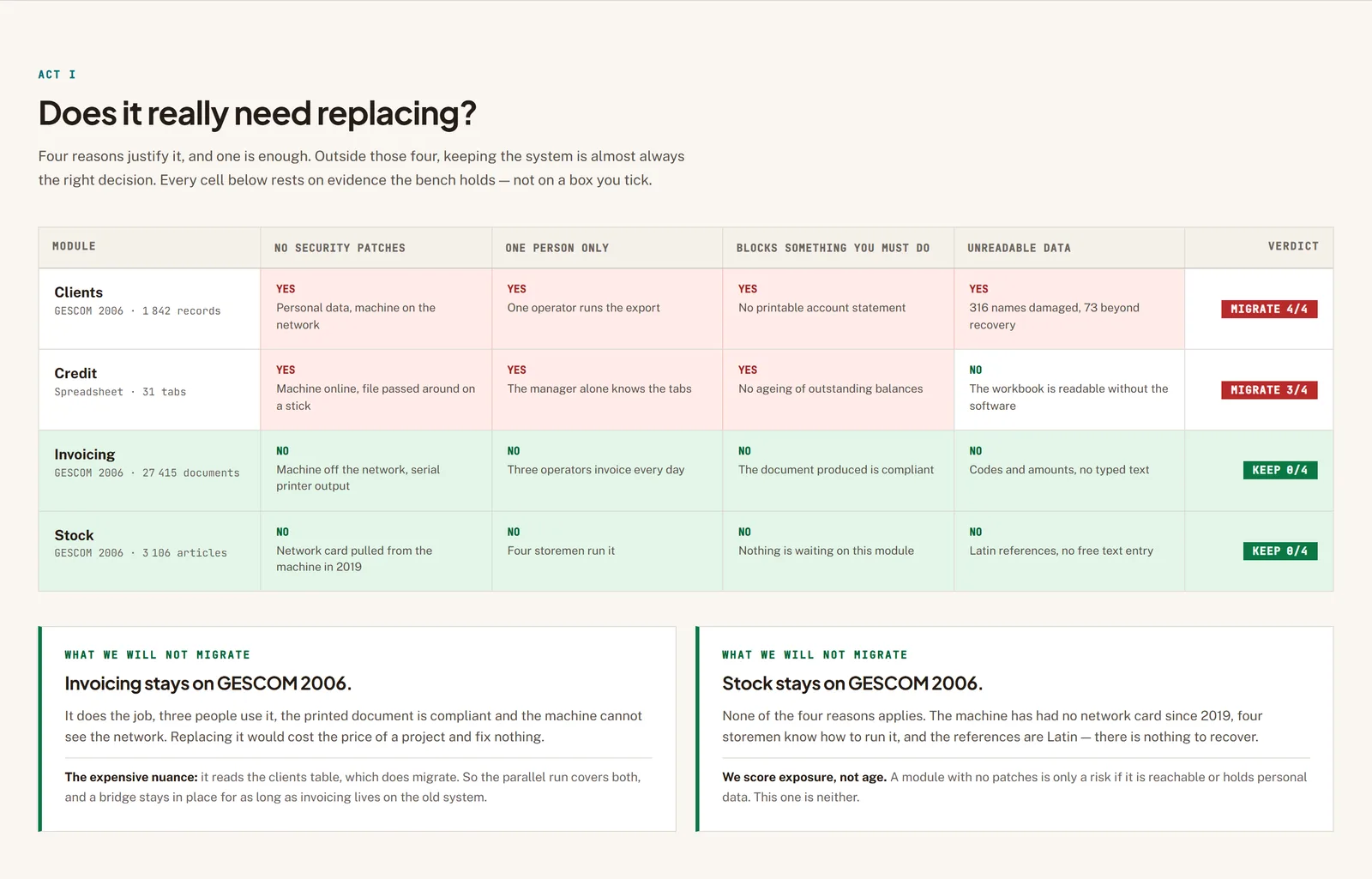
A wholesaler in Boumerdès, twenty years on software whose developer is gone. You run the bench we run before quoting: the four reasons to replace a system, the proof that the data comes out, and both systems running side by side.
See the demonstrationTwo of the four modules come back “keep it”. That is half the requests we get on this subject, and it is what the bench exists to say.
The problem
What we usually find
- Your advertising is seen by the whole city and your customers live three streets away.
- You announce promotions already sold out and people travel for nothing.
- Your real opening hours are stated nowhere.
- You look for new customers while the existing ones stop coming back.
A shop known to have what people need becomes the habit. That reputation is built by announcing what arrived, not by announcing discounts.
Where we stand
What decides here is not the image. It is the information.
Food retail has a tight geography. Your customers live minutes away, and communication reaching the whole city spends most of its budget on people who will never come, whatever the message.
What decides is not image but information: what has arrived, at what price, until when, and is it still available. A post announcing a delivery is worth more than a brand campaign, because it answers a question somebody has right now.
The third reality is frequency. A customer who comes every week is worth incomparably more than a new visit, and yet almost all the sector’s marketing effort is spent on the second.
So our work is to limit reach to the real neighbourhood, publish useful information rather than image, and treat regularity as the main objective.
What arrived, at what price, until when, and whether it is still there.
The engine
The acquisition engine, in nine stages
Nine stages, applied to the most local trade there is: your customers walk to you. Two things follow — reach narrows to a few streets, and the aim is not to bring somebody once but to become a fixed point in their week. And in a market where some prices are regulated and supply is organised, what is left to distinguish a shop is knowing what is on the shelf today.
Stage 00 — Measurement
Till, messaging, counter
Count the regulars, not the visitors.
A customer who comes every week is worth incomparably more than a new visit, and yet almost all the sector’s effort goes on the second. So the figure to follow is how many people come back, and it can be read at the till before it is read anywhere else.
You do
Nothing. Approve one access request.
We do
We build the measurement on regularity rather than on reach.
You get
A target that matches how this trade actually makes money.
Stage 01 — Attention
Social, listing, neighbourhood
A few streets, and not one kilometre more.
A message reaching the whole city puts nearly all of it in front of people who will never come, whatever it says, because they have the same shop below their building. Cutting the reach is the first saving here and the most immediate.
You do
Nothing. Tell us once which streets your regulars come from.
We do
We confine the advertising to that perimeter and do not step outside it.
You get
The same budget concentrated on people who pass your door.
Stage 02 — Intent
Social, messaging, listing
The demand is today’s question: have you got it?
Nobody searches for “grocery shop”. People want to know whether a particular product has arrived, at what price, and until when. A post answering that is worth more than a brand campaign, because it answers something somebody is wondering right now.
You do
Nothing. Tell us once which day the stock arrives.
We do
We set a short announcement format with the price and the date inside it.
You get
Posts read as information rather than ignored as advertising.
Stage 03 — The landing
Social, listing, messaging
Three posts a week beat one handsome post a month.
Regularity makes the habit, and it needs consistency rather than a budget. We keep that rhythm for you, in a short format: a photograph of the shelf, the product, the price, the date. Nothing requiring staging or approval.
You do
Nothing. Let us photograph the shelf on a delivery day.
We do
We post three times a week, working from what has actually reached the shelves.
You get
A presence that survives a busy week, which a campaign does not.
Stage 04 — Conversion
WhatsApp, telephone
Messaging is already an ordering channel. It is just not organised.
In many shops orders arrive as messages and are dealt with as they come, with no list, no cut-off time and no confirmation. A simple arrangement turns that channel into measurable revenue — and it already exists, which makes it free to set up.
You do
Nothing.
We do
We put the day’s list and the confirmation in place, and nothing heavier.
You get
Orders prepared calmly rather than between two customers.
Stage 05 — The reply
WhatsApp, messaging, listing
Answer on availability, and never promise what is not on the shelf.
The assistant says what is available today, at what price, how late you are open, and what you prepare to order. It never announces a delivery that has not arrived: it is the one lie this trade does not forgive, because it makes somebody come down for nothing.
You do
Nothing. Pack the orders it takes for you.
We do
We wire the assistant to that list and to nothing else.
You get
People who come down knowing they will leave with it.
Stage 06 — The follow-up
Social, messaging, window
Festival weeks are prepared months ahead, and they are predictable.
They concentrate a large share of the takings and the calendar is known long in advance. The opening hours, the stock you will announce and the posts for those weeks beat any campaign improvised at the last moment, when everybody is posting at once.
You do
Nothing.
We do
We prepare the posts and the hours in advance, and date them.
You get
Strong weeks run without a single decision taken in a hurry.
Stage 07 — Reputation
Listing, reviews, neighbourhood
Here reputation is spoken aloud in the street.
A neighbourhood shop is not judged online: it is judged between neighbours. What an online presence can do is confirm the hours, the address and availability at the moment somebody checks before coming down — and answer publicly when something went wrong.
You do
Nothing.
We do
We keep them exact and answer the reviews, including the bad ones.
You get
A listing that never sends somebody down to a closed shutter.
Stage 08 — Proof
Social, listing, messaging
Proof is the shelf photographed today.
Not a catalogue image: your shelf, as it is, with the price shown on it. It is the only proof the product exists with you right now, and it is also the fastest content to produce — which is the condition for producing it three times a week.
You do
Read one page a month. Make one decision.
We do
We publish it as it is, with the date, and take down what has sold out.
You get
A window telling today’s truth rather than last month’s.
What we do
What you get
Proximity targeting
Restricted to the real travel radius, often a few minutes on foot or by car.
Delivery announcements
What has arrived, in what quantity, until when. It is the most sought-after information in the sector.
Exact hours
Including special days and holiday periods, where the gap between posted and real is paid for in reviews.
Local reputation
Reviews tracked and answered, because a neighbourhood shop lives entirely on its immediate reputation.
Organised WhatsApp orders
The day’s list, a cut-off time and a confirmation: orders by message become takings instead of interruptions.
Who arrives
Who is looking for you, and where they pass
Five arrivals, and four of them live under ten minutes away. The fifth is only checking that you are open.
Who arrives
Somebody looking for one product, right now
First
Your post from today
Then
Message
Why
Their question is closed: have you got it. One answer is worth a visit.
Who arrives
A customer who comes every week
First
Nothing — they already come
Then
The day’s list
Why
It is the line the shop lives on, and it costs no advertising at all.
Who arrives
Somebody ordering by message
First
List and cut-off time
Then
Confirmed the same day
Why
The channel already exists with you; what is missing is arrangement, not a tool.
Who arrives
A family preparing a festival week
First
Your hours and what you will hold
Then
Ordering ahead
Why
They decide days beforehand, while everybody else is still posting at the last minute.
Who arrives
Somebody checking whether you are open
First
The listing and its hours
Then
They come down
Why
A wrong opening time sends somebody down for nothing, and that gets retold in the building.
On the ground
What brings a customer back to a food shop in Algeria?
Availability outranks price. A shop known to have what is needed becomes the reflex, and that reputation is built by announcing deliveries rather than by announcing discounts.
Holiday periods concentrate a significant share of turnover, and they are predictable far in advance. Preparing hours, announced stock and posts for those weeks beats any improvised campaign.
Finally, messaging serves as an ordering channel in many shops. A fast reply and a clear list of what is available turns that channel into real turnover, and it is often already in place without being organised.
Getting started
How we work
Delimit the area
The real radius your customers come from, which is almost always smaller than imagined.
Fix hours everywhere
Website, local listing, social. A wrong time on a holiday produces a review that lasts years.
Publish what is useful
Deliveries, prices, availability. Image content does not bring anybody into this trade.
State the limits
Quantity and date on every promotion, so nobody travels for nothing.
Work on the return visit
A regular publishing rhythm, because visit frequency is what makes the turnover.
The result
What changes
Reach limited to the neighbourhood
Spend concentrated on the area people actually travel from, which multiplies the effect of the same budget.
Announcements that hold
Deliveries and promotions published with their stock and date limits, avoiding the wasted trip and the furious review.
Customers who return
Regularity worked as an objective in its own right, because it is more profitable than acquisition.
Who this is for
Is this the right fit for you?
We work well with
- You have one or more physical outlets.
- You agree to us posting in your name several times a week.
- You accept announcing stock limits.
We are the wrong choice if
- You want maximum reach. It will cost you dearly without bringing anybody.
- You do not want your shop posting more than once a month. Expired information brings nobody back.
- You announce promotions without matching stock. The review will cost more than the visit gained.
Questions
Frequently asked questions
What area should we target?
The one your customers come from, which is almost always smaller than expected. Widening dilutes the budget without increasing visits.
What should we actually publish?
New stock, prices and availability. It is what people look for, and we post it for you on every delivery day.
How often should we publish?
Several times a week, because the information expires fast. A monthly post has no effect here.
Should we announce sell-outs?
Yes, and it is what builds trust. A forewarned customer does not travel for nothing and comes back next time.
How do we handle orders by messaging?
By setting reply hours and an availability list. The channel already exists; only the organisation is missing.
Do we need a website?
Rarely a priority. An accurate local listing and active social accounts produce more for a neighbourhood shop.
Let's talk
How to start
Tell us where your customers come from and which day your stock arrives.
We come back with the radius to target, the delivery-announcement format, and the calendar of holiday periods to prepare.
- Never a promotion without its limit
- Reach deliberately restricted
- Hours checked before every holiday