 Algeria Agency
Clothing
You dress people.
We bring
orders
in the right size.
We bring clothing shops orders in the right size: real measurements on every page, a worn photograph with the model’s size, a written returns policy, and campaigns paused as soon as a size sells out. A return is not a service detail: it is margin lost.
No commitment. We reply within one working day, and we also tell you what we would refuse to do.
The terms
100%
Of the accounts and photographs in your name
0
Sizes advertised after they have sold out
100%
Of product pages carrying the garment’s measurements
0 DA
Exit fee. You leave with everything.
These four figures are written into the contract. A 6-month minimum term on our digital marketing plans (Starter has none), then cancel any month with 30 days’ notice.
What you can try for yourself
Demonstrations
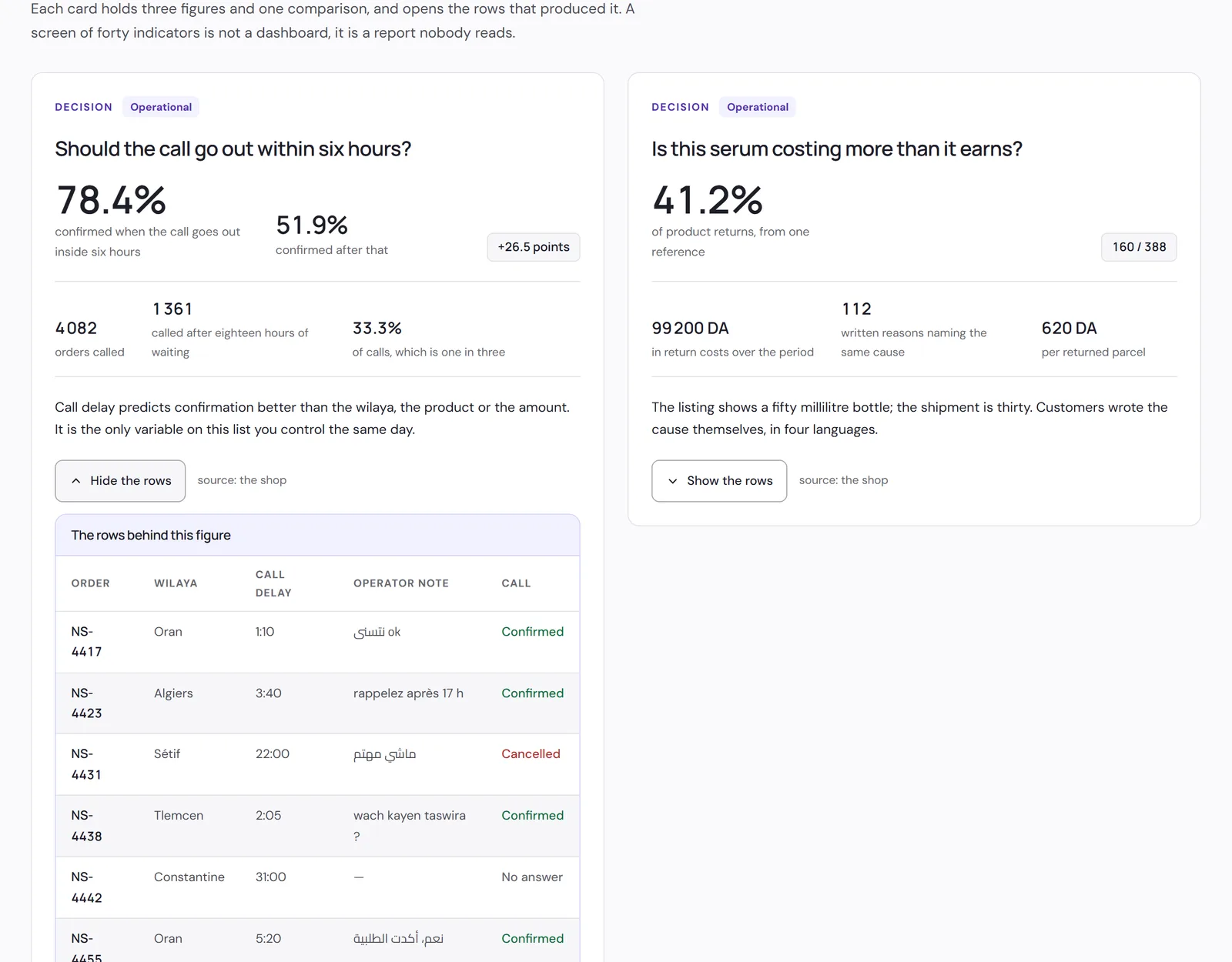
Three tools, one month, and a dashboard that refuses to conclude.
An imaginary online shop, twelve weeks of its orders, and the dashboard that reads them. Three tools give three figures for the same month: the demonstration reconciles them in front of you, produces four decisions, sets two aside for a human, and refuses to draw a forecast from any of it.
See the demonstration (Boutique Nesma)The shop does not exist and the figures are made up. What is real is how they are handled — including the two refusals, which are the part an ordinary dashboard never shows you.
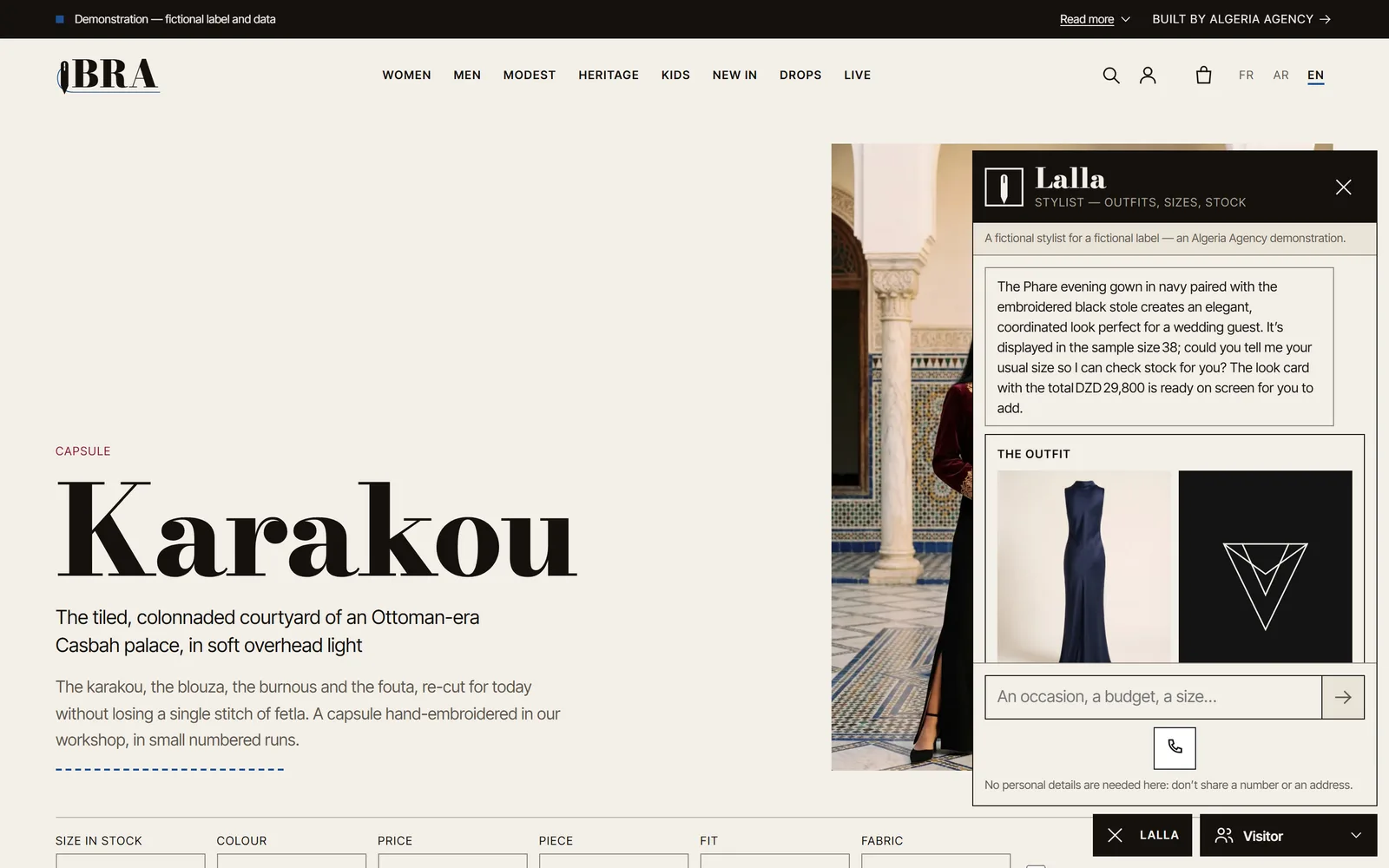
A whole fashion house: the online shop, the boutique tills, the workshop and the resellers.
A whole fashion house on one platform: online shop, lookbook, live shopping, try-on, size advice, the boutique tills, the workshop, resellers, influencers and management.
See the demonstration (IBRA)Fictional label, fictional people, simulated payments and deliveries.
The problem
What we usually find
- A large share of your returns come from a size that did not fit.
- Your photographs do not show the fabric’s real colour.
- You advertise sizes that have sold out.
- Customers ask for measurements in messages because they are not on the page.
A returned garment is not a service incident. It is a round trip already paid for, a size locked up for a week, and a margin disappearing from a sale that had actually happened.
Where we stand
Reducing uncertainty about size raises sales and lowers returns at the same time.
Clothing online has a problem other categories do not: the customer cannot try it on. Everything that reduces uncertainty about size — a precise guide, real measurements, a photograph on a person, a clear returns policy — raises sales and lowers returns at the same time.
The second point is the return itself. In a model dominated by cash on delivery, a refused or returned item costs the round trip and locks up stock for the whole cycle. The return rate is therefore a margin figure, not a customer-service indicator.
The third is rhythm. Collections change, sizes sell out, and advertising running on an out-of-stock item produces cancelled orders and irritated customers. Linking stock to campaigns is not a technical detail, it is a condition of profitability.
Finally, the photograph is the product. Nobody buys a garment from a description: image quality, a real model, and colour fidelity decide. It is the line where investment pays back most directly.
It is the one lever in this trade that moves both at once.
The engine
The acquisition engine, in nine stages
Nine stages, and three of them serve the same question: which size. A garment cannot be tried on, the visual reference buyers hold is that of international accounts, and a return costs transport both ways plus the stock it immobilises. Three ways of saying that the product page does more work here than the advertising.
Stage 00 — Measurement
Parcels, returns, shop
The figure at the top is the return rate per line.
Not an overall rate: per item and per size. That is how you see that three lines produce half the returns, almost always because their cut does not match the size on the label. The rest of the catalogue has no problem at all.
You do
Nothing. Approve one access request.
We do
We sort them by line and by size before touching the catalogue.
You get
The short list of items costing you money while earning you some.
Stage 01 — Attention
Social, paid placement, catalogue
Never advertise a size that no longer exists.
A campaign running on a sold-out item produces cancelled orders and irritated customers, on a budget already spent. The link between stock and campaigns is not a technical nicety: it is what separates a profitable shop from a busy one.
You do
Nothing. Let us photograph one run in the shop.
We do
We stop a line’s delivery the moment its common sizes run out.
You get
A budget that stops paying for orders you will cancel.
Stage 02 — Intent
Social, search, product page
The intention is one item seen on somebody, not a category.
Nobody searches "dress": they look for the one they just saw worn. The arrival lands on a product page, from a feed, and the buyer wants to know whether it will fit her — which is a question about measurements before it is a question of taste.
You do
Nothing. Tell us once which sizes you do not make.
We do
We treat every page as the only one that person will see.
You get
Arrivals that decide on the page, without exploring the shop.
Stage 03 — The landing
Product page, size guide
The garment’s measurements, not a size letter.
An M means nothing from one shop to the next. What settles it is the item’s real measurements — shoulders, chest, length — plus the size the model is wearing in the photograph. Two pieces of information, and they lower returns immediately.
You do
Nothing. Lend us three pieces for a day; we measure them.
We do
We put the measurements on the page and the guide one gesture away.
You get
Orders placed in the right size the first time.
Stage 04 — Conversion
Social, product page, studio
The photograph is the product, and the reference is international.
A worn photograph, properly lit, with faithful colour, converts markedly better than a flat shot — and it lowers returns in the same movement, because disappointment about colour is as common a reason for sending something back as the size.
You do
Nothing.
We do
We organise regular production and check the colours are faithful.
You get
A catalogue that survives comparison with what your customers already follow.
Stage 05 — The reply
WhatsApp, messaging, product page
Answer on size before the order leaves.
The question "will this fit me" arrives as a message and decides the sale and the return at once. The assistant gives the measurements, the model’s size and the usual correspondence, and hands over as soon as a judgement is needed — it never guesses a size.
You do
Nothing. Put aside what it has reserved for you.
We do
We write it onto those figures and forbid it to improvise a size.
You get
Fewer returns, because they are settled at the order rather than on arrival.
Stage 06 — The follow-up
Product page, returns page, message
A written returns policy sells. A vague one costs.
Who pays the transport, within how many days, in what condition, and what happens for a size exchange. Written before the purchase it reassures and produces orders; discovered afterwards it produces exactly the dispute that ends in a public review and a parcel nobody deals with.
You do
Nothing.
We do
We write it in one line on the page and in full on its own.
You get
Size exchanges replacing outright returns.
Stage 07 — Reputation
Reviews, product page, social
Reviews here are about the cut and the colour.
Rarely about the product itself: about the gap between the photograph and the parcel. Publishing faithful photographs and exact measurements removes the source, and answering a size review publicly explains to everybody after them how to choose.
You do
Nothing.
We do
We fix the pages of the most-returned items first, and answer the reviews about cut ourselves.
You get
Reviews that become a size guide written by your customers.
Stage 08 — Proof
Product page, label
Proof is what you can say about the item.
The fabric, the care, and increasingly where it was made. A large share of what sells here is imported, so being able to say an item was made here has become an argument rather than an apology — and it is product-page information, not an "about us" page.
You do
Read one page a month. Make one decision.
We do
We write what is true and leave blank what is not.
You get
A page that answers the questions people put to you in messages.
What we do
What you get
A real size guide
Measurements taken from your own items, not a standard table that matches nothing.
Photographs on a person
The garment worn, with the model’s size stated, which is the only useful reference for a buyer.
Colour fidelity
Consistent shooting from one piece to the next, because a misleading colour is a cause of returns.
Stock linked to campaigns
Unavailable lines and sizes withdrawn automatically from the advertising.
A clear returns policy
Written and visible before purchase, because ambiguity produces disputes and negative reviews.
Who arrives
Who is looking for you, and where they pass
Five arrivals, and four of them ask the same question in different forms: will this fit me?
Who arrives
Somebody who has just seen the item worn
First
The page, with the measurements
Then
The model’s size
Why
They are not looking for a shop: they want to know whether that piece will fit.
Who arrives
Somebody hesitating between two sizes
First
The message
Then
The correspondence for your cut
Why
Without an answer they order the wrong one, and you pay for their hesitation.
Who arrives
Somebody previously disappointed by a colour
First
Your recent photographs
Then
The returns page
Why
They check what you do when it goes wrong before they look at the product.
Who arrives
A customer wanting to exchange a size
First
The written policy
Then
An exchange rather than a return
Why
An exchange keeps the sale; an outright return loses it after paying two trips.
Who arrives
Somebody asking where the item was made
First
The line on the product page
Then
Order
Why
The question is becoming common, and a silent page answers "probably not here".
On the ground
How do you sell clothing online in Algeria?
Cash on delivery makes returns particularly expensive: the parcel goes out, comes back, and the item is locked up for the whole cycle. A high return rate is therefore not a service problem, it is a loss line, and reducing it is worth more than raising traffic.
The photograph is what sells, and the visual reference is high because buyers compare with international accounts. A worn photograph, properly lit, with the model’s size stated, converts markedly better than a flat product shot — and reduces returns at the same time.
Finally, most traffic lands on a product page from a social platform. That page therefore has to contain everything that decides: measurements, fabric, price, estimated delivery charge, availability by size, and a way to order immediately.
Getting started
How we work
Measure the returns
How many, on which items, for what reason. Sizing dominates almost always, and it can be corrected.
Fix the product pages
Real measurements, fabric, care and charges, answering before the question is asked.
Produce the photographs
A batch session, worn, with consistent treatment that does not betray the colour.
Connect the stock
Campaigns follow availability by size, not only by product line.
Measure on collected revenue
The useful figure is the order delivered, paid for and not returned. The rest flatters the reports.
The result
What changes
Fewer returns
A precise size guide and real measurements reduce the leading cause of returns, which weighs directly on margin.
Pages that answer on their own
Size, fabric, colour and charges stated, which removes half the pre-purchase messages.
Campaigns that follow stock
Sold-out sizes drop out of the advertising, which stops paying full price for cancellable orders.
Who this is for
Is this the right fit for you?
We work well with
- You sell clothing and already deliver.
- You can measure your items and photograph them worn.
- You accept treating your return rate as a margin figure.
We are the wrong choice if
- You want more traffic without fixing the product pages. Returns will rise with sales.
- Your stock changes with nothing reflecting it online. Advertising will pay for cancellations.
- You use supplier photographs that do not match what you sell. Returns are guaranteed.
Questions
Frequently asked questions
How do we reduce returns?
By attacking sizing, which is almost always the leading cause: real measurements, a worn photograph with the model’s size, and a clear guide. It is the most profitable correction in the sector.
Can we use supplier photographs?
Rarely without risk. They do not show your item as it arrives, and the gap produces returns that cost more than the photo session.
Do we need an online shop?
When volume makes messaging unmanageable: orders copied by hand, sizes untracked, no customer data. Below that, social is enough.
How do we handle sold-out sizes?
By linking campaigns to stock by size, not only by product line. Advertising an unavailable size pays for an order you will cancel.
Should we accept returns?
A clear policy sells better than no policy, even a restrictive one. Ambiguity produces public disputes that cost more.
What photography budget should we plan?
We do not put a figure on it before seeing your catalogue. A batch session covering several pieces costs less per item than people expect, and it is the line that pays back most directly.
Let's talk
How to start
Tell us your approximate return rate, what comes back most often, and whether your pages state measurements.
We come back with what returns actually cost you, the page corrections to make first, and the photography production plan.
- Real measurements
- No retouching of colours
- Advertising linked to stock by size