 Algeria Agency
Automotive
You sell cars.
We bring you
buyers who have
checked the file.
We bring you buyers who have already checked: one verifiable file per vehicle — history, mileage, faults photographed — a displayed price, and calls measured over the real length of a purchase, weeks rather than days. The workshop is handled separately: calling your customers back for their service is almost always the first gain, before any advertising budget.
No commitment. We reply within one working day, and we also tell you what we would refuse to do.
The terms
100%
Of the accounts and listings in your name
0
Known faults hidden in a listing’s photographs
100%
Of listings carrying a price and a mileage
0 DA
Exit fee. You leave with everything.
These four figures are written into the contract. A 6-month minimum term on our digital marketing plans (Starter has none), then cancel any month with 30 days’ notice. In this market, a fault discovered on the test drive costs the visit, the sale and the review that follows.
What you can try for yourself
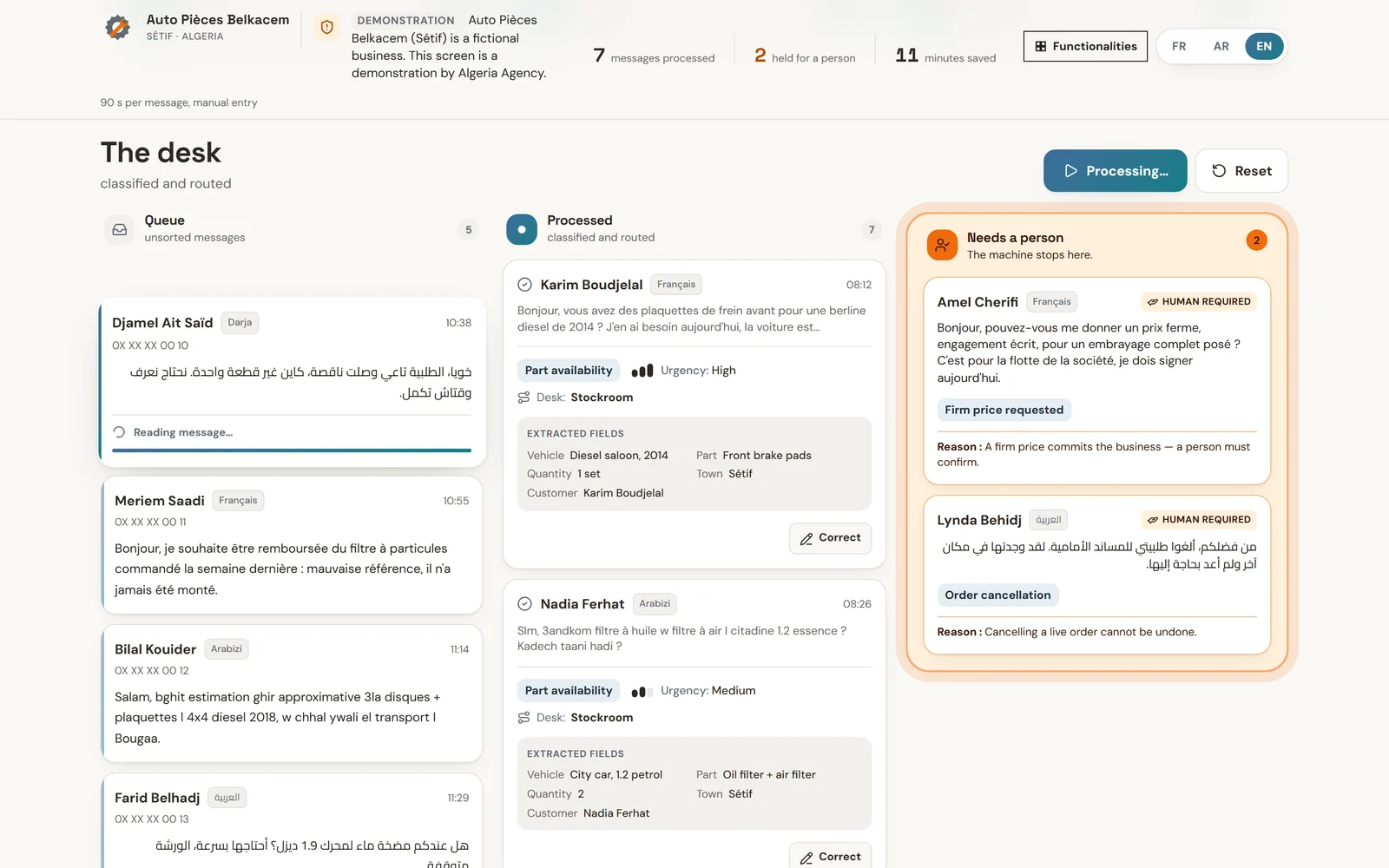
A demonstration
An inbox that sorts itself, apart from three messages.
Imaginary auto-parts shop in Sétif, one screen: you take the desk, not the counter. Fourteen messages in Darja, Arabic, French and Arabizi sort themselves — except three.
See the demonstrationFictional business: nothing you send here reaches anybody.
The problem
What we usually find
- Your campaigns are judged over three weeks while your customers take three months.
- Your listings do not show the faults and the visit goes badly.
- Your customers are not called when their service falls due.
- You do not know whether a sale came from a listing or from word of mouth.
The buyer knows they hold less information than you do, and they are right. Anything that narrows that gap is worth more than an argument, precisely because few sellers agree to narrow it.
Where we stand
Trust here attaches to the vehicle’s history, not to the seller.
Automotive has a long cycle. Weeks can pass between somebody starting to look and buying. A campaign judged on this week’s enquiries therefore misses the point, and one cut too early removes the channel just before it produces.
The second reality is trust, in a sector where the buyer knows they are at an information disadvantage. What reassures is concrete: a verifiable history, honest photographs including the faults, a displayed price, and written terms. Hiding a fault produces a wasted visit and a review.
The third is the workshop. For many dealerships and garages the sale is visible and the servicing is profitable. A good part of the work is therefore bringing existing customers back for a service rather than finding new ones to buy.
So our work is to measure over a cycle long enough to be honest, make the information verifiable, and treat sales and after-sales separately, since they share neither the customer nor the message.
A file that can be checked replaces everything you might say instead.
The engine
The acquisition engine, in nine stages
Nine stages, applied to two trades sharing one address: the sale, with a cycle of several weeks, and the workshop, whose customer is already yours. Mixing them produces the most misleading measurement in this sector — and nearly every first contact arrives by telephone, so a dashboard counting only forms describes a trade that is not the one you run.
Stage 00 — Measurement
Telephone, messaging, listings
Measure over the real cycle, or the reading is wrong.
Weeks pass between the first look and the purchase. A campaign judged on this week’s enquiries concludes that a channel failed when it was filling the diary, and a campaign cut short is almost always cut just before it would have produced.
You do
Nothing. Approve one access request.
We do
We set the measurement window to that and instrument the calls.
You get
A judgement made at the right moment rather than at the end of the week.
Stage 01 — Attention
SMS, WhatsApp, customer list
The workshop first: those are your customers, and they come back.
The sale is visible, the servicing is profitable. Bringing existing customers back for a service costs a list and a few messages, where one more sale costs weeks of advertising. It is almost always the first gain available, and nobody takes it.
You do
Nothing. Send us your workshop customer list once.
We do
We build the service reminder on those dates and measure what it returns.
You get
A full workshop before spending a dinar on advertising.
Stage 02 — Intent
Search, listings, messaging
Two buyers, and the second is searching from abroad.
There is the local buyer comparing available vehicles. And there is the one preparing a permanent return, buying under precise rules — the vehicle’s age, the engine type, the capacity, a procedure prepared months ahead. Their questions are administrative, and almost nobody answers them.
You do
Nothing. Tell us once whether you accept vehicles imported by private buyers.
We do
We write the page for that procedure and keep it current when the rule moves.
You get
A flow prepared months in advance, on which your competitors are silent.
Stage 03 — The landing
Listings, site, vehicle page
A listing that shows the faults sells better than one that hides them.
The price displayed, a coherent mileage, the service invoices, and photographs that include the scratches. Hiding a fault does not remove it: it appears on the test drive, and it costs the trip, the sale and the review. Declaring it turns away wasted visits and brings somebody who has already accepted.
You do
Nothing. Open the yard to us for half a day.
We do
We build a page per vehicle with the verifiable file inside it.
You get
Fewer visits, and more test drives that convert.
Stage 04 — Conversion
Vehicle page, workshop
Talk about parts before anybody asks.
A model whose parts are scarce resells badly and is expensive to service, and buyers know it. Saying so openly distinguishes rather than harms — and it spares you the buyer who comes back to complain about something you already knew.
You do
Nothing.
We do
We write it on the page, with what you can guarantee on the workshop side.
You get
Sales that do not turn against you six months later.
Stage 05 — The reply
WhatsApp, telephone, listings
Answer fast on availability, never on mechanical condition.
The assistant says whether the vehicle is still there, the price displayed, the mileage, the documents available and the test-drive slots. It gives no view on mechanical condition and negotiates nothing: both belong to somebody with the vehicle in front of them.
You do
Nothing. Run the test drives it has booked.
We do
We stop it before mechanical condition and pass those questions to you.
You get
Test drives booked in the evening, with no machine judging an engine.
Stage 06 — The follow-up
SMS, WhatsApp, email
Two follow-ups, and they have nothing in common.
The sales one accompanies a long cycle without harassing: a matching vehicle, a price drop, an arrival. The workshop one is dated and expected: a service, an oil change, an inspection. The second fills itself and the first requires patience.
You do
Nothing.
We do
We write two cadences and never put both into one send.
You get
A steady workshop, and buyers who do not block you.
Stage 07 — Reputation
Reviews, listing, workshop
Reviews are about the after-sales, not the purchase.
People rarely write on the day they buy. They write three months later, when a part has failed and they have had to see how you react. So it is the workshop that writes your reputation, and that is where you reply in public.
You do
Nothing.
We do
We publish your workshop guarantees before the sale, and draft a reply to every after-sales review.
You get
Reviews that talk about how you settle a problem.
Stage 08 — Proof
Vehicle page, site
Proof is the file, not the photograph.
Service invoices, a coherent mileage, declared faults, written terms. It is worth more than any sales argument, because few sellers supply it — and it is the one thing a suspicious buyer can check for themselves before making the trip.
You do
Read one page a month. Make one decision.
We do
We publish what exists and say what is missing, rather than leaving a blank.
You get
A buyer who arrives having already decided to trust you.
What we do
What you get
Complete listings
Price, mileage, history and visible faults, which filters before the visit rather than after.
Honest photographs
Including what is wrong. A buyer who discovers a fault on site does not come back.
Call tracking
Essential: most serious contacts come by phone and appear nowhere without it.
Service reminders
A message at the point a service is due, which fills the workshop with customers you already have.
Reputation watched
Reviews monitored and handled, because an automotive dispute is visible and travels fast.
Who arrives
Who is looking for you, and where they pass
Five arrivals. Two of them have already been to you, and they are the only ones that cost nothing.
Who arrives
Somebody who has been looking for three weeks
First
Vehicle page with the file
Then
Test drive
Why
They compare slowly, and will keep the one where something could be checked.
Who arrives
Somebody preparing a permanent return
First
The procedure page
Then
Messaging
Why
Their question is regulatory, prepared months ahead, and nobody answers it.
Who arrives
A customer who bought their car from you last year
First
A dated service reminder
Then
Workshop
Why
It is the most profitable line on this list, and it needs no advertising at all.
Who arrives
Somebody looking for a part for their model
First
Parts and workshop page
Then
Booking
Why
They become a workshop customer without ever passing a sales listing.
Who arrives
A buyer with a problem after three months
First
What you wrote before the sale
Then
Your public reply
Why
That moment produces the review the next forty people will read.
On the ground
What decides a vehicle purchase in Algeria?
Trust attaches to the vehicle’s history more than to the seller, and it is structurally low. A verifiable file — service invoices, a consistent odometer, faults declared — is worth more than any sales argument, precisely because few sellers provide one.
Parts availability also shapes the purchase. A model whose parts are scarce resells badly and is expensive to maintain, and buyers know it. Addressing it openly in a listing distinguishes rather than harms.
Finally, almost all first contacts come by phone and messaging. A campaign measuring only forms regularly concludes that a channel filling the diary has failed, and it is the most frequent analytical mistake in the sector.
Getting started
How we work
Set the measurement window
The real time between first contact and purchase, which decides the period a campaign is judged over.
Complete the listings
Price, history, faults and terms, so that the visit confirms rather than discovers.
Measure calls
Without it, a channel making the phone ring all day looks unproductive.
Separate sales from workshop
Two campaigns, two messages, two audiences. Mixing them produces volume in the wrong category.
Reactivate the customer record
Service reminders to existing customers, which is almost always the cheapest channel.
The result
What changes
Measured on the right cycle
Campaigns judged over the real decision period, which avoids cutting a channel just before it produces.
Visits that go well
Honest listings, faults shown, price displayed: fewer visits, but visits that close.
A workshop that fills
Existing customers called back for servicing, which costs a fraction of acquisition and returns regularly.
Who this is for
Is this the right fit for you?
We work well with
- You sell vehicles or run a workshop with regular customers.
- You accept displaying prices and showing the real condition.
- Somebody can call back within the day.
We are the wrong choice if
- You want to judge a campaign over a fortnight. The cycle is longer and the conclusion will be wrong.
- You do not want to display prices. The volume of unqualified enquiries will cost more than the gain.
- You do not intend to show faults. The wasted visit and the review cost more than the contact gained.
Questions
Frequently asked questions
Should we display prices?
Yes. It is the first filter, and its absence produces a volume of out-of-budget calls that occupies the team without producing sales.
Should we show faults?
Yes, and it sells better. A buyer who discovers a fault on site feels misled; a forewarned buyer arrives informed and buys.
Over what period should a campaign be judged?
Over the real decision period, which is long here. We set the window before starting to avoid a premature conclusion.
How do we fill the workshop?
By calling back existing customers when a service is due. It is the cheapest and most regular channel, and almost nobody uses it.
Should we measure calls?
Here more than anywhere. Most serious contacts arrive by phone, and without measurement the campaign looks unproductive.
Do reviews matter?
A great deal, because an automotive dispute involves significant sums and travels fast. Answering it calmly is worth more than trying to make it disappear.
Let's talk
How to start
Tell us how long on average passes between first contact and sale, and whether you call customers back for servicing.
We come back with the measurement window to adopt, what to add to the listings, and the workshop reminder campaign that is almost always the first gain.
- Nothing concealed in a listing
- Measured on the real cycle
- The workshop before acquisition