 Algeria Agency
Restaurant & Hospitality
You cook.
We bring
the guests
to your door.
We bring customers to restaurants and hotels: a complete listing pinned correctly on the map, photographs of the dish you actually serve, recent reviews asked for honestly, and replies within minutes on WhatsApp. Your delivery storefront is treated as a second shopfront, with its own hours.
No commitment. We reply within one working day, and we also tell you what we would refuse to do.
The terms
100%
Of the listing and accounts in your name
0
Reviews bought, invented or written by us
100%
Of photographs taken of the dish you serve
0 DA
Exit fee. You leave with everything.
These four figures are written into the contract. A 6-month minimum term on our digital marketing plans (Starter has none), then cancel any month with 30 days’ notice.
What you can try for yourself
Demonstrations
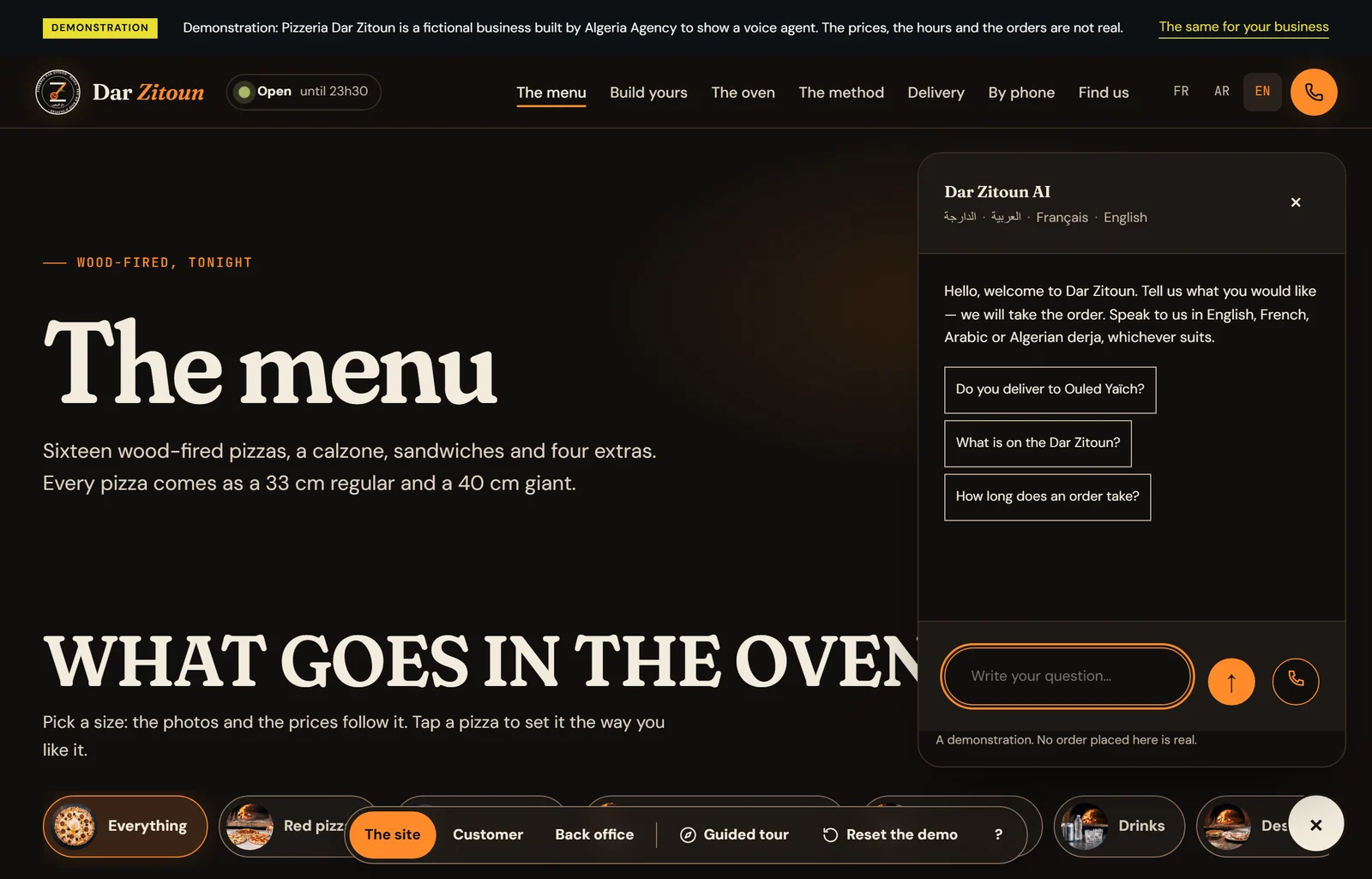
An order spoken aloud, written down as it is said.
An imaginary pizzeria in Blida. You call Dar Zitoun and order aloud, in derja, Arabic, French or English.
See the demonstration (Pizzeria Dar Zitoun)The business is fictional: no order placed here is real.
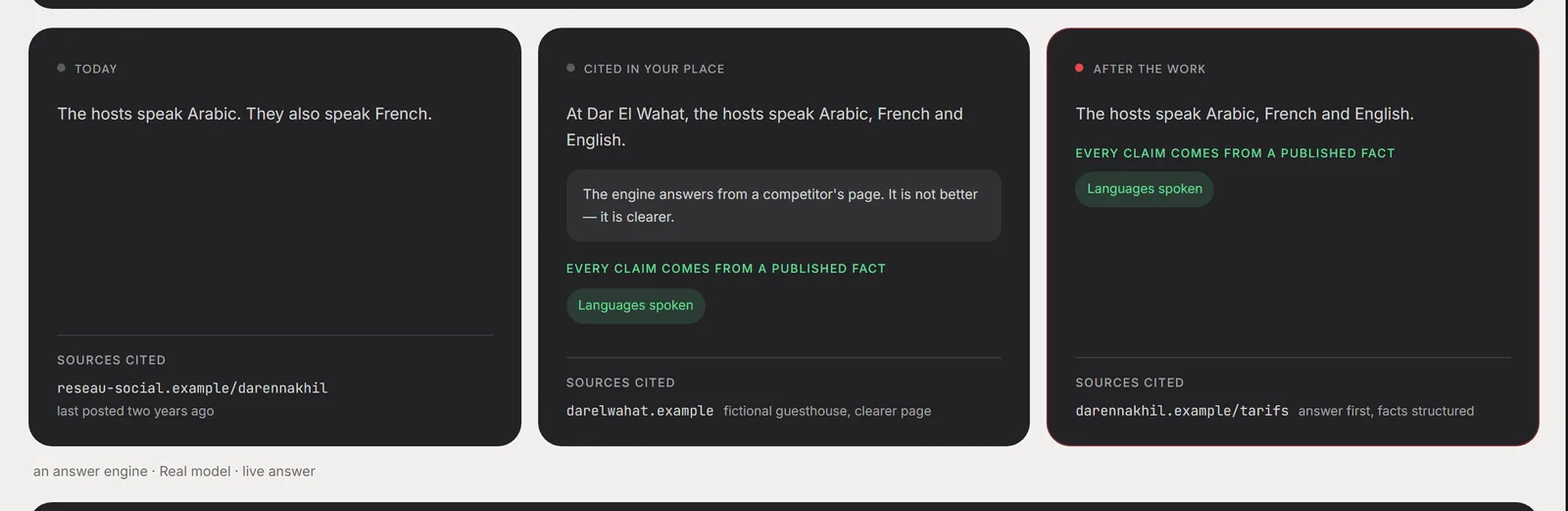
One question, three answers, and only the sources differ.
A fictional guesthouse in Ghardaïa, described by an answer engine three times over: from its current sources, from a competitor’s page, then from a file of published facts. Same model, same question, different sources.
See the demonstration (Dar Ennakhil)The engines named in the table write none of the answers shown, and the fourth goes on citing a directory even after the work.
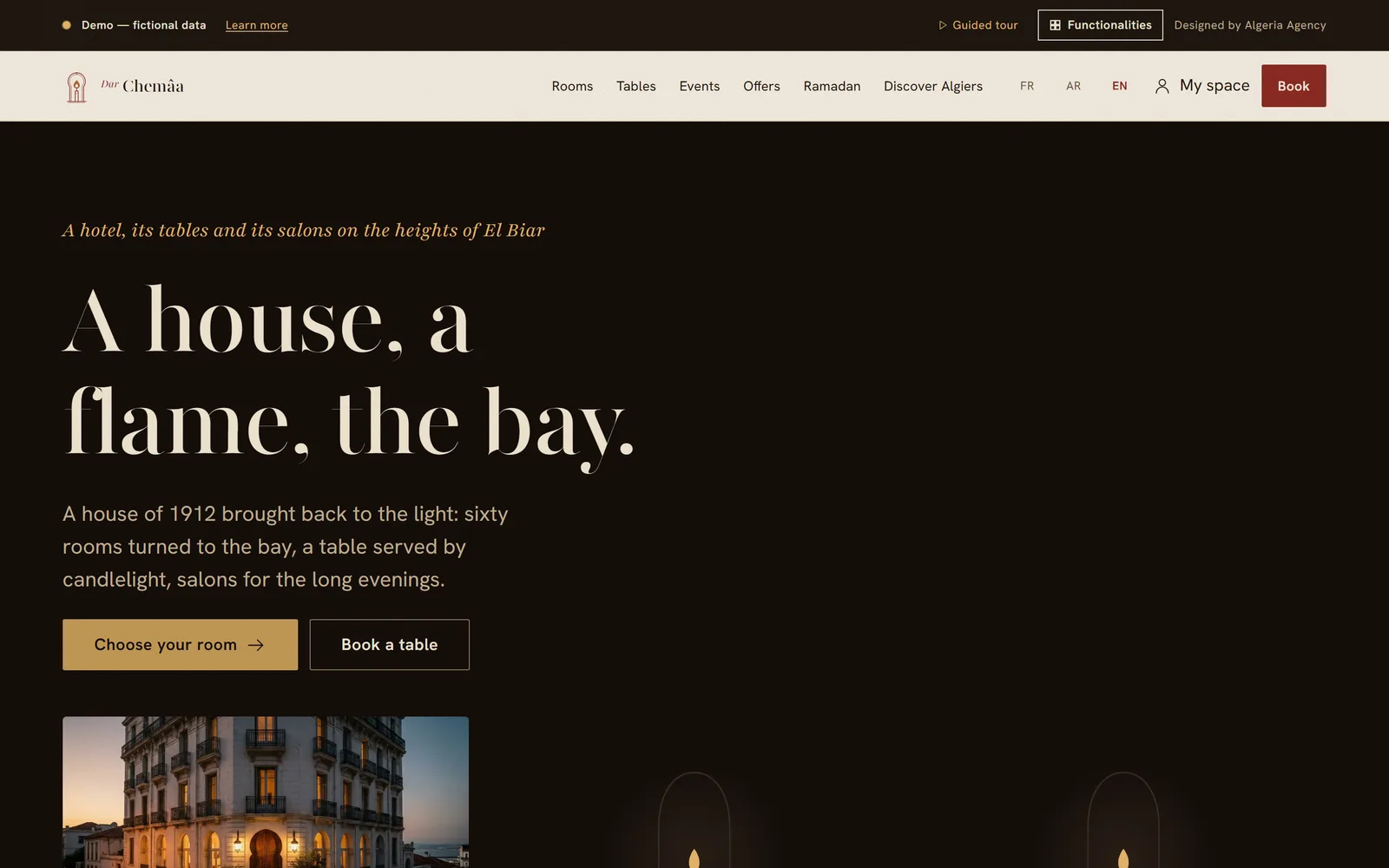
A hotel, its tables and its salons on one platform: rooms chosen by their view, tables on a floor plan, kitchen screens and events.
A hotel, its restaurants and its salons on one platform: a public site to book rooms, tables and events, menus with allergens, a guest space with online check-in and a digital key, then the front desk, the dining room and kitchen screens, housekeeping, events sales and management.
See the demonstration (Dar Chemâa)Fictional property; bookings, payments and messages are simulated; rates are indicative.
The problem
What we usually find
- Your listing shows the wrong hours and two photographs from the opening.
- A negative review has sat at the top for months and nobody has answered it.
- Your rooms sell mainly through booking platforms, commission included, and almost never direct.
- Your photographs do not look like what arrives on the plate.
The customer decided before seeing you. They looked at a rating, two photographs and three recent reviews, and chose the second address on the list because the first had no opening hours.
Where we stand
The listing works harder than the site and the social page together.
In hospitality, most of the decision is made before the customer has seen you. They search for somewhere nearby, look at the rating, two or three photographs and the latest reviews, and choose within a minute. Your business listing therefore does more work than your social page and your website combined.
The second reality is that reviews cannot be deleted, but they can be diluted. One bad review among forty recent ones weighs almost nothing; the same one alone at the top of an empty listing decides. Asking satisfied customers for reviews is the most profitable and least practised lever in the sector.
The third is the photograph. An over-retouched image produces disappointment on arrival, and disappointment is paid for in reviews. A properly taken picture of the dish actually served convinces better and creates no gap between expectation and reality.
So our work is to put the listing in order, install a review collection that runs itself, and produce honest visual material in batches rather than one session a year.
And putting it right comes before any ad budget.
The engine
The acquisition engine, in nine stages
The nine stages hold, and in this trade nearly all of them are settled before anybody pushes the door. Two shopfronts run in parallel — the listing and the delivery storefront — with separate hours, photographs and reviews, which most places discover on the day an order is refused.
Stage 00 — Measurement
Listing, map, till
Where your customers come from, and where your pin falls on the map.
A great many places sit wrongly on the map, which sends people elsewhere without leaving a trace — no complaint, no call, nothing to measure. Checking the exact pin and the route is often worth more than a month of advertising.
You do
Nothing. Approve one access request.
We do
We correct the pin, the route and the entrance, and measure the directions requested.
You get
Customers who arrive, instead of takings that are short for no visible reason.
Stage 01 — Attention
Listing, marketplace, map
Two shopfronts, and the second keeps its own hours.
The listing and the delivery storefront are worked separately. The second has its own service window, its own catchment and its own photographs, and a whole neighbourhood can sit outside the coverage without anybody in your kitchen knowing. A refused order leaves a review, not a phone call.
You do
Nothing. Let us photograph during a real service.
We do
We put both shopfronts in order and keep them agreeing with each other.
You get
Two accurate windows rather than one good one and one forgotten.
Stage 02 — Intent
Search, listing, map
Nobody searches for "restaurant". They search a dish, a neighbourhood, an hour.
Demand is local and immediate, and it comes out in three words. What captures it is not a presentation page but a readable menu, exact hours, and naming what you genuinely do well — even when that is one thing.
You do
Nothing. Tell us once what you have stopped serving.
We do
We put your dishes and hours where search finds them, in people’s own words.
You get
Arrivals that wanted exactly what you are serving tonight.
Stage 03 — The landing
Listing, site, menu
Here the landing page is the listing. The site carries the menu and the table.
A site that takes thirty seconds to load a menu as an image loses the customer standing in the street. The menu has to be text, readable one-handed, with the prices — and booking has to take two gestures, with no account to create.
You do
Nothing. Send us the menu once; we keep it current after that.
We do
We publish the menu as light text and remove everything that sits in front of it.
You get
A menu readable on a pavement with one bar of signal.
Stage 04 — Conversion
Booking, marketplace
Book or order in two gestures, with no account to create.
Every added step costs a table. A name, a number of covers, a time — and for delivery, a storefront whose photographs and service window are right, because that is where the order is decided rather than on your site.
You do
Nothing.
We do
We ask for that only, and align the storefront to the same truth.
You get
Bookings that are kept, and orders that are not refused on arrival.
Stage 05 — The reply
WhatsApp, messaging, listing
Replying in minutes beats being better rated.
A place that answers within minutes converts markedly better than a better-rated place answering tomorrow. The assistant holds availability, the menu, the hours and the address, takes a simple booking, and hands over the moment a group or an event is involved.
You do
Nothing. Seat the tables it books for you.
We do
We wire it to your real hours so it never promises a service that is closed.
You get
Tables taken in the evening and on Friday, with nobody on the phone.
Stage 06 — The follow-up
WhatsApp, social, SMS
Follow up on an occasion, never on a reminder to be hungry.
What works is dated and useful: a Ramadan menu, an announced closure, a service changing its hours, a group that came at the same time last year. The rest becomes noise, and noise is what makes somebody switch the notification off.
You do
Nothing.
We do
We send only what carries a date, and never twice in one week.
You get
Messages still being opened in six months.
Stage 07 — Reputation
Listing, table, receipt
A review is not deleted. It is diluted.
One bad review among forty recent ones weighs almost nothing; the same review alone at the head of an empty listing decides on your behalf. Asking satisfied customers is the most profitable and least used lever in this sector, and it has nothing to do with buying any.
You do
Nothing.
We do
We build the ask into the service and reply to what arrives, good or bad.
You get
A flow of recent reviews, which is the only thing that neutralises a bad one.
Stage 08 — Proof
Listing, social, storefront
Proof is a photograph of the dish you genuinely serve.
An over-retouched image produces disappointment on arrival, and disappointment is paid for in reviews — so the retouching costs twice. Honest photographs taken in batches across real services convince better than an annual session, and open no gap with the plate.
You do
Read one page a month. Make one decision.
We do
We produce material in batches and replace whatever has left the menu.
You get
An expectation that matches what reaches the table.
What we do
What you get
A completed business listing
Real hours, menu, services, recent photographs and a location verified on the map.
Review collection
A simple route for asking at the right moment, without buying or fabricating anything.
Replies to reviews
Every criticism, quickly, in the language of the review, and the positive ones regularly.
Regular content
Photographs and short video produced in batches, to sustain a presence without relying on inspiration.
Local advertising
Targeted on your real catchment area, because beyond it the spend produces nothing.
Who arrives
Who is looking for you, and where they pass
Five arrivals, and four of them are settled without ever opening your site.
Who arrives
Somebody hungry, three hundred metres away
First
Listing and map pin
Then
Directions
Why
They choose in a minute, and a wrong route lands them at the neighbour’s.
Who arrives
Somebody ordering from an app
First
Your marketplace storefront
Then
Photographs and service window
Why
The order is decided there, on photographs that are not the ones on your listing.
Who arrives
A group looking for a table on Friday
First
Messaging
Then
Booking
Why
They write to three places and keep the first that answers, not the best rated.
Who arrives
A disappointed customer, writing now
First
Your public reply
Then
The recent reviews around it
Why
It is not the review that decides, it is the forty recent ones surrounding it.
Who arrives
A traveller looking for a bed and a meal
First
Listing, map, room photographs
Then
Messaging
Why
They do not know the neighbourhood, so they trust whatever is documented.
On the ground
What decides the choice of a restaurant in Algeria?
Searching is local and immediate: a dish, a neighbourhood, an hour. The business listing captures that intent better than any other surface, and it is where most nearby visits are decided — often without the customer ever opening your social page.
Map location is an underestimated point. Many establishments are mislocated, which sends customers elsewhere without leaving any trace. Checking the exact point and the route is often worth more than a month of advertising.
Finally, messaging extends the listing: bookings, availability, questions about the menu. A place that replies within minutes converts markedly better than a better-rated one that replies the next day.
Getting started
How we work
Put the listing in order
Almost always the most profitable action, and it costs nothing but care.
Answer what is there
Working through waiting reviews, starting with the most visible.
Open collection
A review request built into the service, at the moment the customer is happy.
Produce material
One session covering several weeks, rather than photographs snapped in a hurry.
Advertise locally
Spend concentrated on the area your customers genuinely come from.
The result
What changes
A listing that works
Accurate hours, recent photographs and reviews that get answered: what decides most nearby visits.
A protective volume of reviews
Recent, numerous reviews put an isolated incident back in proportion, which is the only honest mechanism.
Continuous visual material
Photographs and video produced regularly, because one session a year does not sustain a feed.
Who this is for
Is this the right fit for you?
We work well with
- You have premises with a local customer base.
- You accept asking satisfied customers for reviews.
- You can keep displayed hours accurate and update them.
We are the wrong choice if
- You want reviews deleted. That is not reliably possible and we will not sell it.
- You cannot keep your hours current. A wrong listing does more harm than no listing.
- The problem the reviews point at is real and will not be fixed. Communication will not hide it.
Questions
Frequently asked questions
Can a bad review be deleted?
No, except on a clear breach of platform rules. The right answer is to reply calmly and dilute with recent volume.
How do we get more reviews?
By asking at the right moment, simply, once. Most happy customers do not think of it; unhappy ones think of it unprompted.
Do we need a website?
Less urgent than a listing in good order. A site becomes useful for the menu, bookings and events, once the listing is handled.
Is advertising worth it?
On a narrow area, yes, particularly for an opening or something new. Running beyond your catchment spends without producing.
Should we show menu prices?
Yes. It is one of the first things a customer looks for, and its absence drives away people who would have come.
What about an unfair review?
Reply once, factually, without argument. A measured answer to excessive criticism often convinces better than an absence of incidents.
Let's talk
How to start
Send us the link to your listing and tell us where most of your customers come from.
We come back with what the listing is missing, what your reviews actually say, and the collection route we would put in place.
- No fabricated reviews
- Photographs that look like the dish
- The listing before the advertising