 Algeria Agency
Beauty & Wellness
You care for people.
We fill
your empty
slots.
We fill the diaries of salons and beauty institutes: a reply the same evening where appointments are really made, your clients reminded at the right moment, your own photographs with their consent, and indicative prices. This trade is decided in the evening, in a messaging app, a few streets from your door.
No commitment. We reply within one working day, and we also tell you what we would refuse to do.
The terms
100%
Of the accounts and photographs in your name
0
Result photographs that are not your own work
100%
Of treatments shown with an indicative price
0 DA
Exit fee. You leave with everything.
These four figures are written into the contract. A 6-month minimum term on our digital marketing plans (Starter has none), then cancel any month with 30 days’ notice.
What you can try for yourself
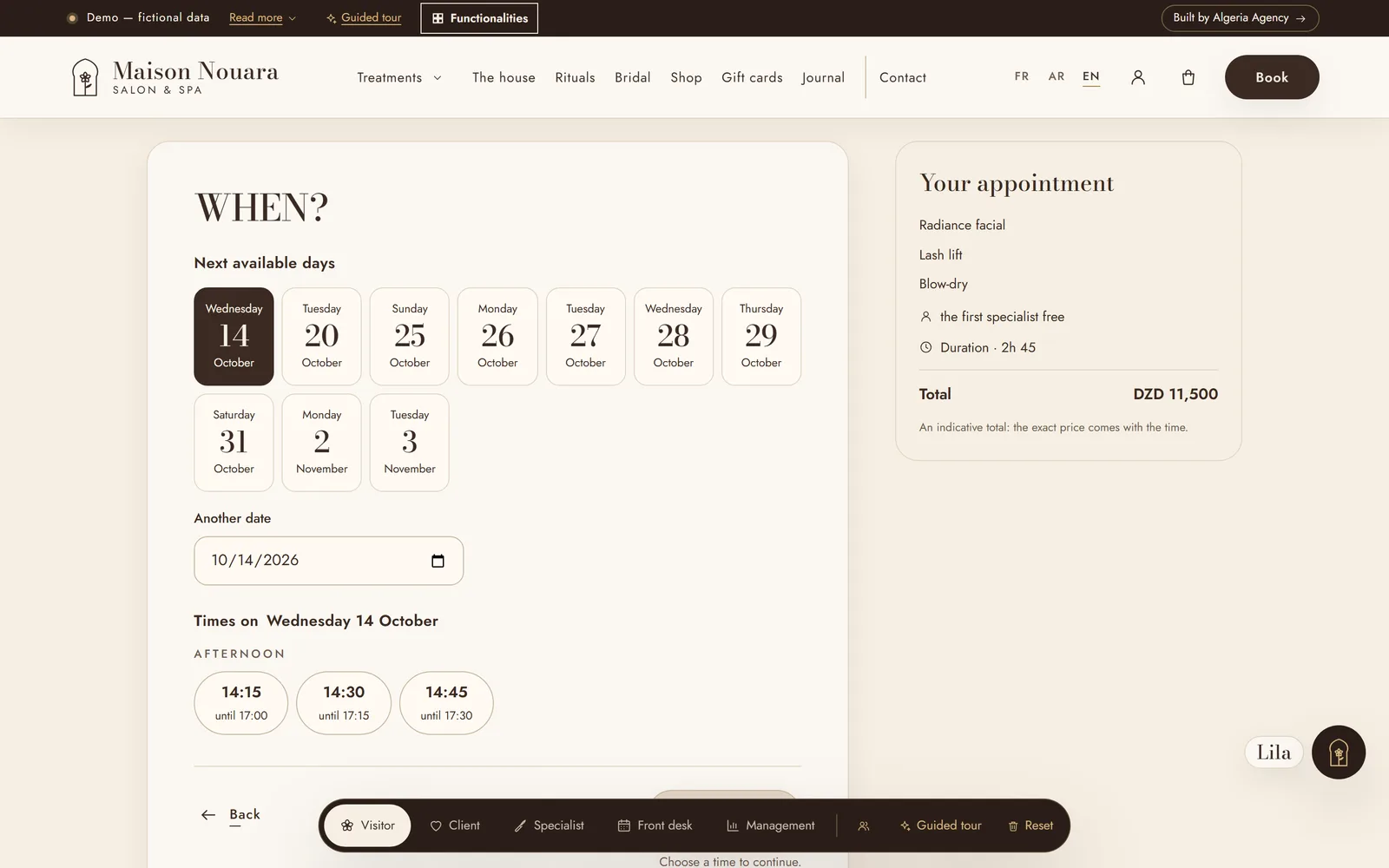
A demonstration
A whole salon & spa: the site, the booking engine, the shop and four working spaces.
A complete salon & spa: website, multi-treatment booking, shop, voice assistant, beauty analysis and five working spaces — client, specialist, reception and management.
See the demonstrationFictional salon, fictional data, simulated payments.
The problem
What we usually find
- You produce good results and never photograph them.
- Your morning slots stay empty while Saturday overflows.
- Your messages arrive in the evening and you reply the next morning.
- You have no way of calling back a client who has not returned.
Somebody who answers within the hour takes the appointment three others will lose by answering tomorrow. It costs nothing, and nobody organises it.
Where we stand
Your stock is time, and an empty slot is never recovered.
Beauty is one of the rare sectors where the result of the work is immediately visible and can be photographed. That is a considerable advantage: you produce every day the visual material other trades have to manufacture, provided you get into the habit of capturing it.
The second characteristic is recurrence. A client returning every six weeks is worth vastly more than a new one who comes once. That shifts the work: keeping a client record, calling at the right moment and filling the empty slots returns more than buying additional traffic.
The third is the appointment. It is made in messaging, often outside opening hours, and response time decides. Whoever replies within the hour takes the appointment three others will lose by replying the next day.
So our work is to organise the capture of results, put a recall of existing clients in place, and treat messaging as the sales channel it genuinely is.
Filling it with your existing clients costs less than finding new ones.
The engine
The acquisition engine, in nine stages
Nine stages, reduced here to one constraint: you sell a thing that expires. A Tuesday four o’clock that goes unsold is gone for good, and it is far easier to fill with somebody who has already been than with a stranger. Which is why recall comes before advertising, in that order.
Stage 00 — Measurement
Appointment book, messaging
Two figures almost nobody keeps: the gaps, and the messages.
Which slots stay empty, week after week, and how many messages arrive without becoming an appointment. Both can be rebuilt from your diary and your messages, with no new tool, and together they say whether the job is to fill, to answer faster, or both.
You do
Nothing. Approve one access request.
We do
We cross the two to find out whether the problem is demand or reply time.
You get
The answer to the only question that changes what you should do next.
Stage 01 — Attention
Social, listing, map
Your market fits inside a few streets.
Clients come from one neighbourhood, sometimes one block, because a treatment is repeated every six weeks and the journey eventually tells. Advertising city-wide spends the budget on people who will not come a second time.
You do
Nothing. Let us photograph one treatment, with the client’s consent.
We do
We tighten the area to that perimeter and keep the whole budget inside it.
You get
Advertising that reaches people capable of becoming regulars.
Stage 02 — Intent
Search, social, listing
People search a treatment, a neighbourhood, a price. And increasingly a product.
The first three are familiar. The fourth is new: clients ask what is being put on them, and the answer has become possible — a growing share of what sells here is made here. Naming the products and the protocol is information your neighbours still avoid giving.
You do
Nothing. Tell us once which treatments you do not offer.
We do
We write a page per treatment, with the product and the duration inside it.
You get
Precise enquiries, from people who already know what they are coming for.
Stage 03 — The landing
Social, listing, site
A page that shows your work and says how much, or nothing.
The photographs have to be yours, taken in your light, on your clients and with their agreement. An indicative price beside them avoids the conversation that opens with "how much" and ends without an appointment — and it filters out what you do not want to do.
You do
Nothing. Send us your treatment list once.
We do
We organise the capture across real treatments rather than in a photo session.
You get
A gallery that grows on its own and looks like what you actually do.
Stage 04 — Conversion
WhatsApp, messaging, telephone
The appointment is made in messaging, usually after closing.
That is where the sale happens, not on a form. What is needed is not a booking tool but an arrangement: who answers, at what hour, and with which replies already written for the ten questions that always come back.
You do
Nothing.
We do
We prepare the frequent replies and wire the assistant to the rest.
You get
Appointments taken at eleven at night while you are asleep.
Stage 05 — The reply
WhatsApp, messaging
Answer fast, give the range, never promise an outcome.
The assistant gives the duration, the range, the availability and what to prepare before coming. It promises nothing about hair or skin it has not seen, because the gap between what was announced and what appears in the mirror is the only real dispute in this trade.
You do
Nothing. See the clients it has booked in.
We do
We stop it before the outcome and pass those cases to you.
You get
Slots taken overnight, and nothing agreed in your name.
Stage 06 — The follow-up
WhatsApp, SMS, appointment book
The client list is your asset, and almost nobody keeps one.
A client comes back every six weeks if she is reminded, and disappears if she is not. A reminder set to her own cycle fills the Tuesday gaps and is worth more than any budget — because she is already convinced and there is nothing to buy.
You do
Nothing.
We do
We build the reminder on each person’s cycle rather than on a group send.
You get
Empty slots filled by people who were coming back anyway.
Stage 07 — Reputation
Listing, social, reviews
The recommendation decides, and it is checked in thirty seconds.
A friend gives a name, and the person immediately looks at what exists under it: recent photographs, an address, prices, a way to write. Advertising does not replace a recommendation; what it can do is exist at the exact moment one is being checked.
You do
Nothing.
We do
We put photographs, prices and messaging on one screen, in that order.
You get
A recommendation that converts instead of evaporating.
Stage 08 — Proof
Social, listing, treatment page
Proof is your work photographed in your own room, and what you apply.
No stock image, no result that is not yours: the likeness is the only argument available here, and a borrowed photograph destroys it on the day of the appointment. Beside it, naming the products used answers a question asked more and more often, and which few salons answer.
You do
Read one page a month. Make one decision.
We do
We publish only what came from your room, and date every post.
You get
An expectation that matches the mirror, which is the only judge this trade has.
What we do
What you get
Capturing results
A simple method for photographing properly in the salon, with no equipment and no dedicated session.
Regular posting
A sustainable rhythm fed by your daily work rather than by bought images.
A client record
Who came, when, for what — the base that makes recalling at the right moment possible.
Reminders and recalls
A message at the point where the treatment is due again, which fills the empty slots.
Neighbourhood advertising
On a narrow radius, because nobody crosses the city for a recurring appointment.
Who arrives
Who is looking for you, and where they pass
Five arrivals, and the most profitable one was in your chair six weeks ago.
Who arrives
Somebody a friend has just given your name to
First
Recent photographs and an address
Then
Message
Why
The check takes thirty seconds, and an empty page cancels the recommendation.
Who arrives
Somebody writing at eleven at night
First
A reply, even a prepared one
Then
A slot offered
Why
She wrote to three salons that evening, and takes whichever answered first.
Who arrives
A client who came six weeks ago
First
A reminder set to her cycle
Then
The empty Tuesday slot
Why
She was coming back anyway: the only question is to whom, and when.
Who arrives
Somebody who only asks "how much"
First
An indicative price on display
Then
Message
Why
Without a range the conversation opens on price and usually stops there.
Who arrives
Somebody who wants to know what you use
First
The page naming the products
Then
Appointment
Why
The question has become common, and almost nobody answers it in writing.
On the ground
How does someone book a salon appointment in Algeria?
Almost every appointment comes through messaging, often late in the evening and at weekends. Response time is therefore the first conversion factor, ahead of price and ahead of photographs. A simple arrangement — who replies, when, with what prepared answers — is worth more than additional advertising budget.
The catchment area is very narrow. Clients come from one neighbourhood, sometimes a few streets, and a campaign run across the city wastes most of its budget. Narrowing the area is almost always the first profitable correction.
Finally, recommendation between people who know each other remains the dominant channel, and advertising does not replace it. What it can do is more useful: be visible at the moment somebody checks a recommendation, with real photographs, indicative prices and a way to write immediately.
Getting started
How we work
Set up the capture
A properly lit corner and a habit of photographing, which costs almost nothing and changes everything.
Build the record
Clients, treatments and dates, even simply, so that recalling becomes possible.
Handle messaging
A decided response window and prepared answers to price and availability questions.
Fill the gaps
Recalls targeted on the empty slots rather than general advertising on hours already full.
Advertise locally
A narrow campaign on the neighbourhood, with real results as the creative.
The result
What changes
Daily visual material
Your results captured regularly, which feeds posts and campaigns with no dedicated production.
Empty slots filled
Recalling existing clients at the right moment is worth more than new traffic, at a fraction of the cost.
Appointments that do not go elsewhere
Messaging treated as a sales channel, with a response time that decides who gets the slot.
Who this is for
Is this the right fit for you?
We work well with
- You have a salon or clinic with a local client base.
- Your treatments repeat: hair, skincare, beauty, wellbeing.
- You can photograph your results with clients’ consent.
We are the wrong choice if
- You are already full every day. The budget would do more elsewhere.
- You cannot reply to messages within the day. The appointment will go elsewhere.
- You want to publish results without consent. That is neither lawful nor wise, and we will refuse.
Questions
Frequently asked questions
Do we need consent to publish a photograph?
Yes, always, and preferably in writing. It is a matter of law and of trust, and a photograph published without consent always rebounds.
Should we show prices?
An indicative list at minimum. It is the first question asked in messaging, and answering it up front frees time and filters enquiries.
How do we fill the morning slots?
By recalling existing clients with an offer on those specific hours. It is far cheaper than buying traffic for hours that are already full.
Do we need a website?
Rarely as a priority. A complete business listing, an active account and messaging handled properly cover most of this trade’s needs.
How quickly should we reply to a message?
As fast as possible, and within the day in any case. In this trade the first reply gets the appointment.
Should we work with content creators?
It can work locally, provided the choice is made on the real neighbourhood audience rather than follower count. We measure appointments obtained, not reach.
Let's talk
How to start
Tell us your emptiest slots, how many messages you receive a week, and whether you keep any record of your clients.
We come back with the capture method, the recall route that fills those slots, and the narrow area to advertise on.
- No photograph published without consent
- No retouching that misleads
- The client record before the advertising