 Algeria Agency
Healthcare
You treat.
We make you
easy to find
in your commune.
We make your practice easy to find when somebody searches for your speciality in their commune: the business listing, informative pages per procedure, reviews answered with care, booking with no medical reason asked, and messages answered in the evening. No campaign on your procedures: the disciplinary risk would be yours.
No commitment. We reply within one working day, and we also tell you what we would refuse to do.
The terms
100%
Of the accounts and the listing in your name
0
Medical reasons collected in a form
100%
Of review replies approved by you
0 DA
Exit fee. You leave with everything.
These four figures are written into the contract. A 6-month minimum term on our digital marketing plans (Starter has none), then cancel any month with 30 days’ notice. No promise about the outcome of any treatment: professional ethics forbid it.
What you can try for yourself
Demonstrations
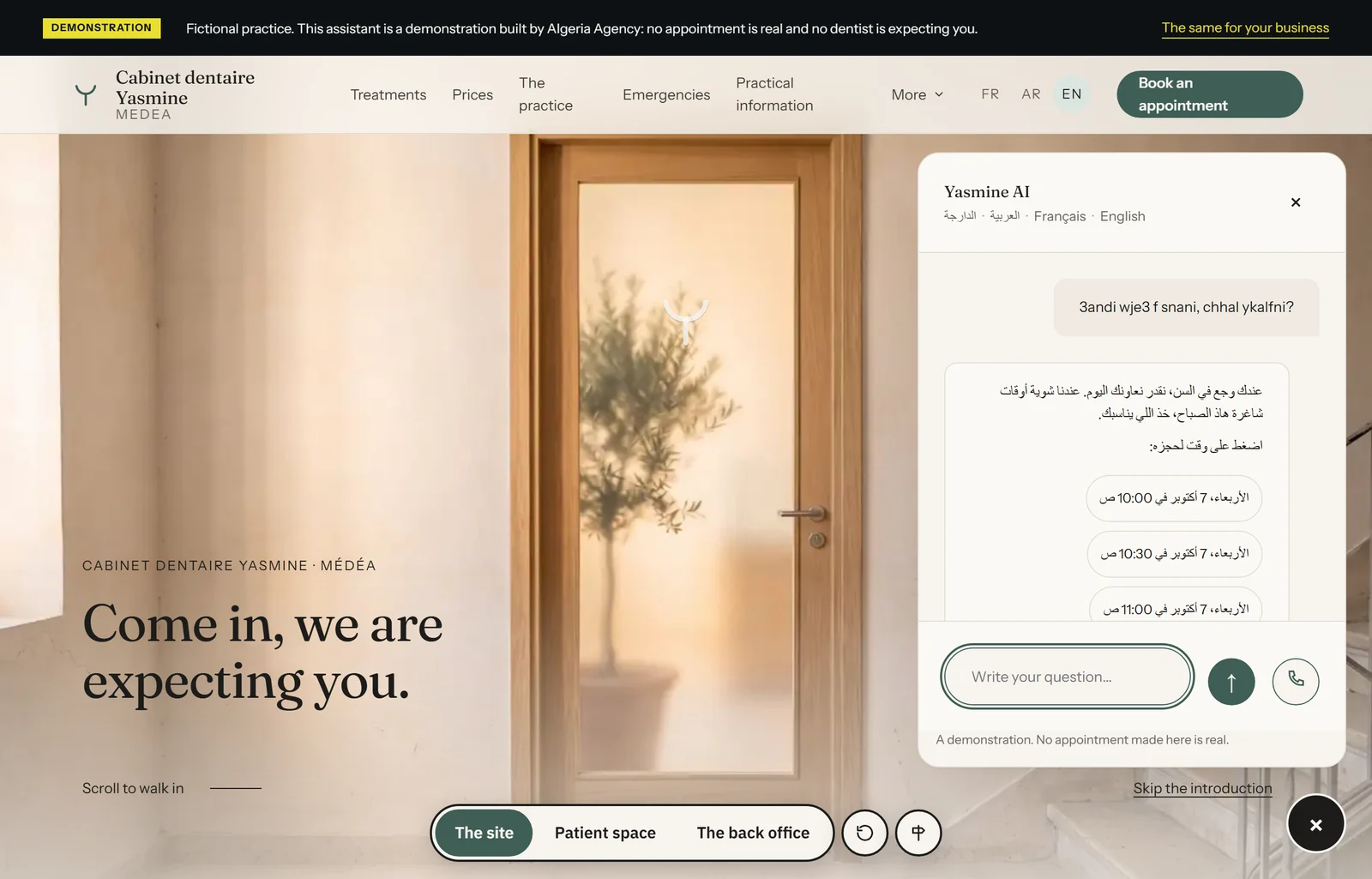
An assistant answering, on a real site.
An imaginary dental practice, six pages. Its assistant answers in derja, Arabic, French and English — even typed in Latin letters.
See the demonstration (Cabinet dentaire Yasmine)The practice is fictional: nothing you book there exists.
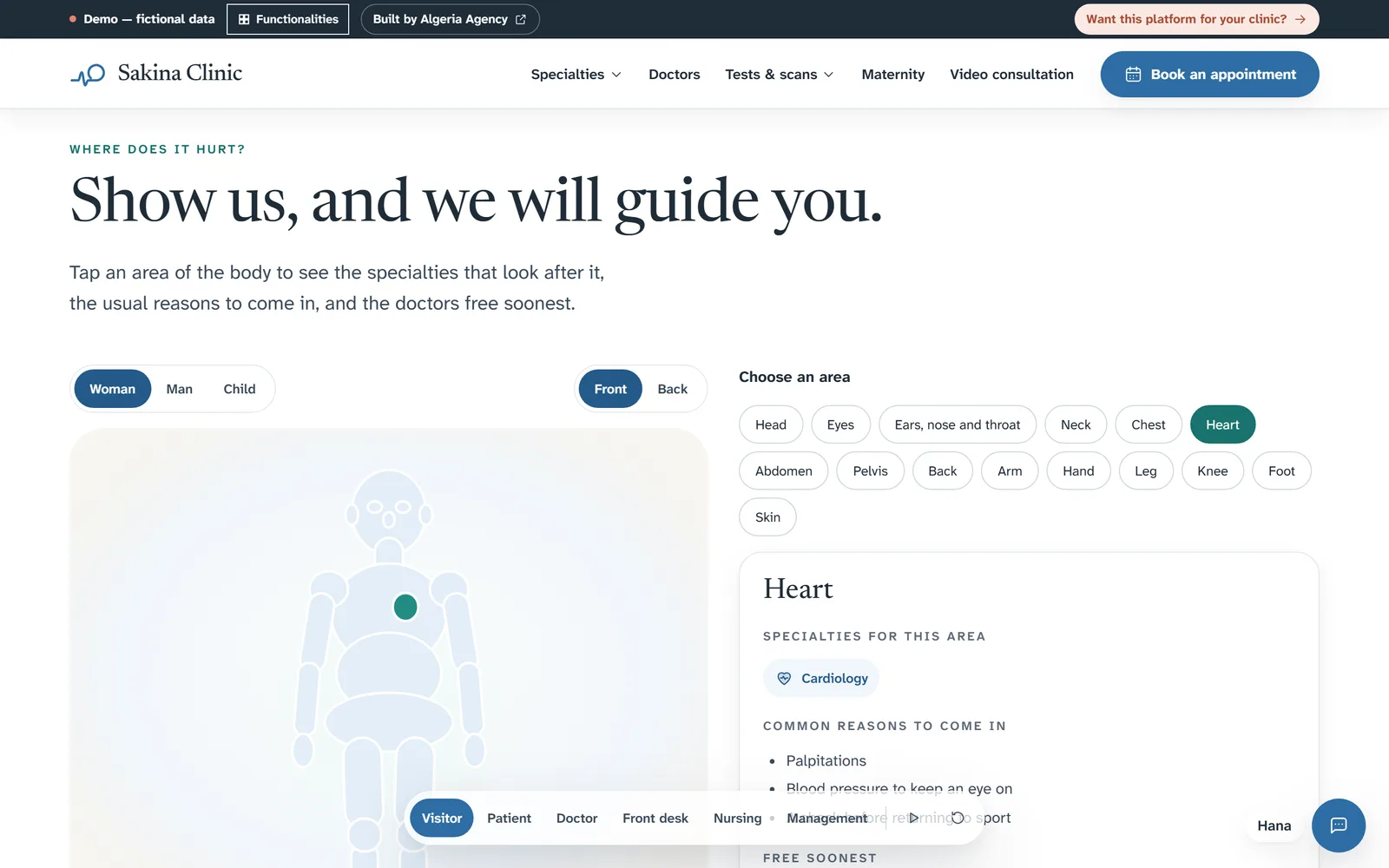
A whole private clinic: the site, appointments, triage, teleconsultation and five working spaces.
A complete private clinic: appointment booking, AI triage, teleconsultation, results, maternity, and the patient, doctor, front desk, nursing and management spaces behind them.
See the demonstration (Sakina Clinic)Fictional clinic, doctors and patients. No medical advice.
The problem
What we usually find
- Patients cannot find you when they search for your speciality in your city.
- A negative review sits at the top of your listing and you do not know whether you may reply.
- Your appointments arrive by messaging, with medical reasons written out in plain text.
- You were offered an advertising campaign your professional body would not accept.
- You answer the messages yourself, in the evening and on Friday.
None of these is solved by a campaign. They are solved by making the practice findable, legible and reachable — which is exactly what your profession allows without reservation.
Where we stand
Knowing what is permitted is not your job.
Healthcare is the sector where we turn down the most work, and it is worth saying at the outset. Advertising for medical procedures and professions is regulated, professional ethics limit what may be promised, and a practitioner who accepts an over-aggressive campaign carries a disciplinary risk the agency does not.
What remains possible is substantial and quite sufficient. Being findable when somebody searches for your speciality near them. Having a complete listing with accurate hours. Explaining a procedure, what follows it and its limits, informatively. And answering reviews, which here account for a large part of reputation.
The second constraint is data. A practice handles information of a particular sensitivity: appointments, reasons for consultation, contact details. A badly designed form or badly configured messaging creates a far more serious risk than in any other sector.
So our work is to build local visibility and information, handle reputation seriously, and design tools with an eye on what you are not entitled to collect casually.
Your work does not change. Ours starts by checking what yours allows.
The engine
The acquisition engine, in nine stages
The nine stages are the same in every trade we serve. What changes in healthcare is what each one is allowed to do: stage 01 pushes no advertisement for a procedure, stage 04 collects no reason for consultation, and stage 07 publishes no patient testimonial.
Stage 00 — Measurement
Listing, telephone, messaging
We count the calls before changing anything.
How many calls, how many messages, how many appointments kept — and where they come from. Without that dated starting point every improvement is an impression, including ours.
You do
Nothing. Approve one access request.
We do
We wire measurement to the listing, the site and the number, never touching patient records.
You get
A dated starting figure you can hold against ours in three months.
Stage 01 — Attention
Business listing, maps
Seen by somebody searching, not by somebody passing.
In healthcare this stage pushes no advertisement. It works the business listing: the speciality, real hours, on-call cover, a verified address, photographs of the place and practical information — what somebody who has already decided to consult actually looks at.
You do
Nothing. Approve the creative if you want to — none of it is about a procedure.
We do
We complete the listing, verify the address and publish only what is permitted.
You get
A listing that answers the questions you get asked on the telephone.
Stage 02 — Intent
Search, pages per procedure
Demand here is a speciality plus a commune.
Nobody searches for “healthcare”. They search for a dentist in Bab Ezzouar, a paediatrician open on Saturday, a laboratory under an arrangement. Those searches are taken one at a time, with a page that answers rather than a page that boasts.
You do
Nothing. Tell us once which procedures you do not perform.
We do
We write one informative page per procedure and commune, with no comparison and no promise of a result.
You get
Pages that answer a precise question, and that you read before they are published.
Stage 03 — The landing
Site, landing page
Where, when and how to reach you — before anything else.
A patient arriving on your site wants three things in ten seconds. Everything placed in front of those costs them time and costs you the call. It is also the page we test standing up, on a phone, one-handed.
You do
Nothing. Send us your hours once, on-call included.
We do
We put the answers at the top of the page and the number within thumb reach.
You get
A page usable in the street, and a call you no longer lose in a menu.
Stage 04 — Conversion
Appointment booking, calls
Booking an appointment without writing a medical reason.
This is the stage where the risk is created rather than managed. A free-text field invites a patient to write their condition into a web form, and that data becomes yours to protect. We design so it never arrives.
You do
Nothing.
We do
We build a form that asks for a name, a telephone number and a slot — and nothing else.
You get
Usable appointments, and no reason for consultation stored on a web server.
Stage 05 — The reply
WhatsApp, messaging, site
Replying in under a minute, never giving a medical opinion.
Most first contacts arrive by messaging. The assistant answers practical questions — hours, address, documents to bring, published fees — and hands over the moment a question becomes medical. The list of what it may say is yours.
You do
Nothing. Approve once what the assistant may say.
We do
We write it, test it in Arabic, Darja and French, and hold it back on everything else.
You get
Messages answered in the evening and on Friday, and no diagnosis given by a machine.
Stage 06 — The follow-up
SMS, WhatsApp
Reminding somebody of an appointment, not chasing a sale.
Follow-up in healthcare is administrative: confirming a slot, recalling a document, flagging a postponement. It is not commercial, and a check-up reminder only goes out if you asked for one.
You do
Nothing.
We do
We schedule them with the minimum of information: a time, a place, a name.
You get
Fewer slots lost, and no message that reveals why somebody is coming.
Stage 07 — Reputation
Reviews, listing
Reviews decide more here than elsewhere, and replying takes care.
A reply never confirms somebody is a patient and never discusses a case. That is the constraint, and it does not prevent replying: a general, measured reply beats criticism left standing alone and visible.
You do
Nothing. No reply to a review goes out without your approval.
We do
We draft them, watch for new reviews and organise the ask to satisfied patients.
You get
Volume built honestly, and never a testimonial published on your behalf.
Stage 08 — Proof
Report, dashboard
A report that counts appointments, not impressions.
The figure that matters is how many new patients came from the work in progress, and what it cost. We put it against the figure from stage 00, and we say what did not work before you ask.
You do
Read one page a month. Make one decision.
We do
We set that number against the starting measurement and hand you the comparison.
You get
Enough to decide to continue or stop, on a figure rather than an impression.
What we do
What you get
A carefully kept listing
Speciality, accurate hours, verified address, contact routes and practical information.
Informative pages
What a procedure is, how it goes, what follows it — informative rather than promotional.
Review management
Monitoring, careful replies that disclose nothing, and honest collection from satisfied patients.
Simple appointment booking
With no free-text field inviting a medical reason, because that field is what creates the risk.
Access security
Named accounts and backups on the practice’s tools, treated as a subject in its own right.
Who arrives
Who arrives at a practice, and how
Five ways of arriving, and they are not handled the same way. This table says where to start in each case, and why the order matters more than the budget.
Who arrives
Somebody searching for your speciality in their commune
First
A complete business listing
Then
A page per procedure and commune
Why
This is the largest demand and the cheapest to take.
Who arrives
Somebody who has your name and is checking
First
Reviews, and replies to them
Then
Accurate hours and an about page
Why
They have already decided to come; they are looking for a reason not to.
Who arrives
A patient referred by a colleague
First
A reachable number and visible slots
Then
Confirmation by SMS
Why
The referral is won. What gets lost is the first contact.
Who arrives
Somebody writing on WhatsApp at ten at night
First
An answer to the practical questions, straight away
Then
Hand-over to a person in the morning
Why
With no reply that evening, they write to the next practice.
Who arrives
A former patient coming back
First
A check-up reminder, if you asked for one
Then
Booking in two taps
Why
The cheapest of the five, and the one almost nobody organises.
On the ground
What decides the choice of a doctor in Algeria?
Searching is local and precise: a speciality, a commune, sometimes an arrangement with a scheme. That is where most new demand is decided, and a complete listing with accurate hours produces more there than an elaborate website.
Reviews weigh heavily, more than in many sectors, because the choice matters. Replying takes care — never confirming somebody is a patient, never discussing a case — but not replying at all leaves the criticism standing alone and visible.
Finally, a large share of appointment-making happens through messaging and the telephone. That is practical and it creates a risk: medical information circulating through channels not designed for it. A simple arrangement — what is asked for and what is not — reduces that risk without complicating the work.
Getting started
How we work
Check what is permitted
We look at what your profession allows before proposing anything, and we tell you plainly.
Handle local visibility
Listing and pages by speciality and city, capturing real search without promotion.
Take on the reviews
Replies to waiting criticism, then collection from satisfied patients.
Design the tools
Appointment booking and forms that limit collected data to the strict minimum.
Write the information
Pages that explain, without promising a result and without comparing to colleagues.
The result
What changes
Findable locally
Listing and pages built on the real search — a speciality, a city — which is most of the demand.
A reputation kept
Reviews watched, measured replies, and volume built honestly, in a sector where they decide a great deal.
Tools that create no risk
Forms and appointment booking designed not to collect what should not be collected.
Messages answered
Practical questions get a reply in under a minute, and medical questions reach a person.
Who this is for
Is this the right fit for you?
We work well with
- You practise a healthcare profession and want to be findable locally.
- You accept informative rather than promotional communication.
- You want to treat the patient data question seriously.
- You want messages answered outside opening hours.
We are the wrong choice if
- You want an advertising campaign for procedures. We will refuse, and not only out of caution.
- You want before-and-after results or patient testimonials. That is regulated and we will not write it.
- You want to collect reasons for consultation in a web form. We will propose something else.
- You want an assistant that answers medical questions. Ours hands over, every time.
Questions
Frequently asked questions
Can a practice advertise?
It is regulated and depends on your profession. We check what is permitted before proposing, and we refuse anything that would expose you — the risk is yours.
Can we reply to a negative review?
Yes, carefully: without confirming the person is a patient and without discussing a case. A general, measured reply is possible and beats silence.
Can we publish testimonials?
No, and we will not propose it. It is regulated in most healthcare professions, and it is also what rebounds fastest.
What can a website do, then?
A great deal: hours, address, contact routes, explanation of procedures, practical information. That is what patients look for, and few practices do it properly.
Is online appointment booking a good idea?
Often yes, provided it does not collect a medical reason. We design the form to ask only what is strictly necessary.
What about patient data?
Collect the minimum, protect it seriously, and do not let it circulate in ordinary channels. It is a technical subject as much as an ethical one, and we treat it as such.
Can the assistant give medical advice?
No. It answers practical questions — hours, address, documents to bring, published fees — and hands over to a person the moment a question becomes medical. You set that list.
How long before anything shows?
The listing and the reviews move in weeks; search takes months. We say so before starting rather than announcing a timetable that does not exist.
Do the accounts stay in my name?
Yes, always. We work through delegated access, and you keep the listing, the site and the history the day you leave.
What if my profession allows almost nothing?
Then the listing, accurate hours, informative pages, reviews and answered messages remain — and those produce most of the new demand. We will tell you that before invoicing, not after.
Let's talk
How to start
Tell us your speciality, your commune, and what has been proposed to you so far.
We come back with what is possible without exposing you, starting with local visibility and reviews, and with what we would refuse to do.
- We refuse what exposes you
- No patient testimonials
- The minimum data collected