 Algeria Agency
Artificial intelligence
AI automation: every enquiry sorted and routed without waiting
Every incoming enquiry read, sorted and routed to the right person, your tools connected — automated where a mistake can be undone, and only there.
What you can try for yourself
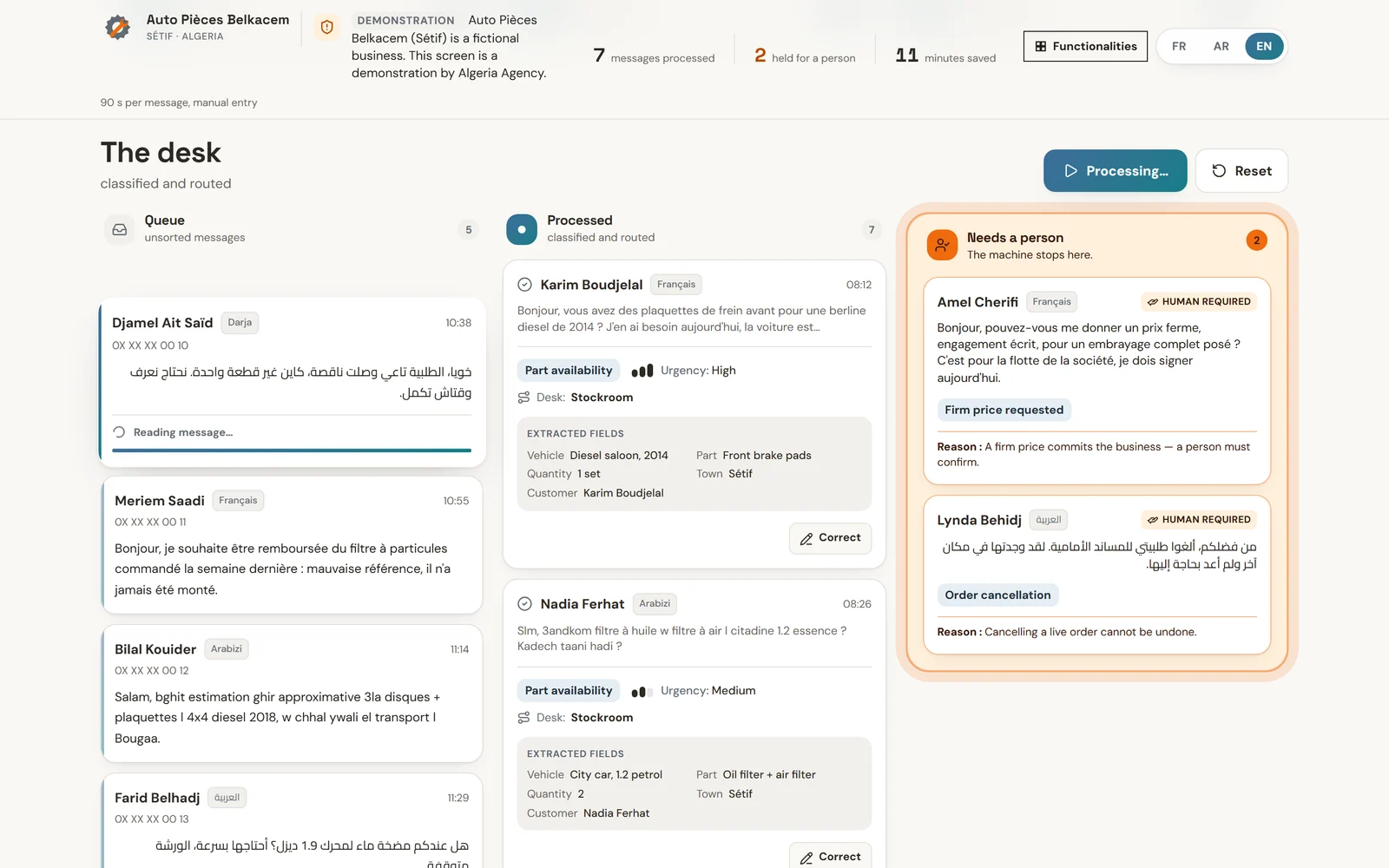
A demonstration
An inbox that sorts itself, apart from three messages.
Imaginary auto-parts shop in Sétif, one screen: you take the desk, not the counter. Fourteen messages in Darja, Arabic, French and Arabizi sort themselves — except three.
See the demonstrationFictional business: nothing you send here reaches anybody.
A customer enquiry that waits until Sunday because nobody sorted it on Thursday is often a lost enquiry. Automation fixes that delay — but it does not make a process better, it makes it faster. If the process is sound you gain hours; if it is broken you produce mistakes faster than before and find them later. So the first part of this work is describing what you actually do, rather than what the written procedure says you do.
The rule we apply fits in a sentence: automate what can be undone, require approval for what cannot. Sorting an incoming enquiry, filling a record, preparing a draft, reconciling two lists — a mistake there is visible and correctable. Sending a quote, confirming a firm appointment, charging, deleting, writing to a customer in the company name — a mistake there reaches somebody and does not come back.
AI only touches part of the job in any case. Most of a useful automation is ordinary connecting work: connect two tools, move a field, write a rule. The model earns its place where free text written by a human has to be read — an enquiry in a private message, an email, a scanned document — and nowhere else. Paying a model to compare two numbers is spending hard currency on a free operation.
We also estimate the time saved before starting, and we tell you when it is small. A task that takes ten minutes a week does not deserve three days of integration: the payback lands years out, and by then the tool will have changed its interface.
What we usually find
- Your team retypes data by hand that already exists in a message or a document you received.
- Incoming enquiries are not triaged by anyone, so the urgent ones wait exactly as long as the rest.
- Your customer records are incomplete, and nobody knows which ones or since when.
- You have tools that do not talk to each other, bridged by a file somebody exports on Monday.
What changes
An explicit line between automatic and approved
Every step is classified as undoable or not, and that classification decides what runs alone. Written with you, not inferred by us.
Hours returned, measured before and after
How long the task takes today, measured, then measured again a month later. An automation that cannot say what it saved has saved nothing.
A chain that stops properly
When a step fails, the rest does not run and a person is alerted with the affected record. The worst outcome is not a breakdown, it is half a job.
What you get
Qualifying incoming enquiries
Each enquiry read, classified by subject and urgency, and routed to the right person. The classification is visible and correctable, and a correction improves the next sort.
Extraction from documents
Purchase orders, invoices, records arriving as photos: fields pulled out automatically and shown for checking. The check stays, because a misread figure travels far.
Record enrichment
Information already sitting in your correspondence copied into the record, with a source for each field so a doubtful value can be verified.
Bridges between the tools you have
Your CRM, shop, accounting and inbox connected without replacing any of them. Replacement is a different project, longer and dearer.
A log of everything decided
Every automatic action traced with its input, output and timestamp. Without it, a disagreement with a customer becomes impossible to investigate.
A switch per automation
Each one stops independently of the others, with no technical intervention. An automation you cannot switch off on a bad day is a risk, not a gain.
How we work
Watching the real process
We follow the task as it is actually done, with the person doing it. The gap from the written procedure is universal, and that gap is where the edge cases live.
Sorting undoable from irreversible
Every step placed in one of two columns, with you. That page decides the scope and can be re-read in five minutes six months later.
Building in small delivered steps
One automation at a time, live before the next begins. A six-week build delivered in one go is a build where nobody knows which part works.
Measuring, and removing what does not earn its place
A month later we measure again. Anything that saves no time is removed rather than kept out of politeness.
Is this the right fit for you?
This is for you if
- A repetitive task takes several hours a week and follows rules that can be described.
- Your current tools have a programming interface or can export cleanly.
- Somebody is available to approve what needs approving, every day.
This is not for you if
- The process changes every month because it was never stabilised.
- You want to automate sending commercial commitments without review.
- The task takes ten minutes a week — the arithmetic will never work.
What we commit to
Nothing irreversible without a human hand
Sending to a customer, committing a price, deleting, paying: proposed, never executed alone. That is the limit we do not move, even on request.
The gain is measured, not asserted
We measure before, measure again after, and give you both numbers even when the second one is disappointing. If the numbers do not add up at scoping, we do not bill the project.
You keep control of your tools
We build on your accounts, not ours. If we disappear everything keeps running and another supplier can pick it up.
What changes for an Algerian business
The starting point is almost never a line-of-business application; it is a shared spreadsheet and an inbox. That makes automation more accessible than people expect — a well-kept spreadsheet automates fine — and far more fragile, because the rule lives in the head of whoever fills it in. We start by writing that rule down.
The order of operations matters more here than elsewhere. Automating a process whose next step is a physical trip, a cash payment or a verbal agreement only wins the digital part, which is often the shortest. We say so upfront, because it decides whether the project is worth doing at all.
Usage billing is in foreign currency. An automation that calls a model on every row of a ten-thousand-row file costs real money for work a few rules do free, and that difference is paid monthly. The choice between them is made at design time, not when the invoice arrives.
Frequently asked questions
Do we have to change our tools?
Not in most cases. We connect what you have; if a tool genuinely cannot take it, we say so rather than working around it with something fragile.
What happens if an automation gets it wrong?
It stops and alerts a person with the affected record. Later steps do not run: a half-finished job costs more than an unstarted one.
Does this cut jobs?
It is not what we sell and not what we observe. What disappears is retyping; the recovered time goes to the cases nobody had time to look at.
How long for a first automation?
Often a few weeks for the first and less for the rest, because most of the initial work is describing the process.
Where do the automations run?
On your accounts and your tools. We tell you what leaves the country and for which processing, and anything that must not leave is handled differently.
How do we know it is worth the cost?
By measuring the task first. If the time spent does not justify the integration, we say so at scoping and do not bill for the project.
How to start
Write to us and describe the repetitive task that annoys your team most — and, if you can, how long it really takes over one week.
We tell you what can be automated, what has to stay approved, and whether the arithmetic works.
Let’s find where your next customers will come from
Tell us where things stand — your ads, your website, your Google listing — and what you are after. We reply within one working day, and the conversation commits you to nothing.
- Nothing irreversible without a human hand
- The gain is measured, not asserted
- You keep control of your tools