 Algeria Agency
Artificial intelligence
Custom AI integrations: AI inside your tools, not another demo
AI connected to your site, CRM or till, working from your real data — without replacing what works or locking you to one provider.
What you can try for yourself
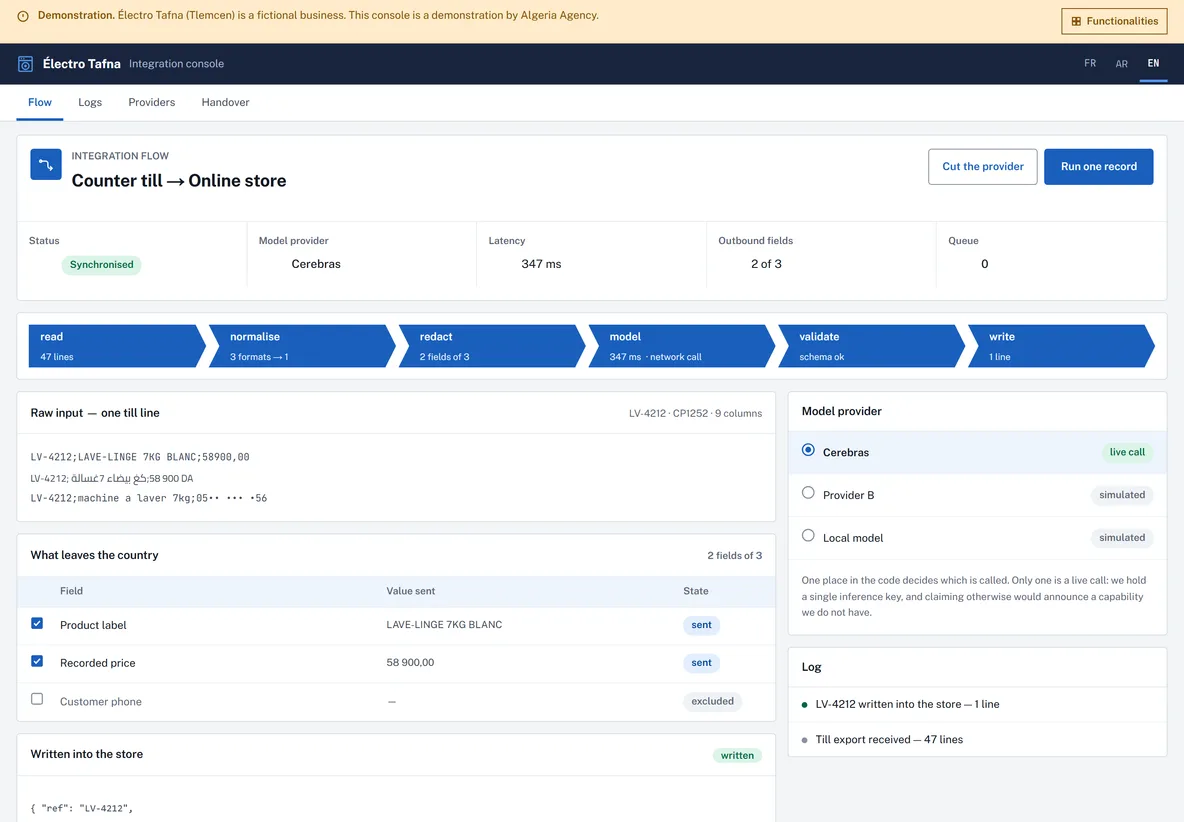
A demonstration
A till and a shop that never quite agree.
A fictional appliance shop in Tlemcen whose till and online store never quite agree. You take the operator's seat: run the flow, switch the model provider, drop a field from what leaves the country, and cut the connection to see what happens.
See the demonstrationA fictional business: nothing you run here reaches a real shop.
An AI answering your customers has to know your stock, your prices and their orders — otherwise it makes things up. And most AI projects that fail do not fail on the model, but on that connection: the data sits in a till that exposes nothing, the CRM has three "phone" fields filled differently depending on the year, and the online shop does not know the shop floor’s stock. The model works perfectly in the demo because the demo crosses none of those obstacles.
So our work starts with an inventory of what you have and what can genuinely come out of it. It is an unspectacular stage and it is the one that decides the project: an existing system that does not expose its data forces either an intermediate interface, or a periodic export, or — sometimes — dropping the idea.
We then build the integration as a separate part, not as a graft. The model is called behind an interface that belongs to you, which means swapping it costs a day rather than a project. That precaution looks theoretical right up until a provider multiplies its prices, withdraws a model from the catalogue, or becomes unreachable from Algeria.
Finally, we refuse to present an integration as a product. What we deliver has limits and we write them down: what it handles, what it ignores, what breaks it, and what will need redoing the day the tool on the other side changes. An integration without that page becomes unverifiable the moment whoever built it leaves.
What we usually find
- Your useful data is locked inside a till or an application that exposes nothing outward.
- You were shown a convincing demo that never reached your real system.
- Every new tool asks you to retype the same customers with the same mistakes.
- You worry about depending on an AI provider whose price and availability are outside your control.
What changes
An honest inventory of what can be connected
System by system: what comes out, how, how often, and what will not come out at all. Delivered before any development commitment.
An abstraction layer you own
The model provider sits behind your own interface. Swapping it is configuration rather than a rewrite — and that has already been needed more than once.
Documentation that outlives its author
Connection points, formats, failure cases and the recovery procedure. Written for the team that was not there during the project.
What you get
Connecting to what exists
Site, CRM, till, ERP, shop: we connect to what you have rather than proposing to replace it. Replacement is a separate decision.
An intermediate interface where needed
Software that exposes nothing gets a dedicated read layer rather than direct database access, which would break on the first update.
An interchangeable model provider
One place in the code decides which model is called. It is the most useful protection in the project and costs almost nothing at design time.
Handling provider outages
What happens when the remote interface does not answer: a queue, an announced degradation, or a clean stop. Decided in advance rather than endured.
Control over what leaves the country
The fields sent to a foreign service listed one by one, with the option to exclude any of them. A customer phone number does not need to travel to classify a message.
A test environment with your real data
A copy where a change can be checked before it touches production. Without it, every change is a gamble.
How we work
Technical inventory
We list your systems, what they expose and what state the data is in. This technical inventory is a paid study, separate from our first conversation, and its result stays yours even if you go no further.
A prototype on the hardest path
We connect the riskiest part first, not the easiest. A prototype that only proves the simple route proves nothing.
Building with the abstraction layer
The integration written against your interface, the provider behind it. Switching to another model is tested during the project rather than promised.
A documented handover
Code, credentials and documentation handed to you or your technical team, with a walkthrough session and a period where we answer questions.
Is this the right fit for you?
This is for you if
- You have a system in place that works and you do not want to replace it.
- Your data exists, however badly organised, and somebody internally knows where.
- You want to be able to change AI provider without redoing the project.
This is not for you if
- You have no system yet and are looking to start with AI.
- Your data needs cleaning first — that is a separate project, and it comes before this one.
- You want a turnkey solution without giving access to your own systems.
What we commit to
The code and credentials are yours
Placed in your accounts during the project, not at the end. You never have to ask our permission to work with somebody else.
We write down what will break
External dependencies, versions, and what happens when the tool opposite changes. An integration is a contract with software that never signed it.
The inventory is allowed to conclude "no"
If your systems cannot carry it, we say so when the inventory ends and the project stops there. You will have paid for a study, not for a failure.
What changes for an Algerian business
A share of the management and point-of-sale software installed locally consists of older desktop applications with no programming interface, sometimes with no documentation, and sometimes with no publisher still reachable. That is the first real obstacle in these projects, and it is why the inventory precedes the commitment rather than following it.
Depending on a foreign provider is not only a price question. A service can become unavailable, change its access terms, or stop serving a region, and an integration written directly against it then becomes an emergency rebuild. The abstraction layer answers that risk; it is not architectural elegance.
Paying for foreign services is a subject in itself. The payment method, the ceiling and who holds the card are part of scoping, because an integration that stops for want of a renewal produces exactly the same outage as a technical fault.
Frequently asked questions
What if our software has no programming interface?
We look at what it can export and how often. There is usually a way; sometimes there is not, and we say so at the inventory stage.
Can we change AI provider later?
Yes, that is the point of the abstraction layer, and we test the switch during the project so it is verified rather than merely asserted.
Does our data go abroad?
Only the necessary fields, listed one by one and approved by you. Anything you exclude is handled differently or not at all.
Who maintains the integration after delivery?
You, your team or us, as you decide. The documentation is written so that the third option is not compulsory.
How long does a typical project take?
The inventory takes a few days. The integration itself depends entirely on what the inventory finds, and we do not price it beforehand. If a deliverable runs late, you are told before the deadline, with a new date.
Do we redo everything if we change CRM?
Not the model side. The connection side, yes — which is precisely why the two are kept separate in what we deliver.
How to start
Write to us and tell us which software you use (till, CRM, online shop) and what you would like AI to do for your customers.
We return an inventory of what can be connected, what cannot, and what that implies.
Let’s find where your next customers will come from
Tell us where things stand — your ads, your website, your Google listing — and what you are after. We reply within one working day, and the conversation commits you to nothing.
- The code and credentials are yours
- We write down what will break
- The inventory is allowed to conclude "no"