 Algeria Agency
Manufacturing
You manufacture.
We bring you
the buyers
who can sign.
We bring you the buyers who can sign — the engineer, the purchaser and management — with what each of them checks: precise capacity, dated certifications, and a spec sheet that argues your case in a meeting you are not in. Success is measured in contract value, never in contact count.
No commitment. We reply within one working day, and we also tell you what we would refuse to do.
The terms
100%
Of the accounts and documents in your name
0
Capacity advertised that you cannot hold
100%
Of certifications published with their validity date
0 DA
Exit fee. You leave with everything.
These four figures are written into the contract. A 6-month minimum term on our digital marketing plans (Starter has none), then cancel any month with 30 days’ notice. We publish no capacity you cannot hold: a supply failure at an industrial customer is paid for once and retold for years.
What you can try for yourself
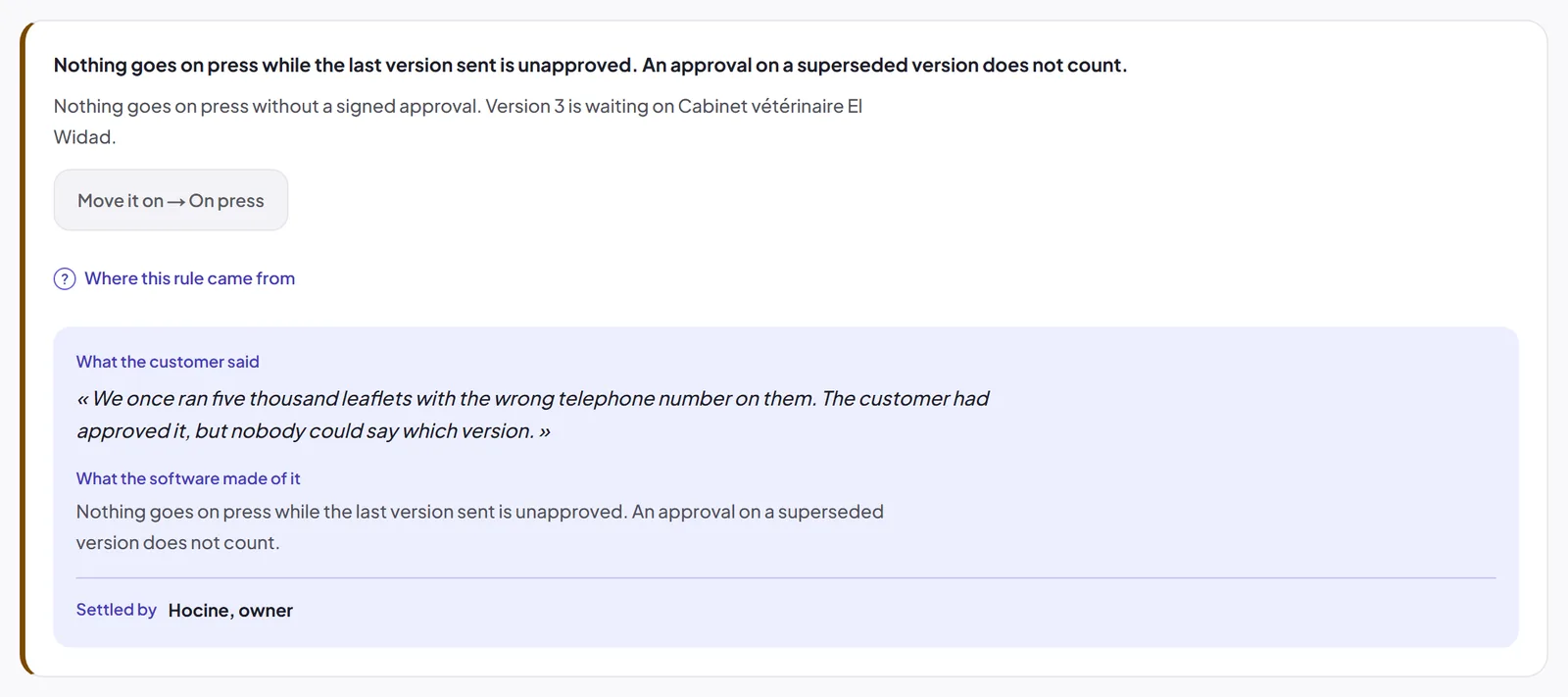
A demonstration
A whole workshop, and the rule that stops the press.
The internal software of an imaginary print shop in Batna: sixteen screens, three seats, and one job crossing the whole house from the message in to the invoice settled. You sit at the front desk and run it.
See the demonstrationThe customers, the jobs and the invoices are invented, and the five refusals you will run into are precisely what the demonstration exists to show.
The problem
What we usually find
- Your specifications are nowhere and your prospects cannot evaluate you.
- You receive enquiries from consumers when you sell to industry.
- Your foreign competitors document everything and you document nothing.
- You judge campaigns by contact count when a single contract is what matters.
Your potential customers number in the dozens. A campaign reaching thousands of people has therefore not worked better: it has simply spent more.
Where we stand
A certification does not improve your standing. It opens the door or shuts it.
Manufacturing does not have a volume problem, it has a precision problem. Your potential customers often number in the dozens, and a campaign reaching thousands of people has not worked better — it has simply spent.
The decision is collective. The engineer wants specifications, the buyer wants lead times and terms, management wants to know whether you will still exist in three years. A website addressing only one of the three leaves the other two unanswered, and the decision stops there.
The cycle is long and a contract is worth a great deal. That changes the whole calculation: a campaign producing two serious enquiries a quarter can be excellent, and one producing a hundred unusable contacts can be a complete failure.
So our work is to make technical capability verifiable, answer the three readers separately, and measure on contract value rather than contact count.
Published with its validity date, it removes a question and a chase.
The engine
The acquisition engine, in nine stages
Nine stages, applied to a market where the count means nothing. The decision is taken by three — an engineer who wants specifications, a buyer who wants lead times and terms, the management team that wants to know whether you will exist in three years — and a site answering only one of them leaves the other two with nothing, which is where the decision stops.
Stage 00 — Measurement
Form, email, trade fair
Measure contract value, never contact count.
Two serious enquiries in a quarter can be an excellent result; a hundred unusable contacts can be a complete failure. While the dashboard counts contacts, it rewards exactly what should stop being produced.
You do
Nothing. Approve one access request.
We do
We build the measurement on those two before advertising anything at all.
You get
A judgement that stops confusing a good quarter with a noisy one.
Stage 01 — Attention
Search, directories, trade fair
Target roles, not a sector.
You are not looking for “industry”: you are looking for a methods manager, a buyer, a technical director, inside a finite number of companies that can be named. Broad delivery here is not a useful approximation, it is spending with no target.
You do
Nothing. Send us the names of the companies you are targeting, once.
We do
We target those roles and cut anything that looks like volume.
You get
A whole budget spent on people able to sign.
Stage 02 — Intent
Site, spec sheet
The real objection is almost never the price.
The comparison is often with an imported supplier, and it turns on supply reliability as much as on rate. Documenting real lead times and a capacity you can hold answers the actual objection; cutting a price answers the one that was said out loud.
You do
Nothing. Tell us once what you do not make.
We do
We publish your real lead times as they are, with the monthly capacity you genuinely hold.
You get
Conversations that start after the objection instead of stalling on it.
Stage 03 — The landing
Site, pages per capability
Three readers on one page, each looking for something else.
The engineer wants specifications, the buyer wants lead times and terms, the management wants to know you will be there in three years. A page answering one of them leaves two people with no argument to carry into a meeting — which is exactly where the file stops.
You do
Nothing. Approve the specifications once: they commit you technically.
We do
We write all three readings, separated and findable, on one page.
You get
A file that survives the meeting you are not in.
Stage 04 — Conversion
Spec sheet, email
The conversion is a downloaded document.
Nobody signs from a form. What the page must produce is a spec sheet that leaves in an internal email, circulates, and is reread without you. It is the most profitable document in this sector and the one almost nobody produces properly.
You do
Nothing.
We do
We build a document that stands alone, dated and versioned.
You get
A document representing you in a room you never entered.
Stage 05 — The reply
Email, site, telephone
Answer like a professional: figures, or nothing.
The assistant gives capacity, formats, standard lead times and the certifications you hold, with their dates. It produces no quotation and fixes no delivery date: each is calculated against your load at the time.
You do
Nothing. Reply to the buyers it has qualified.
We do
We bound it to the published figures and close off anything resembling a commitment.
You get
A buyer who gets an exact figure the same day, which rarely happens to them.
Stage 06 — The follow-up
Email, telephone, trade fair
A long cycle is worked with contributions, not chases.
Across several months, commercial chasing wears the relationship out. What holds it is a send that brings something: a new capability, a renewed certificate, a lead time that improved. Three useful sends beat twelve polite reminders.
You do
Nothing.
We do
We write only on those occasions, and date every send.
You get
A presence that never turns into insistence.
Stage 07 — Reputation
Site, documentation, trade fair
Here reputation is a question of continuity.
An industrial buyer is not looking for a good deal: they are looking for somebody who will still deliver in two years. Longevity, investment, the stability of the plant and the ability to hold a volume say that better than any promise — and they can be checked.
You do
Nothing. Send us your certificates once.
We do
We write it factually and leave blank whatever you cannot show.
You get
An answer to the question management always asks last.
Stage 08 — Proof
Site, spec sheet
Proof is certificates carrying their validity dates.
A certification conditions eligibility: without one, a public tender or an export route is closed before any discussion. And few manufacturers publish theirs: showing them, with their dates, separates you before anybody has looked at a price.
You do
Read one page a month. Make one decision.
We do
We publish them with their dates and warn you before they lapse.
You get
An open door, checkable by a buyer without writing to you.
What we do
What you get
Capability sheets
Machines, tolerances, materials, minimum and maximum volumes. It is what a buyer looks for first.
Certifications and standards
What you hold, dated, valid until when. Verifiable, therefore credible.
Downloadable documentation
Technical sheets and catalogues, which circulate inside the customer’s organisation without you.
Professional targeting
By role and sector rather than by volume, because your market fits into few people.
Value tracking
Enquiries followed through to contract and value, the only honest measure in this trade.
Who arrives
Who is looking for you, and where they pass
Five arrivals, and three of them concern one company: three people who will decide together.
Who arrives
An engineer looking for a specification
First
The spec sheet
Then
Download
Why
They need a document they can circulate, not a page somebody has to narrate.
Who arrives
A buyer comparing you with an imported supplier
First
Your real lead times and capacity
Then
A request for terms
Why
They are comparing supply reliability, and the price only comes afterwards.
Who arrives
Management, signing off last
First
Whatever proves continuity
Then
Meeting
Why
Their question is whether you will still deliver in two years, and it is a fair one.
Who arrives
A company preparing a tender
First
Your certificates and their dates
Then
Submission
Why
Without certification you are not expensive: you are ineligible, before any discussion.
Who arrives
A buyer met at a trade fair
First
What you send the next day
Then
Spec sheet
Why
They go home with a pile of documents and reread only the ones that stand alone.
On the ground
What decides an industrial buyer in Algeria?
The comparison is often against an imported supplier, and it turns on supply reliability as much as on price. Documenting real lead times and a capacity to hold a volume answers the actual objection, which is almost never about tariffs.
Certifications and standards compliance are examined early, because they condition eligibility for certain markets. Publishing them with their validity dates avoids a question and a follow-up.
Finally, documentation circulates internally. A downloadable technical sheet will be reread in a meeting without you, and it is often what keeps you in or takes you out. It is the most profitable asset to produce in this sector.
Getting started
How we work
Document the capabilities
Precisely. A vague capability gets you eliminated outright by a buyer comparing sheets.
Identify the three readers
Technical, purchasing, management. Each has a different question and must find its answer.
Produce the documentation
In downloadable form, because it will be reread offline and forwarded internally.
Target narrowly
Few people, often identifiable by role. Volume is not the objective.
Measure by contract
Value and duration, not contact count. It is the only reading that reflects the business.
The result
What changes
Evaluable enquiries
Capabilities, tolerances, volumes and certifications published, which turns away everything that is not for you.
All three decision-makers addressed
Technical, purchasing and management each have their page. The decision no longer stalls for want of an answer.
Measurement by value
Tracking covers contracts and their value, not a contact volume unrelated to the business.
Who this is for
Is this the right fit for you?
We work well with
- You sell to other businesses on contracts of significant value.
- You can document your capabilities precisely.
- You accept a cycle of several months.
We are the wrong choice if
- You want results in a month. The industrial cycle does not allow it.
- You do not want to publish your capabilities. A buyer who cannot evaluate you eliminates you.
- You judge performance by contact count. Here, two good enquiries beat a hundred.
Questions
Frequently asked questions
Should we publish our exact capabilities?
Yes. A buyer who cannot verify they are in the right place moves to the next supplier without consulting you.
Is the web genuinely useful in manufacturing?
For verification, invariably. The first contact may come from a trade fair, but the evaluation goes through your documentation.
Do we need a multilingual site?
Useful if you export or supply international groups. Otherwise one well-documented language is better.
How do we measure without volume?
By the number of evaluable enquiries and the value of signed contracts. Click-through rate means nothing here.
Which advertising channel?
Professional targeting by role, complemented by search on precise technical terms. Consumer-scale volume is waste.
How long before a result?
Several months, and that has to be decided before starting. An industrial campaign judged at six weeks will be cut wrongly.
Let's talk
How to start
Send us your capabilities, your certifications and the profile of your last three customers.
We come back with the documentation to produce first, the roles to target, and the contract-value measurement to put in place.
- No capability claimed that you do not have
- Measured in contracts, not contacts
- The documentation is yours