 Algeria Agency
Development
E-commerce development: complete orders, delivered by wilaya
An online shop built for the Algerian market: delivery by wilaya, cash on delivery, and card payment once your bank approves it.
What you can try for yourself
Demonstrations
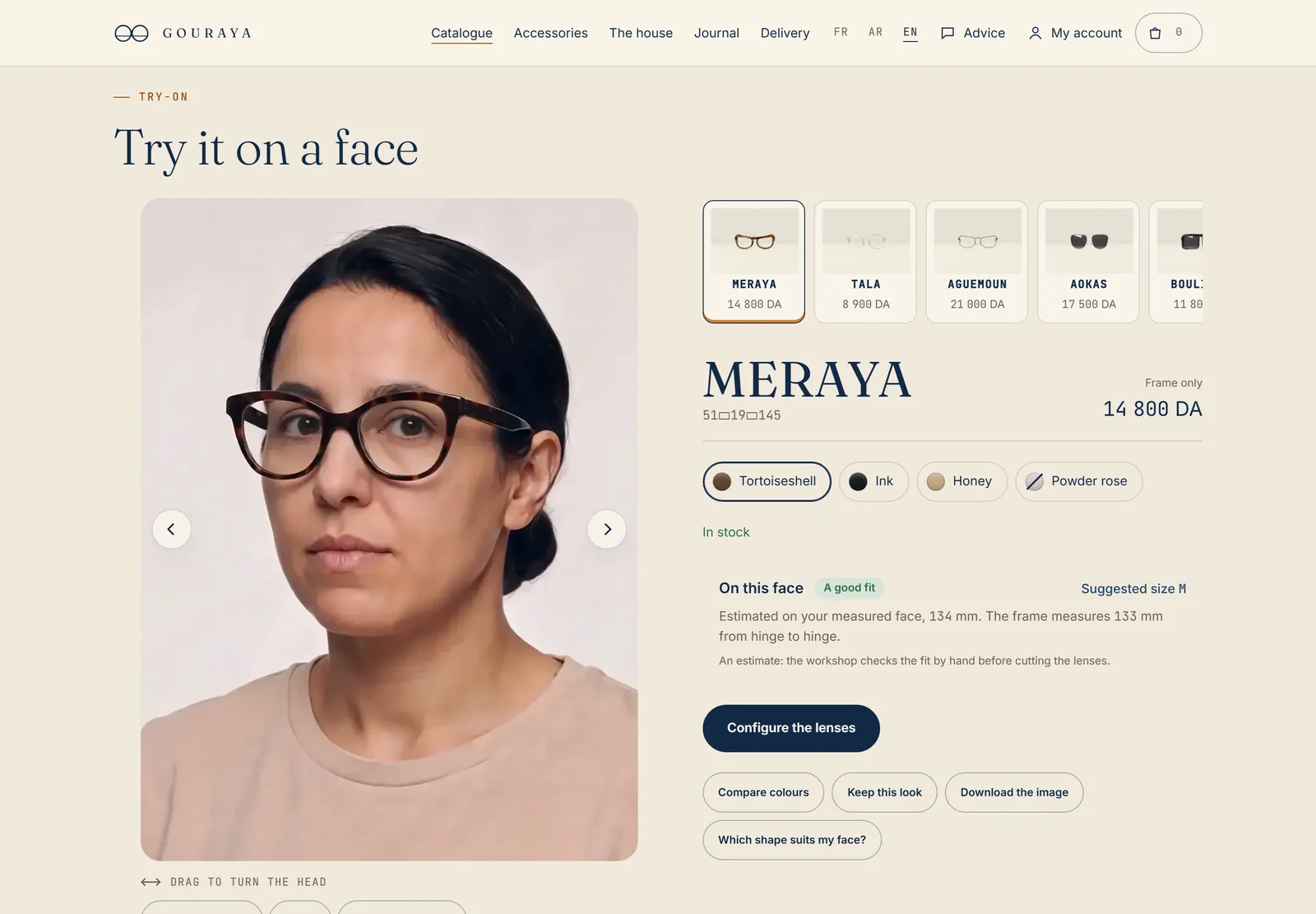
Frames tried on screen, and a basket that counts in dinars.
A complete eyewear shop: turn a model to see a frame on a face, fill a basket, and arrive at a checkout that behaves the way an Algerian order actually behaves — shipping priced by province, cash on delivery, and the card button shown switched off with its reason beside it.
See the demonstration (Gouraya Optical)The shop, the frames and the prices are invented. The order flow is not: it stops on a province the workshop cannot reach, strikes a sold-out line through instead of hiding it, and marks every order number as a demonstration.
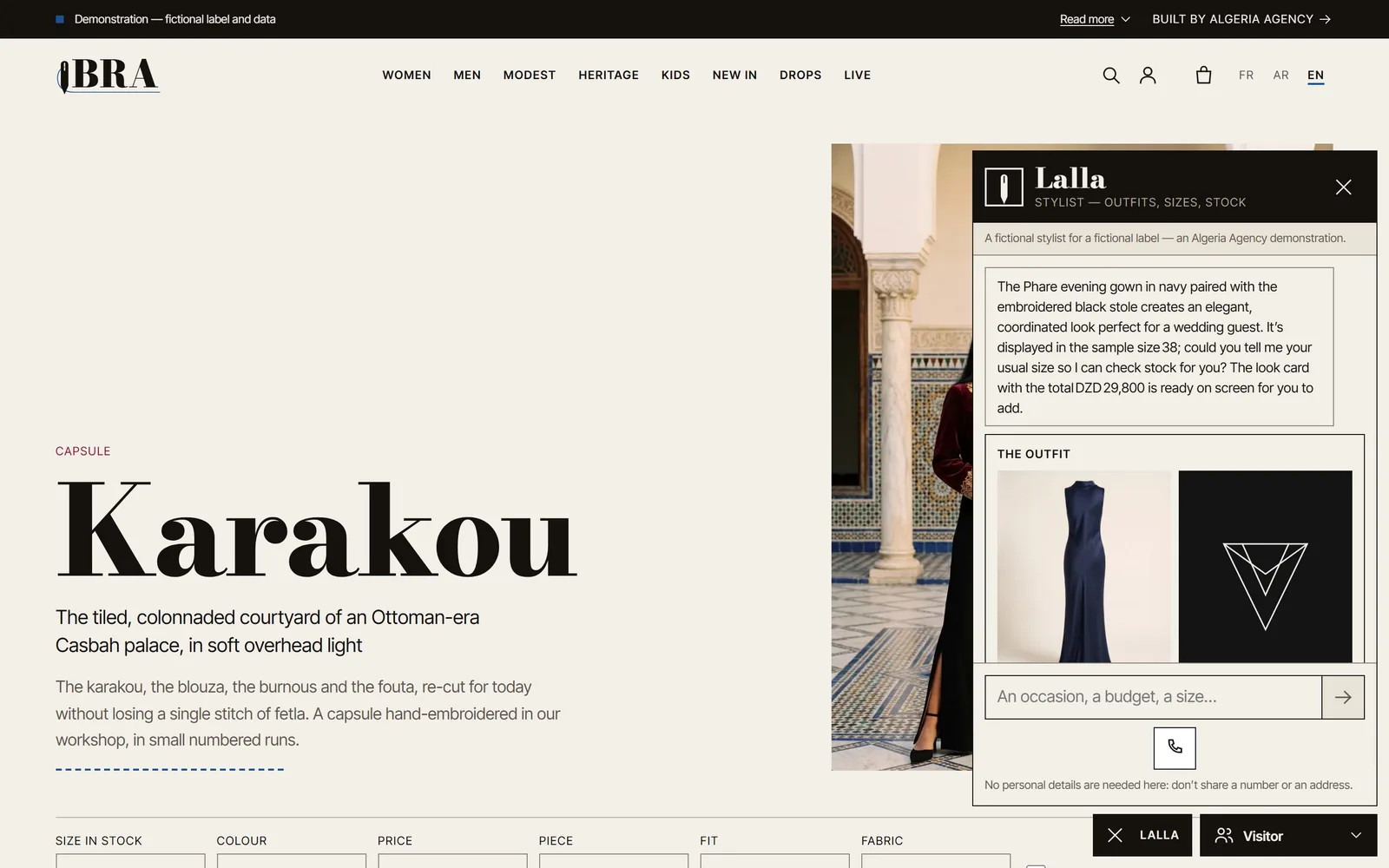
A whole fashion house: the online shop, the boutique tills, the workshop and the resellers.
A whole fashion house on one platform: online shop, lookbook, live shopping, try-on, size advice, the boutique tills, the workshop, resellers, influencers and management.
See the demonstration (IBRA)Fictional label, fictional people, simulated payments and deliveries.
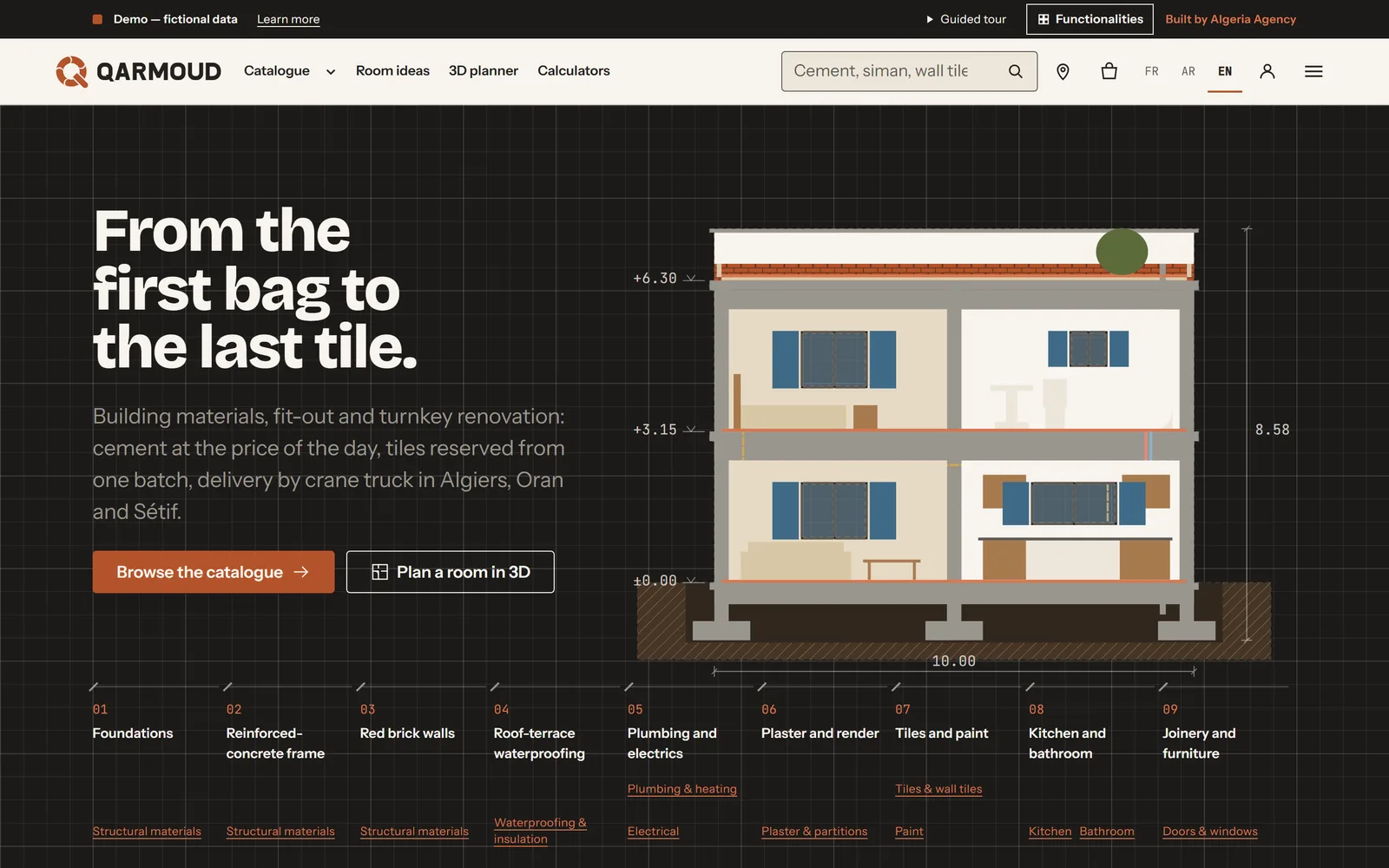
A building-materials merchant and a renovation workshop: quantity calculators, a 3D planner and delivery to site.
A building-materials merchant and a renovation workshop on one platform: a catalogue at the day’s prices, quantity calculators, a 3D planner, trade accounts with credit, the counter, the depot, delivery rounds, site tracking and management.
See the demonstration (Qarmoud)Fictional group, products with no real brand, indicative prices, simulated orders and deliveries.
An online shop almost never fails on the technology. It fails on logistics, on badly designed delivery charges, on a catalogue nobody can keep current, or on a checkout that asks for information the customer does not want to give.
So we start with those questions. How many product lines, who updates them, which wilayas you deliver to, at what price, in how many days, and what happens when a parcel comes back. The answers shape the shop far more than the choice of technology does.
Cash on delivery remains, for many Algerian retailers, how customers actually buy. We treat it as a first-class payment method rather than a fallback — and we add card payment when your bank application comes through.
You receive the sources and the access. Your catalogue, your customers and your orders are exportable at any time, in a format readable elsewhere. A shop whose data you cannot get out is not really yours.
What we usually find
- You take orders in messaging and copy them out by hand.
- Your delivery charge is the same everywhere, so you lose money on distant wilayas.
- You do not know which products actually sell, only which ones you have in mind.
- Every price change means calling someone.
What changes
Structured orders
Address, wilaya, product, quantity, charges: the order arrives complete and ready to pick, with no exchange of messages.
A margin that survives by wilaya
Delivery charges are calculated by zone and weight, which stops the silent loss on distant orders.
A catalogue you hold
Products, prices, stock and photographs editable by your own team, with no invoice and no waiting.
What you get
Catalogue and variants
Sizes, colours, bundles. Variants are handled at design time, not faked with duplicated products.
Delivery by wilaya
A charge grid by zone and weight, stated lead times, and the ability to switch off areas you do not serve.
Cash on delivery
Treated as a complete payment method, with order confirmation and tracking.
Card payment
CIB and Edahabia integration once your bank application succeeds, with no rebuild of the checkout.
Stock management
Quantities, low-stock alerts and automatic removal of sold-out products from the catalogue.
Data export
Orders, customers and catalogue exportable in a standard format, at any time.
Conversion tracking
Installed at launch, so you know which products and which campaigns actually return — and, if we also run your advertising, so it is steered on sales rather than clicks.
How we work
Logistics scoping
Catalogue, areas served, charges, lead times, returns. These answers decide the shop before any design work.
The buying path
Designs for the checkout, from basket to confirmation, approved before development.
Build and import
Development on a staging environment, then an import of your real catalogue rather than sample data.
End-to-end order testing
Real orders placed on a phone, including the awkward cases: out of stock, incomplete address, a return.
Launch and training
Publication, then a session with the person who will run the catalogue day to day.
Is this the right fit for you?
This is for you if
- You sell physical products and already receive orders, even if only in messaging.
- You know which wilayas you can deliver to and at what cost, or you are willing to work it out.
- Somebody in the business will keep the catalogue current.
- You want to own your customer data rather than leave it on a platform.
This is not for you if
- You have not sold a single product yet. Sell by hand first: the shop teaches you nothing you do not already know.
- Your catalogue changes faster than anyone could maintain. Fix that first.
- You sell a bespoke service that gets negotiated. A site with a form will convert better than a basket.
- You only want the lowest price: a subscription platform will be faster and cheaper to start on.
What we commit to
Your data stays exportable
Orders, customers and catalogue export in a standard format at any time, without asking us.
The path works without the card
We never build a shop that only functions if the bank approves online payment.
Tested with real orders
Acceptance means placing genuine orders on a real phone, error cases included.
Selling online in Algeria
Delivery is the first driver of profitability, ahead of the technology. A single flat rate for every wilaya loses money on distant shipments and makes the shop more expensive than necessary for nearby customers. A grid by zone takes longer to prepare and pays for itself immediately.
Cash on delivery brings a refusal rate on arrival that has to be planned for: telephone confirmation, returns handling, and the cost of the round trip. A shop that ignores that cycle displays revenue it will not fully collect.
Finally, a large share of traffic comes from social platforms, often straight onto a product page. That page therefore has to stand on its own: price, availability, estimated delivery charge and a way to order, without forcing anyone to navigate elsewhere.
Frequently asked questions
Should we wait for card payment before opening?
No, and it is often a mistake. Open with cash on delivery and bank transfer, prepare the bank application in parallel, and switch the card on when it arrives. The checkout is built to accept it without a rebuild.
How many products can you handle?
Technically, a great many. Practically, the limit is human: the person maintaining the catalogue. We design the admin interface around whoever will actually use it.
Do you handle couriers?
We integrate the carriers that offer a technical way to do so, and otherwise we produce the labels and exports your carrier needs. We do not promise an integration that does not exist.
Can I also sell in store?
Yes. We can synchronise stock with a till or a spreadsheet, depending on what you use. It is a scoping subject, because it changes how the catalogue is designed.
What if a customer refuses to pay on delivery?
The order stays in the system with its true status, the stock goes back, and the cost of the return is visible in your figures. That is precisely what spreadsheets hide.
Can I migrate from an existing platform?
Yes, in most cases, products and customers included. We look first at what is genuinely exportable from your current platform, because that is what decides the cost of the migration.
How to start
Write to us with your catalogue as it exists — a spreadsheet, photographs, even a list in a notebook — and the wilayas you deliver to.
We come back with the catalogue structure, the delivery grid, the proposed checkout, and an estimate. Logistics scoping happens before the quote, because it changes the number.
Let’s find where your next customers will come from
Tell us where things stand — your ads, your website, your Google listing — and what you are after. We reply within one working day, and the conversation commits you to nothing.
- Your data stays exportable
- The path works without the card
- Tested with real orders