 Algeria Agency
Development
CIB & Edahabia payments: keep the customers who want to pay by card
Algerian card payment on your site: the bank application, the technical integration, and the failure cases nobody tests.
What you can try for yourself
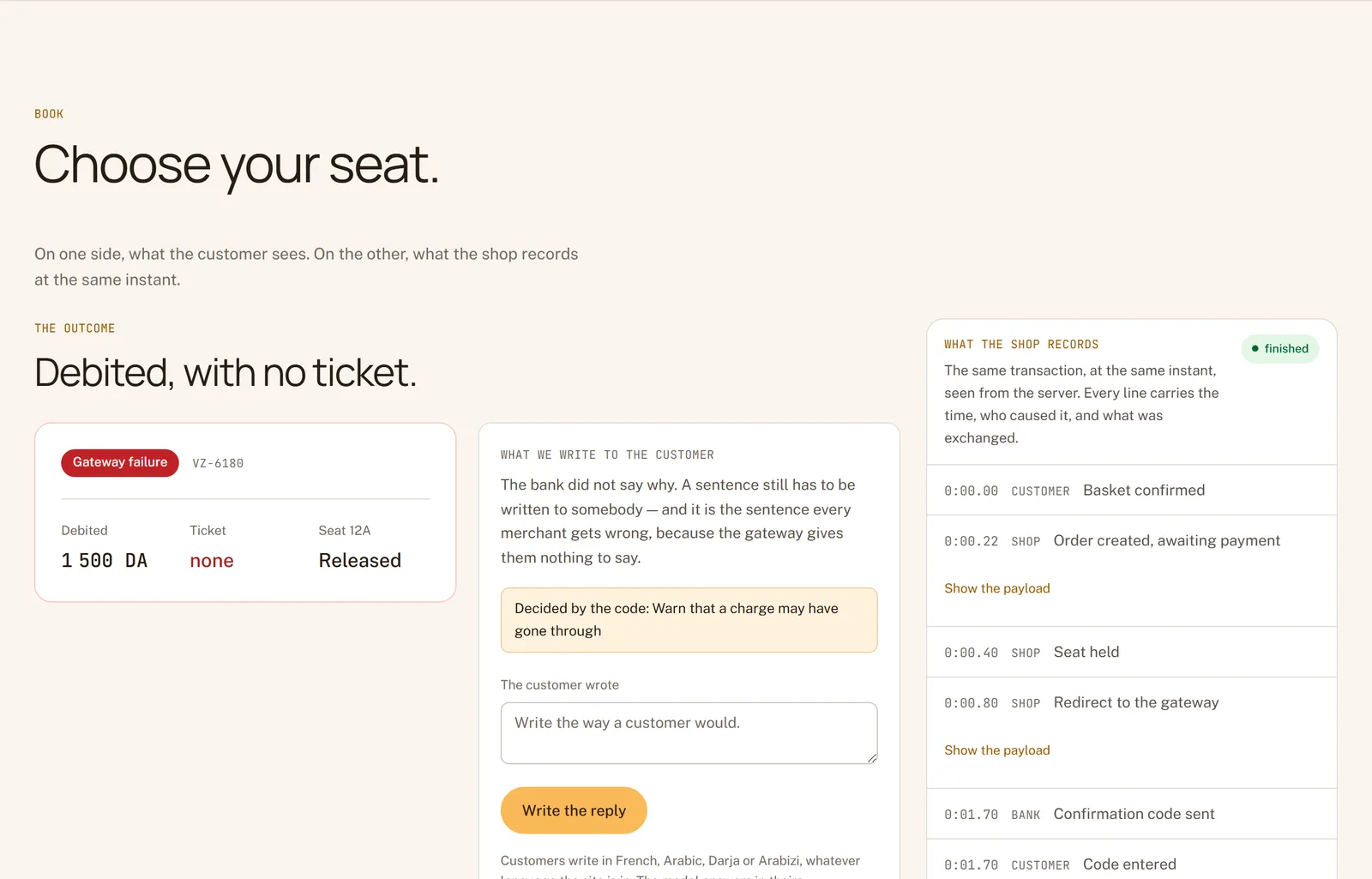
A demonstration
Nine cards, and eight ways a payment goes wrong.
An imaginary coach company, and card payment seen from both sides at once. Choose which customer you are — the refused card, the closed tab, the double click, the drop after the bank said yes — and watch the merchant’s console fill in while you pay. One button even comes back claiming it worked; nothing is issued.
See the demonstrationThe company does not exist and the gateway is simulated. What is real is the list of paths that break, and the fact that a ticket is never issued on the browser’s word.
Accepting a CIB or Edahabia card happens in two halves, and the longer one is not technical. On one side there is an application to your bank, with its documents and its timelines; on the other an integration on your site, which takes far less time than the waiting does.
We do both. We prepare the file, we tell you what the bank will ask for before it asks, and we build the integration so it is ready on the day authorisation comes through. What we do not do is promise a schedule the bank controls.
The technical part is judged on the cases that go wrong, not on the payment that succeeds. A declined card, a customer closing the tab mid-redirect, a double payment, a refund to issue: those are the paths that generate support calls, and those are the ones we explicitly test.
One commercial note rather than a technical one: card payment is not always what increases your sales. On many Algerian catalogues it reassures and professionalises without replacing cash on delivery. We will tell you if your priority lies elsewhere.
What we usually find
- Your customers ask for card payment, and you do not know where to start.
- Your bank gave you a list of documents without explaining what it is checking.
- A supplier "plugged in" payment, and nobody ever tested a declined card.
- You do not know what happens if a customer is charged and the order is not recorded.
What changes
Online payment accepted
CIB and Edahabia work on your site, with the receipts and order statuses that go with them.
Failure cases covered
Decline, abandonment during redirect, double submission, refund: each has a defined and tested behaviour.
A bank file that holds together
Documents assembled in the right order, which avoids the back and forth that costs weeks.
What you get
Preparing the application
List of documents, formatting, and a check in advance of what the bank actually verifies.
Gateway integration
Connection to the payment service, in the test environment and then in production.
Order reconciliation
Every payment is tied to an order, with a status that reflects the banking reality.
Failure handling
Decline, timeout, abandonment: clear messages for the customer and a usable trace for you.
Receipts and records
Confirmation for the customer and an accounting record on your side, in the expected formats.
Refund procedure
The return path is defined and documented, not improvised at the first dispute.
How we work
Eligibility check
We look first at whether your activity and status allow the application at all, before costing you time.
Assembling the file
Documents gathered and lodged with your bank. What follows depends on them, and we say so plainly.
Integration in test
Development and acceptance on the gateway’s test environment while the application progresses.
Testing the failure paths
Decline, dropped connection, double click, browser back button. These are the paths that break in production.
Going live
Activated on the day authorisation arrives, with a first real transaction verified end to end.
Is this the right fit for you?
This is for you if
- You have a registered business and a professional bank account.
- You already sell online, or your shop is ready to open.
- Your customers are asking for card payment, or your average basket justifies the reassurance.
- You accept that the timeline depends partly on your bank.
This is not for you if
- You do not have an online shop yet. Build it first; the card connects afterwards without a rebuild.
- You want to open next week. The bank’s timeline does not compress.
- Your volume is small and your customers are happy paying on delivery. Card is not your priority.
- You are looking for an international payment solution. That is a different subject, with a different application.
What we commit to
No promises about bank timelines
We tell you what depends on us and what does not, and we do not sell a schedule we cannot keep.
Failure cases are tested
A successful payment proves nothing. Acceptance testing covers declines, abandonments and double submissions.
The site works without it
The checkout stays complete with cash on delivery and bank transfer — before, during and after.
What the application actually asks for
The bank verifies that your business exists and is coherent: commercial register, a declared activity matching what the site sells, a professional account, and sometimes a visit. The most common cause of refusal is not technical — it is a mismatch between what the site sells and what the register says.
The site itself is examined. Terms of sale, return and refund policy, legal notice, reachable contact details and prices displayed in dinars: their absence delays an application more reliably than an integration problem does.
Finally, actual behaviour moves more slowly than announcements. A significant share of Algerian buyers still prefer cash on delivery, including on sites that accept cards. Turning card payment on is a good decision; making it the only way to pay is not.
Frequently asked questions
How long does the whole thing take?
The technical integration is short. The bank application is the unknown, and its timeline varies with the bank and with the quality of the file lodged. We tell you what we usually see, without making it a commitment.
Do I need a commercial register entry?
Yes. It is a condition of the application, not a requirement of ours. An unregistered activity cannot accept card payments online.
What if the application is refused?
We look at the reason: it is often fixable, particularly when it concerns an activity mismatch or missing legal pages on the site. The site keeps working without the card in the meantime.
Can you integrate into a site you did not build?
Yes, if the site allows a clean integration. We check that first, and we tell you if the answer is no rather than bolting on something fragile.
How is a refund handled?
Through your bank’s procedure, which we document for you at setup. The site records the refund so that your figures stay correct.
Do customers really pay by card?
It depends on the basket, the sector and the audience. We encourage you to keep cash on delivery active and watch the real split for a few months before drawing a conclusion.
How to start
Write to us and tell us which bank you are with, what your site sells and whether you have already started a process; include the site address if it exists.
We come back with the documents to gather, the parts of your site that will cause trouble in the application, and the integration plan. You will know what depends on you, on us, and on the bank.
Let’s find where your next customers will come from
Tell us where things stand — your ads, your website, your Google listing — and what you are after. We reply within one working day, and the conversation commits you to nothing.
- No promises about bank timelines
- Failure cases are tested
- The site works without it