 Algeria Agency
Development
Custom software development: a tool of your own, when nothing on the market fits
An internal tool built around how you actually work, when nothing on the market fits — and only in that case.
What you can try for yourself
Demonstrations
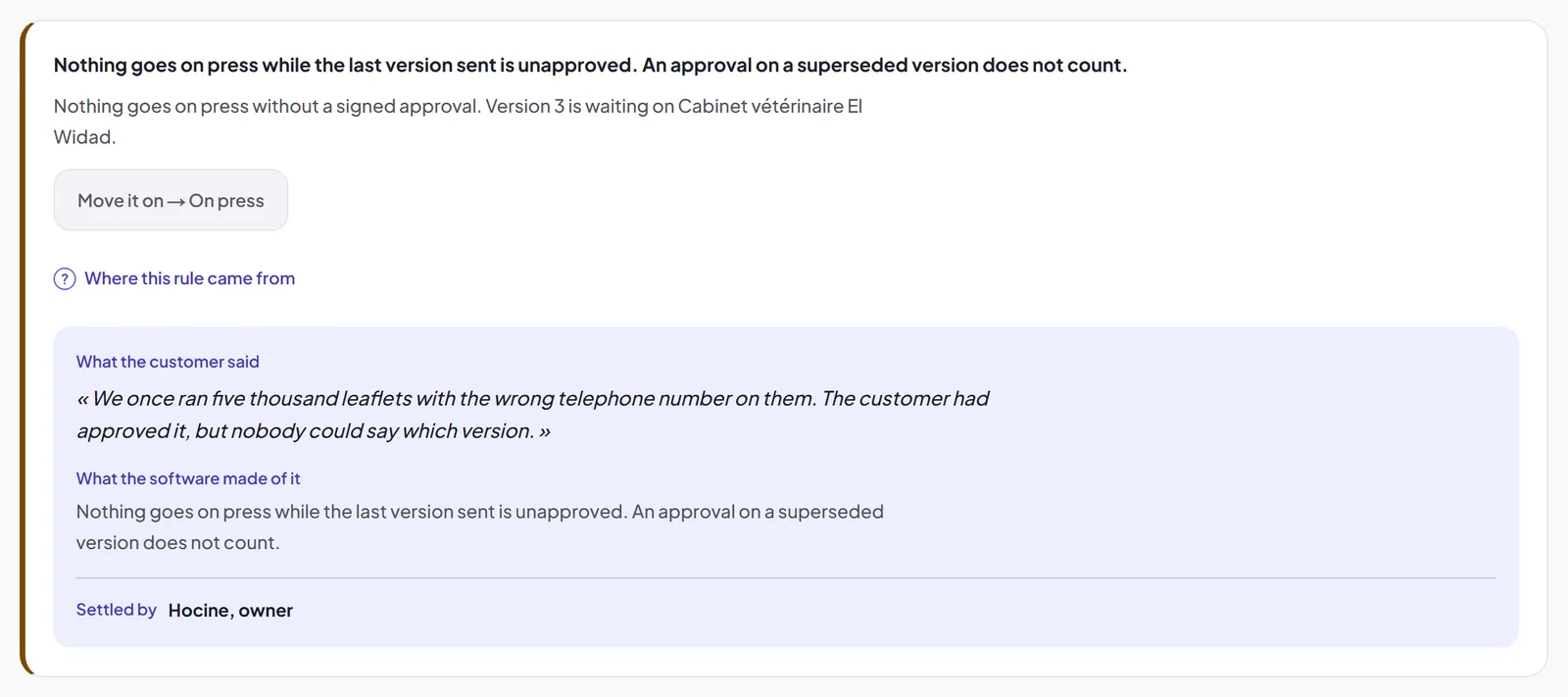
A whole workshop, and the rule that stops the press.
The internal software of an imaginary print shop in Batna: sixteen screens, three seats, and one job crossing the whole house from the message in to the invoice settled. You sit at the front desk and run it.
See the demonstration (Imprimerie Timgad)The customers, the jobs and the invoices are invented, and the five refusals you will run into are precisely what the demonstration exists to show.
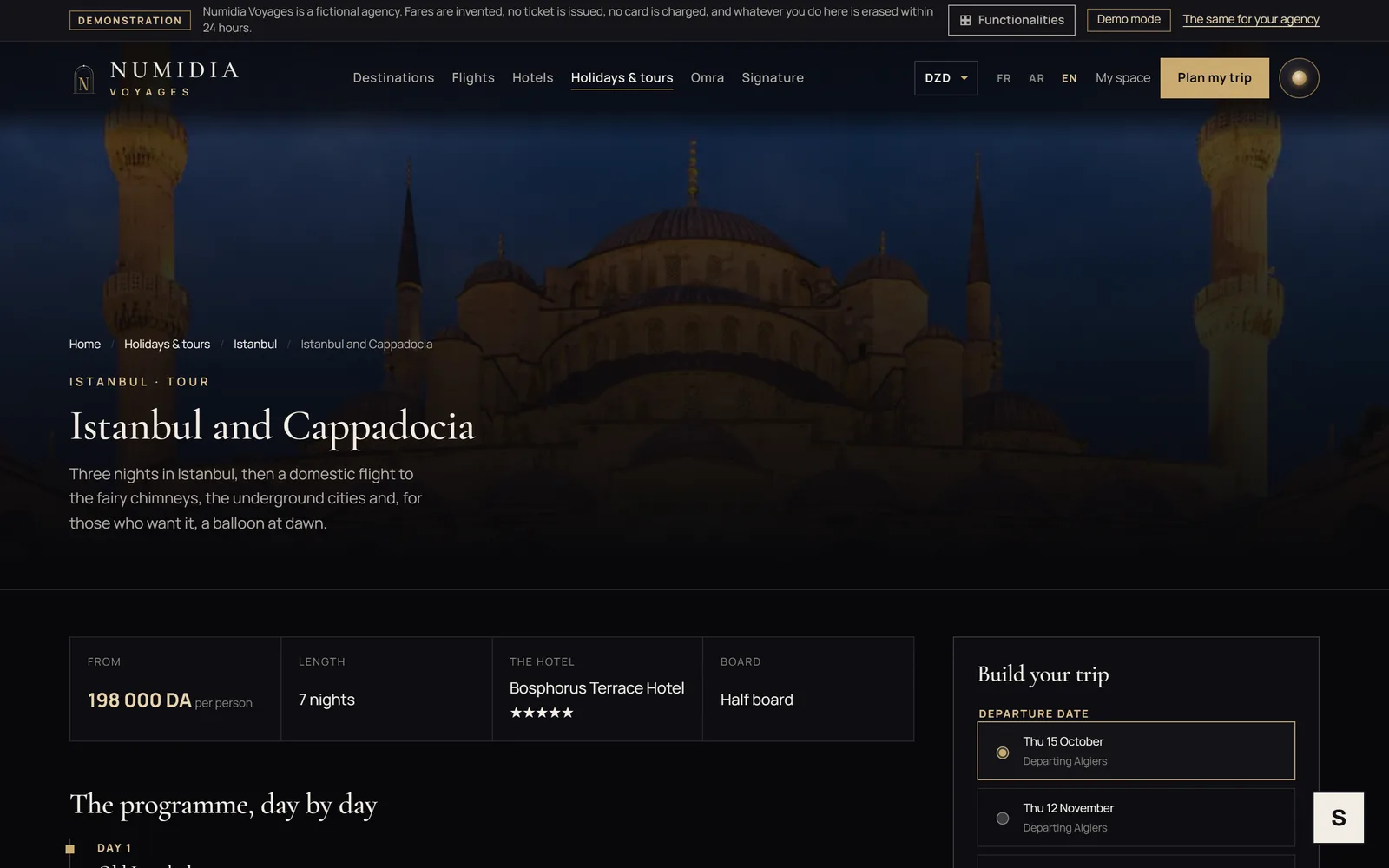
A whole travel agency: the site, the booking engine and both of its consoles.
A complete travel agency, built rather than rented: the site that makes people want to leave, the engine they book a flight, a hotel, a tour or an Omra on, the client space where the trip is prepared and the console the agency runs it from. A concierge can book for you, in writing or by voice.
See the demonstration (Numidia Voyages)The agency, its hotels and its airlines do not exist, and the payment is simulated. What is real: the booking engine, both dashboards, and a concierge that never quotes a price it did not find.
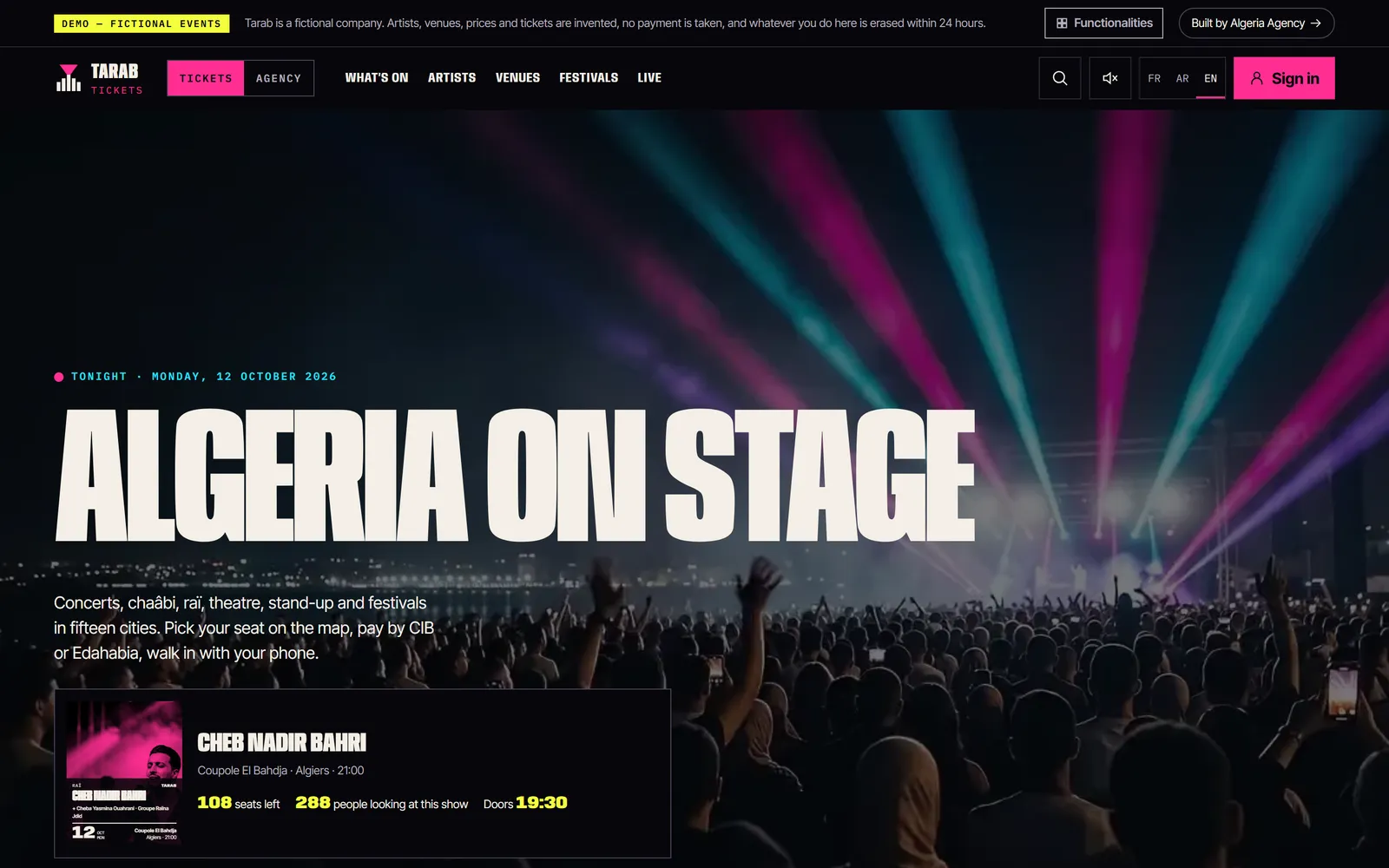
A ticketing platform and an events agency, on one platform with seven trade workspaces.
A complete entertainment company, built rather than rented: a multi-promoter ticketing platform with seat maps, a waiting room and fraud-proof tickets, an events agency with quotes, invitations and seating plans, an offline door-scanning app and a dashboard for every trade. An AI planner designs your event, in writing or by voice.
See the demonstration (Tarab)The artists, venues and events do not exist, and payment is simulated. What is real: the seat map shared live, offline door control, each role’s workspace and the assistant that never quotes a price it has not found.
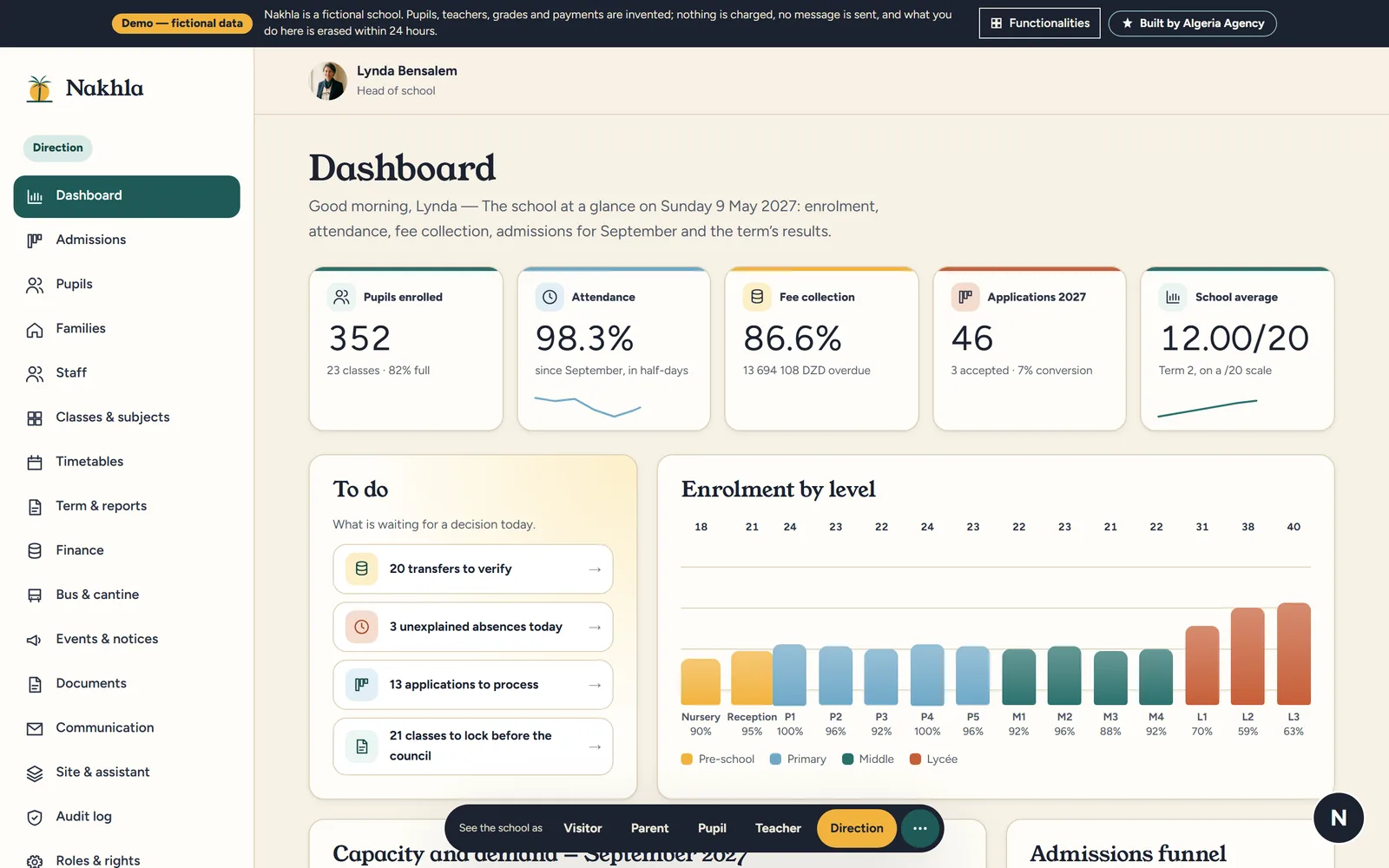
A whole private school: the site, admissions and the platform for parents, pupils, teachers and the direction.
A complete private school, built rather than rented: the site that reassures parents, online admissions, and the platform where parents, pupils, teachers and the direction each work in their own space — grades, report cards, absences, payments, lessons and homework. An assistant answers families in writing or by voice.
See the demonstration (Nakhla School)The school, its pupils and its teachers do not exist, and payment is simulated. What is real: the admissions, the five spaces, the computed report cards, and the assistant that never quotes a fee it has not found.
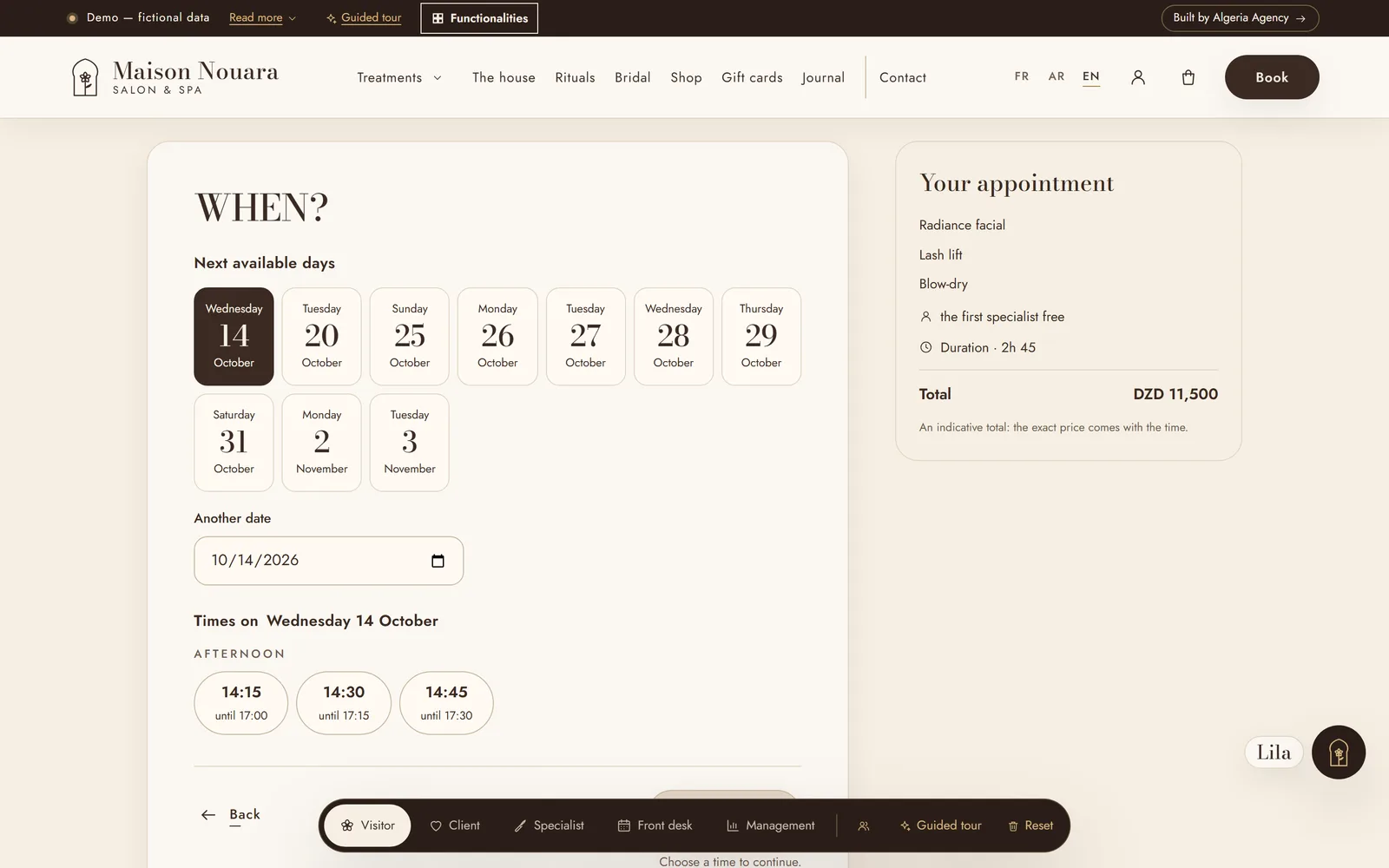
A whole salon & spa: the site, the booking engine, the shop and four working spaces.
A complete salon & spa: website, multi-treatment booking, shop, voice assistant, beauty analysis and five working spaces — client, specialist, reception and management.
See the demonstration (Maison Nouara)Fictional salon, fictional data, simulated payments.
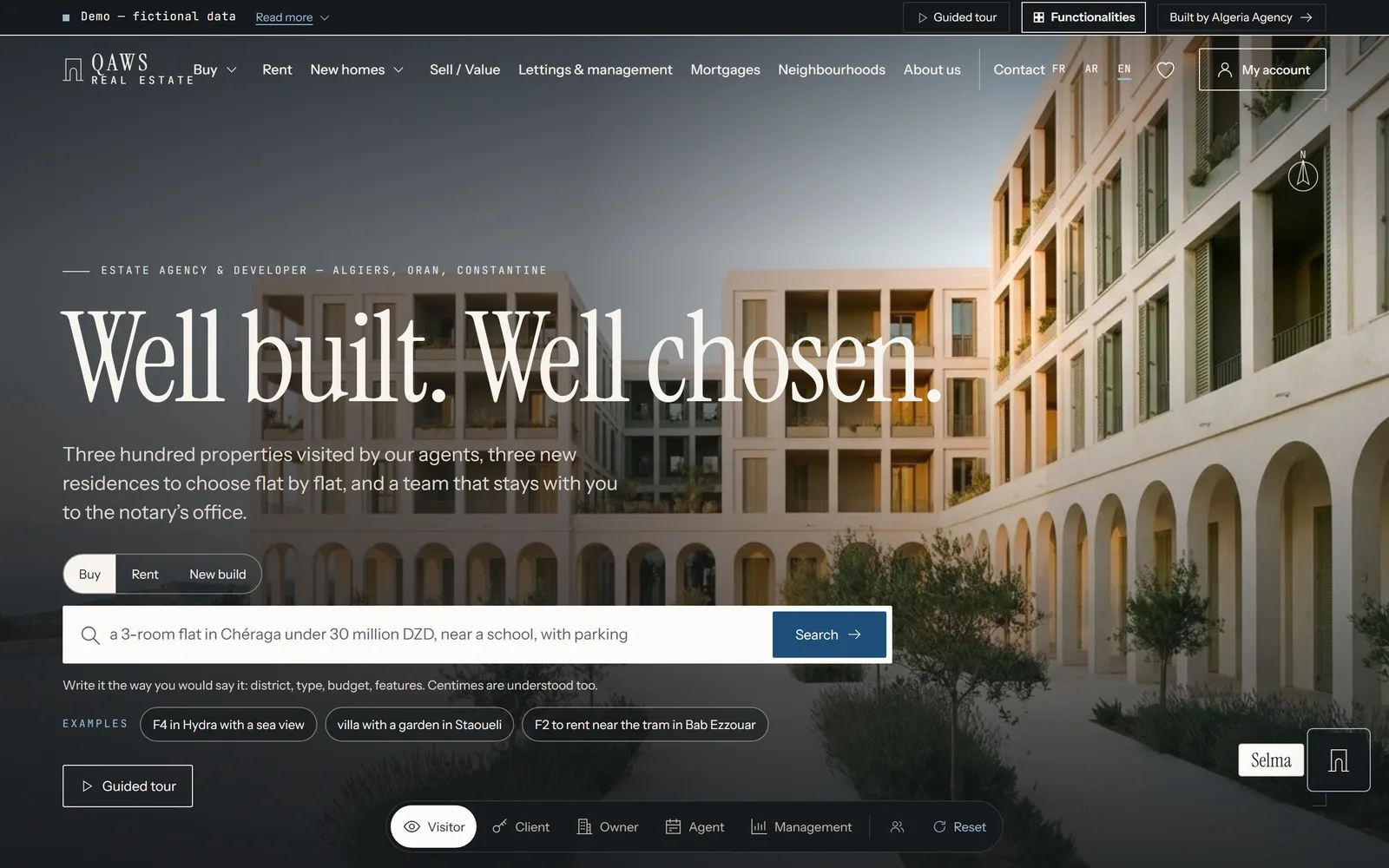
An estate agency and a developer in one: map search, lots in 3D and five working spaces.
An estate agency and a developer in one platform: map search, a 3D lot selector, interactive floor plans, 360° tours, an AI valuation, a voice assistant, and five working spaces — visitor, client, owner, agent and management.
See the demonstration (Qaws Real Estate)Fictional agency, fictional data, simulated payments.
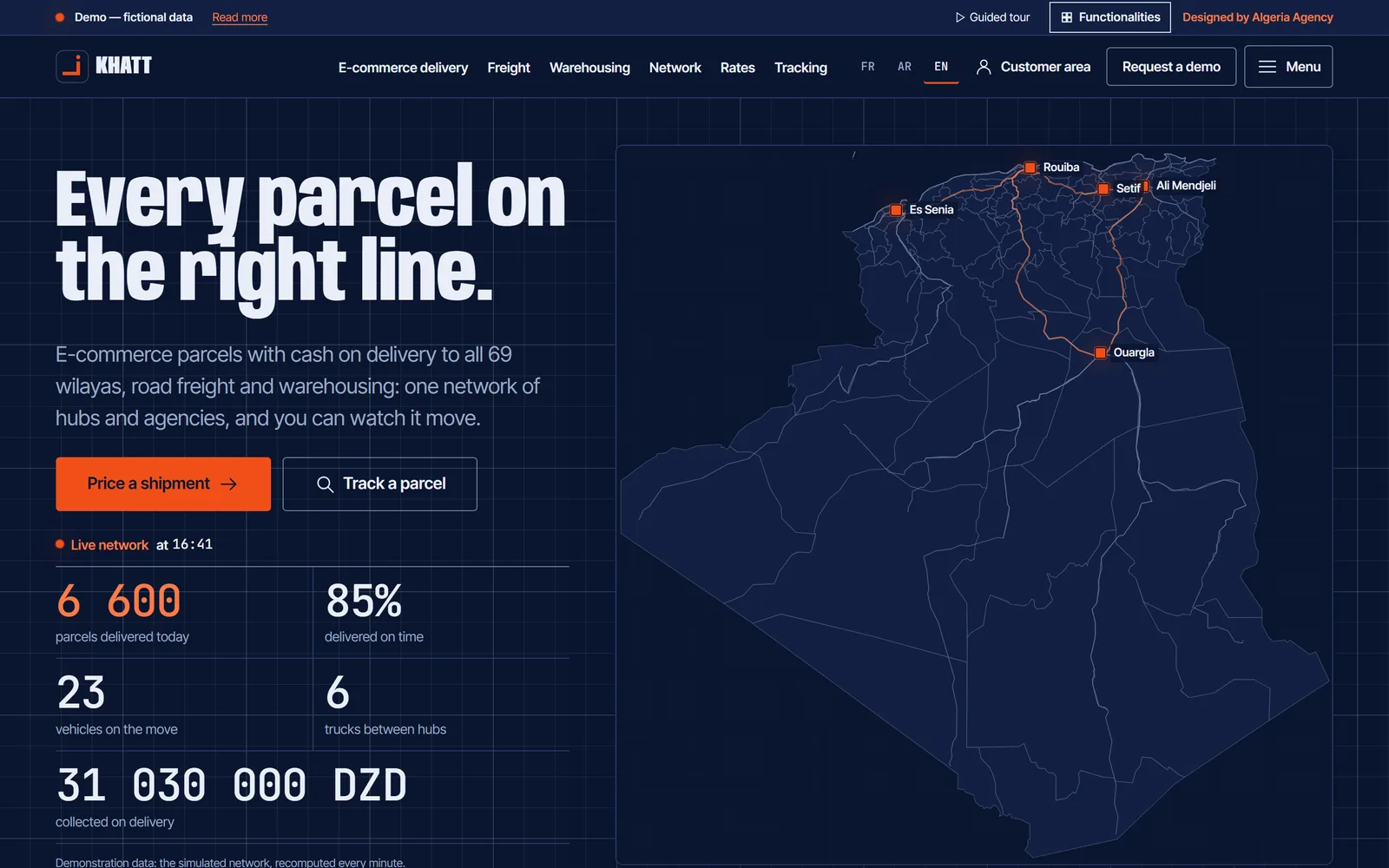
A whole delivery and freight carrier on one network: live tracking, cash on delivery, hubs, a warehouse and a control tower.
A delivery and transport company on one platform: a public site with live tracking and an instant price calculator, a seller space with cash on delivery and payouts, B2B shippers, an offline courier app, hub, agency and warehouse screens, a control tower and the back office.
See the demonstration (Khatt)A fictional company; parcels, vehicles, positions and cash are simulated; tariffs are indicative.
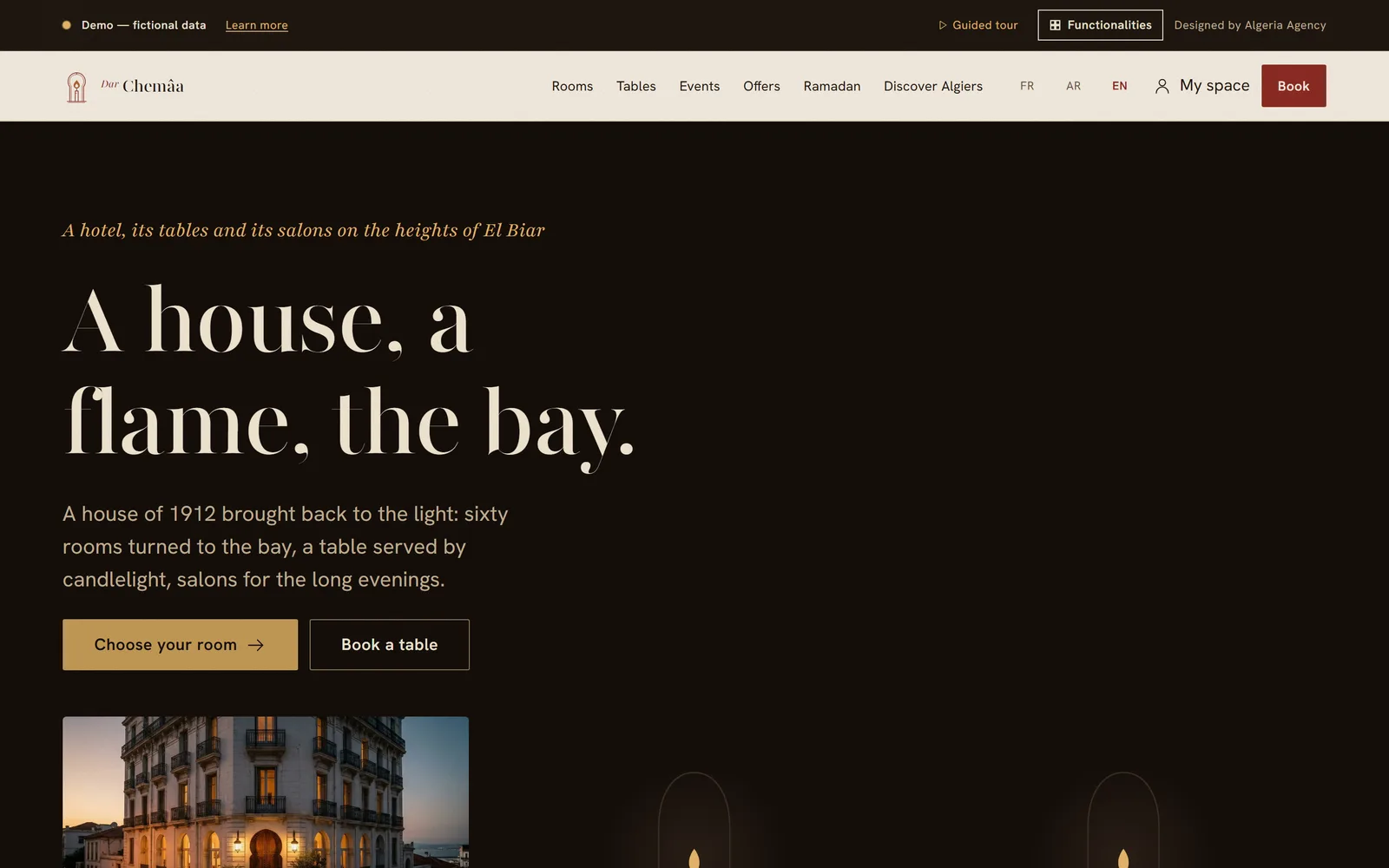
A hotel, its tables and its salons on one platform: rooms chosen by their view, tables on a floor plan, kitchen screens and events.
A hotel, its restaurants and its salons on one platform: a public site to book rooms, tables and events, menus with allergens, a guest space with online check-in and a digital key, then the front desk, the dining room and kitchen screens, housekeeping, events sales and management.
See the demonstration (Dar Chemâa)Fictional property; bookings, payments and messages are simulated; rates are indicative.
Custom software is the most expensive path, and it is only justified when the others are blocked. So our first instinct is to look for what already exists: an off-the-shelf tool, even an imperfect one, costs less than a build, updates without you, and does not depend on a supplier.
It becomes justified when your process is genuinely distinctive and part of your advantage, when no tool speaks the language of your trade, or when your data currently lives in files several people edit at once — which is an outage waiting to happen, not an organisation.
We then build in usable slices. The first version replaces one task, completely, and goes into service. That is what separates software that enters people’s habits from software delivered in one block after a year and never adopted.
The most important question is not technical: it is who, on your side, decides. An internal tool touches habits, and a project without an arbiter on the client side sinks into contradictory requests. We ask about that before starting, and we say so when it is unresolved.
What we usually find
- Your data lives in a shared file that three people edit at the same time.
- You bought software that does 80% of the job, and the remaining 20% is done by hand.
- The same information is entered two or three times into different tools.
- Nobody can say today where a job stands without calling somebody.
What changes
Entered once
Information goes in once and travels. That is almost always the most immediate gain, and the easiest to put a number on.
A current, visible status
Where a job, a site, or an order stands — without calling the person who knows, and so without asking the customer who enquired to wait for a call back.
A tool that follows your trade
The vocabulary, the stages and the rules are yours, which removes the permanent retraining a badly fitted tool demands.
What you get
Process scoping
We map what you actually do, not what the procedure says you do.
Development in slices
Each delivery replaces one task completely and goes into service, instead of waiting for the end.
Access management
Who sees what, who changes what, and a record of who did what.
Taking over what exists
Import of your files and history, with inconsistencies surfaced rather than silently absorbed.
Exports and connections
Your data leaves in standard formats, and the tool talks to what you already use where that is possible.
Documentation and handover
Sources, operating documentation and a deployment procedure delivered, so another developer can take over.
How we work
Look for what exists
We check first whether an off-the-shelf product covers the need. When it does, we say so.
Map the reality
Observation of the process as it is practised, with the people who practise it, not only with management.
First slice
The most expensive task, replaced completely, put into service and corrected with its users.
Progressive extension
Later slices ordered by what they save, not by what looked logical in the specification.
Handover
Sources, documentation and transfer of access, with training for the users who stay after we leave.
Is this the right fit for you?
This is for you if
- Your process is distinctive and part of what you do better than others.
- You have looked for an off-the-shelf product and genuinely nothing fits.
- Somebody on your side can decide and arbitrate between contradictory requests.
- You accept going live in stages rather than in a single delivery.
This is not for you if
- A market tool would cover 90% of it. Buy it: it will be cheaper and better maintained.
- You want everything at once, in one delivery. That is the most reliable way to put nothing into service.
- Nobody on your side can settle a disagreement. The project will stall, whatever the budget.
- You have no budget for changes after delivery. An internal tool lives or dies on its corrections.
What we commit to
We try not to build first
If existing software fits, we say so and help you choose it. That is more honest and considerably cheaper for you.
Your data leaves whenever you want
Export in a standard format, available from the first version rather than added on request at the end.
Live in slices
Every delivery is usable. We do not bill a year of development against a promise.
An internal tool inside an Algerian business
The most common constraint is not technical but behavioural: the tool has to be adopted by people who have worked a certain way for years, sometimes without much computing habit. An interface in Arabic, vocabulary that matches the workshop or the counter, and data entry that takes no more gestures than the notebook it replaces: that is what decides adoption, far more than features do.
Connectivity and power are not continuous everywhere. A tool that demands a permanent network blocks work at the first incident, which alone is enough to have it abandoned. We treat a dropout as a normal state.
Finally, taking over existing data is almost always heavier than expected, because accumulated files contain years of exceptions. We surface them rather than absorbing them silently — unpleasant at import time, and it avoids a tool that holds wrong data from day one.
Frequently asked questions
Would existing software not do?
Very often it would, and it is the first thing we check. We would rather help you choose a market tool than sell you a build you do not need.
How long before something goes live?
We aim for a first usable slice quickly, on the most expensive task. The full timeline depends on scope, but nothing justifies waiting until the end to start using it. If a deliverable runs late, you are told before the deadline, with a new date.
Who owns the software?
You do. Sources, documentation and access are delivered, and you can give further development to another developer.
What if our needs change?
They will, and that is the rule rather than the exception. It is why we build in slices and plan for a change budget rather than a closed project.
Can you take over software built by someone else?
After a code audit, often yes. We will tell you honestly whether taking it over is reasonable or will cost more than a gradual rebuild.
Does it have to be hosted in Algeria?
It depends on the nature of the data and on your obligations. We set out the options, their costs and their practical consequences, and the choice is yours.
How to start
Write to us and describe the task that costs you the most time today; how it is done in detail, exceptions included, can come later.
We come back first with an answer to "should this be built at all?". If yes, with the first slice we would build, what it would replace, and its estimate.
Let’s find where your next customers will come from
Tell us where things stand — your ads, your website, your Google listing — and what you are after. We reply within one working day, and the conversation commits you to nothing.
- We try not to build first
- Your data leaves whenever you want
- Live in slices