 Algeria Agency
Artificial intelligence
AEO: be the source ChatGPT, Gemini and Perplexity cite to your customers
When your customers put their question to ChatGPT, Gemini, Perplexity or Google, we work on your pages so the answer cites your business rather than a competitor.
What you can try for yourself
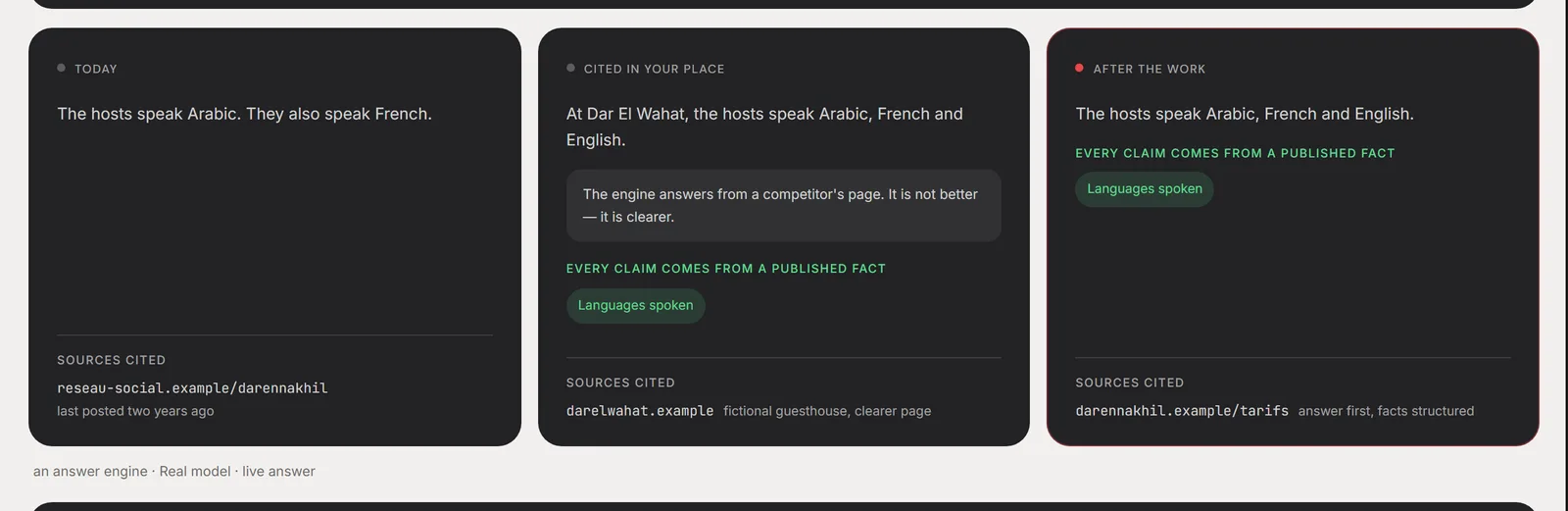
A demonstration
One question, three answers, and only the sources differ.
A fictional guesthouse in Ghardaïa, described by an answer engine three times over: from its current sources, from a competitor’s page, then from a file of published facts. Same model, same question, different sources.
See the demonstrationThe engines named in the table write none of the answers shown, and the fourth goes on citing a directory even after the work.
A growing share of searches ends in a direct answer rather than a list of links: Google AI Overviews at the top of the results, or a reply written by ChatGPT, Gemini, Perplexity or Copilot. In those cases there are not ten positions to occupy but one source cited, or none.
Optimising for those answers is not a discipline separate from search, and anyone selling it as one is worth being wary of. It is the same work, pushed on three points: answering a precise question in the first paragraph, structuring information so it can be extracted, and being consistent enough that a system treats you as a source.
What genuinely changes is the demand for verifiability. A page that asserts without specifying does not get cited. Lead times, conditions, areas served and concrete examples make a page usable as a source; the vague phrasings that have passed until now do not.
We are careful with promises. These mechanisms change quickly, nobody controls what an assistant decides to cite, and a supplier guaranteeing you a citation is selling something they do not own.
What we usually find
- Your customers find answers elsewhere without ever reaching your site.
- Your pages assert a great deal and specify nothing verifiable.
- Your information differs between your site, your listing and your social pages.
- An assistant cites a less competent competitor because their page is clearer.
What changes
Citable pages
Structured, verifiable information a system can extract without misrepresenting what you said.
Pages ready to be quoted
The answer first, precise facts, a readable structure — what direct answers pick up when they cite a source.
Consistency that helps elsewhere
The same work improves your conventional search performance and the clarity of your pages for human readers.
What you get
Answers at the top
The question addressed in the first paragraph, before the context and the argument.
Extractable structure
Headings, lists and structured data that let an answer be isolated unambiguously.
Verifiable facts
Lead times, conditions, areas served and specific examples, because vagueness does not get cited.
Consistent information
Site, business listing and profiles aligned, so that no source contradicts another.
Question coverage
The real phrasings of questions, including long and conversational ones — as they are typed into ChatGPT or Perplexity, not as short keywords.
Citation monitoring
Periodic checks engine by engine — ChatGPT, Gemini, Perplexity and Google AI Overviews — of what gets cited on your subjects and who is cited instead of you.
How we work
Identify the questions
What your customers ask in natural language, not only as short keywords.
Check what is cited today
We put your questions to ChatGPT, Gemini, Perplexity and Google, and record who is cited in your place and why that source.
Restructure the pages
Answer at the top, extractable structure, specific facts in place of assertions.
Align the sources
Site, listing and profiles made consistent, because a contradiction disqualifies.
Observe
Periodic monitoring, with due caution: these mechanisms change often.
Is this the right fit for you?
This is for you if
- Your customers ask precise questions before buying.
- You can publish verifiable facts: lead times, conditions, areas served.
- You already do search work, or you are starting it alongside.
This is not for you if
- You want this to replace search work. It is an extension, not an alternative.
- You cannot publish anything specific: no lead times, no conditions, no areas served.
- You want a guarantee of being cited. Nobody can give one.
What we commit to
No citation guarantee
We do not control what an assistant chooses to cite, and we will not sell you otherwise.
Not a separate service by default
In most cases this work is part of search. We will bill it that way rather than adding a line item.
Facts, not assertions
We will ask you for publishable figures and conditions. Without them the work has no material.
What this changes for an Algerian business
Generated answers feed on what exists online, and on many Algerian subjects what exists is thin or wrong. A business publishing precise local information — prices actually charged, real lead times, applicable procedures — occupies a space almost nobody is filling.
Consistency between your sources matters particularly here, where one business’s information often differs between its site, its social page and its listing. A contradiction does not merely make a customer doubt; it disqualifies the source in the eyes of a system that compares.
Finally, Arabic is even less covered than French in these formats: put a specific Algerian question to ChatGPT or Perplexity in Arabic and the answer is often generic, or drawn from a source that does not cover Algeria. A clear Arabic answer to a common question is currently one of the few places where editorial work meets almost no competition.
Frequently asked questions
Which engines exactly are we talking about?
The assistants that write an answer — ChatGPT, Gemini, Perplexity, Copilot — and Google AI Overviews, the generated block at the top of the results. They do not draw on the same sources or at the same pace, which is why we check them separately rather than talking about "AI" in general.
Is this really different from SEO?
Only slightly, and it matters to say so. The same foundations count; what changes is how the answer is structured and the requirement for verifiable facts. Be wary of anyone selling this as an entirely new discipline.
Can you guarantee being cited?
No. These systems change, and nobody controls their choices. We work on what makes a page citable, which is different from a guarantee.
Do we have to publish prices?
It helps when you can. Otherwise publish what can be checked — lead times, areas served, conditions, and what moves the price: that is what we do ourselves.
How do we know it is working?
By periodic manual checks on your subjects, and by traffic from snippets. It is less precise than conventional position tracking, and we present it as such.
Does this replace our search traffic?
No. Some searches still end in clicks, and a direct answer often cites a source people then visit.
Should we do this now?
The work overlaps heavily with good search practice, so yes: it is useful even if these formats evolve. That is precisely why we do not sell it as a bet.
How to start
Write to us with your website address and three precise questions your customers ask before buying.
We look at what is cited on those questions today, why, and what would need changing on your pages for you to be a usable source.
Let’s find where your next customers will come from
Tell us where things stand — your ads, your website, your Google listing — and what you are after. We reply within one working day, and the conversation commits you to nothing.
- No citation guarantee
- Not a separate service by default
- Facts, not assertions