 Algeria Agency
Education
You teach.
We bring
the families
before the intake.
We bring families and trainees to schools and training centres: campaigns launched before enrolment opens, a page per course with its fee and its accreditation, and a reply within the hour during the week when everything is decided.
No commitment. We reply within one working day, and we also tell you what we would refuse to do.
The terms
100%
Of the accounts and pages in your name
0
Pass rates published that you cannot substantiate
100%
Of courses shown with their price range
0 DA
Exit fee. You leave with everything.
These four figures are written into the contract. A 6-month minimum term on our digital marketing plans (Starter has none), then cancel any month with 30 days’ notice.
What you can try for yourself
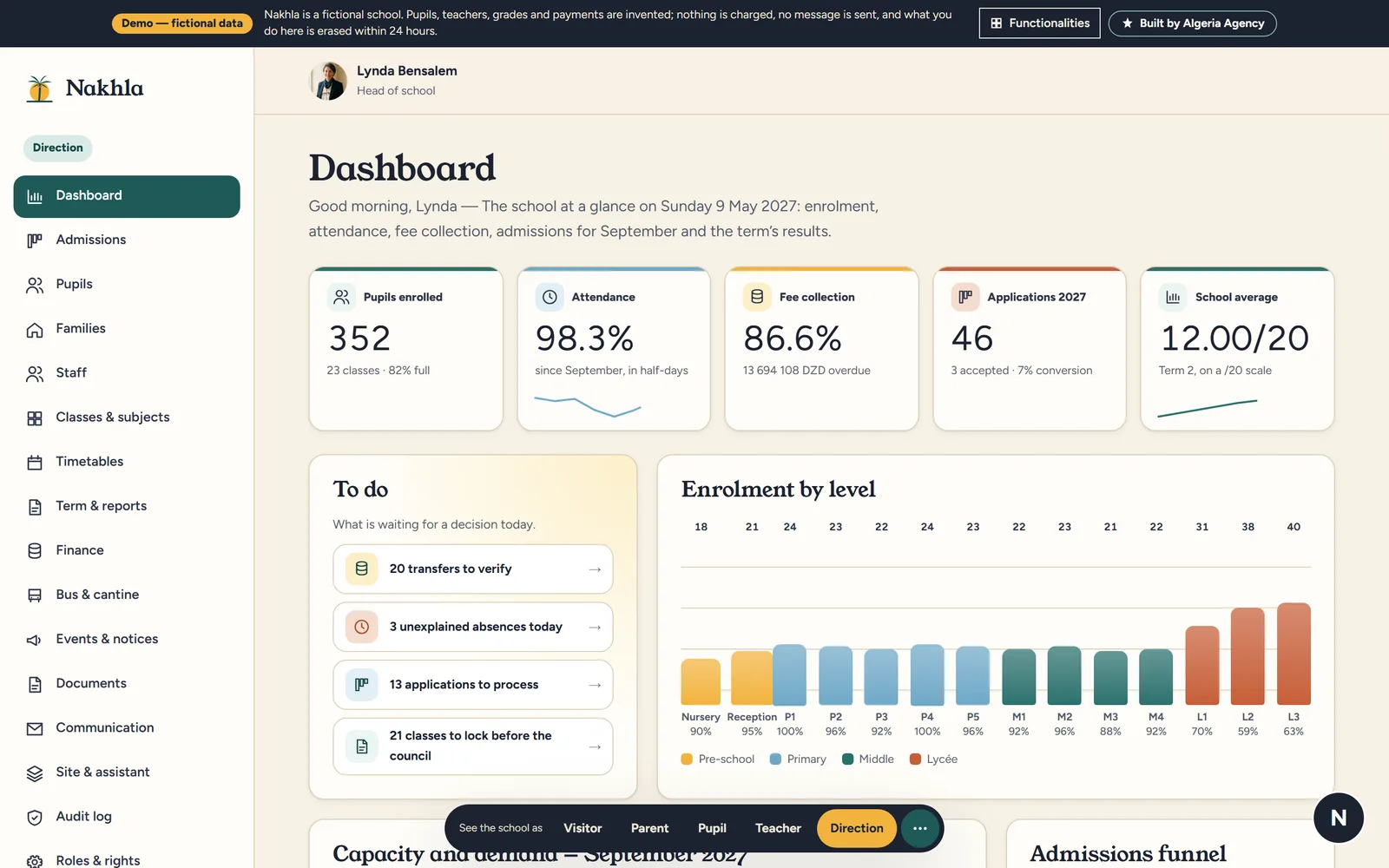
A demonstration
A whole private school: the site, admissions and the platform for parents, pupils, teachers and the direction.
A complete private school, built rather than rented: the site that reassures parents, online admissions, and the platform where parents, pupils, teachers and the direction each work in their own space — grades, report cards, absences, payments, lessons and homework. An assistant answers families in writing or by voice.
See the demonstrationThe school, its pupils and its teachers do not exist, and payment is simulated. What is real: the admissions, the five spaces, the computed report cards, and the assistant that never quotes a fee it has not found.
The problem
What we usually find
- Your enrolments are decided in three weeks and your campaigns start late.
- Your pages speak to students and not to parents, or the reverse.
- You promise results like everybody else, with nothing verifiable.
- You receive many information requests and few enrolments.
The sector is saturated with promises of success nobody can check. That is precisely what makes a detailed syllabus and a published price more convincing than any superlative.
Where we stand
What can be checked is worth more than what can be promised.
Training and education work in intakes. Demand concentrates into a few weeks a year, and a campaign launched after enrolment opens arrives once decisions have been made. The calendar therefore matters more than the total budget.
The second particularity is that the decision is rarely taken alone. A parent and a student, an employee and their employer: two people with different criteria have to be convinced, and a page addressing only one of them loses the other along the way.
The third is proof. In a market where many promise results, what distinguishes is verifiable: named teachers, a detailed programme, written terms, figures you can justify. An unverifiable promise reads like every other one.
So our work is to prepare the intake in advance, write for both decision-makers, and lead with what can be verified rather than what can be promised.
An accreditation number, a syllabus, a fee. Three things almost nobody writes down.
The engine
The acquisition engine, in nine stages
Nine stages, held here by a calendar with three entrances: the September intake, the February one for vocational training, and January’s disappointing report card, which is not an intake at all and which nobody prepares for. Two people also decide every enrolment, and a page addressing one of them loses the other on the way.
Stage 00 — Measurement
Telephone, front desk, form
Count by window, and never add the three together.
September enrolments, February enrolments and mid-year tutoring enquiries share neither a buyer, nor a timescale, nor a price. An annual average blends all three and describes none of them. We separate them before spending a dinar.
You do
Nothing. Approve one access request.
We do
We open three separate counters and keep them apart.
You get
Three readable seasons instead of one average that steers nothing.
Stage 01 — Attention
Search, social, listing
Arrive before enrolment opens, not during it.
A campaign launched after enrolment opens arrives when the decisions are made. The calendar therefore matters more than the budget: the same sum spent three weeks earlier reaches families while they are comparing, instead of reaching them after they have signed.
You do
Nothing. Approve the creative if you want to.
We do
We date the preparation backwards, and stop when the window closes.
You get
Presence during the comparison, which is the only week that counts.
Stage 02 — Intent
Search, pages per course
People search a level, a subject, a commune. And sometimes an accreditation.
The searches are concrete and local, and a generic establishment page captures none of them. Alongside them lives a verification query — somebody with your name who wants to know whether you are accredited — which practically no establishment works.
You do
Nothing. Tell us once which courses you no longer run.
We do
We write a page per course and a page that answers the check.
You get
Both intentions, one of which your neighbours leave empty.
Stage 03 — The landing
Site, page per course
One page for two readers looking for different things.
The parent looks at supervision, hours, the address and the price; the pupil looks at what the lessons are like. An employee and their employer split the same way: one wants the content, the other the duration, the certificate and the cost. Both fit on one page if it is ordered for it.
You do
Nothing. Send us your accreditation once.
We do
We write both readings onto one page, and put the fee near the top of the page.
You get
Fewer out-of-budget calls during the one week you have no time.
Stage 04 — Conversion
Form, WhatsApp, front desk
The conversion is a visit or a trial session.
Nobody enrols a child from a form. What the page has to obtain is an appointment: the level, the commune, and when the family can come in. Three fields, because the fourth costs an enrolment during a peak week.
You do
Nothing.
We do
We offer real visit slots, with no extra field.
You get
Scheduled visits instead of an unpredictable queue.
Stage 05 — The reply
WhatsApp, messaging, telephone
Reply within the hour during the window, or not be kept.
A family writes to three establishments the same evening and decides within the week. The assistant gives the syllabus, the hours, the range, the address and remaining places if you keep those current. It commits to no place and announces no result.
You do
Nothing. See the families it has booked in.
We do
We restrain it on results and on anything resembling a guarantee.
You get
Replies in the evening, when families are genuinely comparing.
Stage 06 — The follow-up
SMS, WhatsApp, email
Follow up on a date in the school calendar, never "just in case".
The report card, re-enrolment, the closing date for an exam registration: three dates families know and expect. A message set against those does a service; a message sent on a Tuesday in March to remind them you exist teaches them to ignore the next one.
You do
Nothing.
We do
We write only on those dates, and once per date.
You get
Re-enrolments that happen without a telephone round.
Stage 07 — Reputation
Listing, reviews, accreditation
The recommendation decides, and your job is to be findable when it is checked.
Word of mouth weighs more than advertising and there is no way around it. What communication can do is more modest: exist at the moment somebody checks a name they were given, with the syllabus, the fee, the address and the accreditation within reach of the first search.
You do
Nothing.
We do
We make them easy to find and ask for reviews at the end of a cycle.
You get
A recommendation that confirms instead of dissolving into nothing.
Stage 08 — Proof
Site, syllabus, conditions
Proof is what we take out of your copy.
Named teachers, a detailed syllabus, written conditions, and only rates you can document. The useful part of the work is removing the unverifiable superlatives, which file you with everybody who writes them and which convince nobody here any more.
You do
Read one page a month. Make one decision.
We do
We write what can be checked and cut the superlatives, with nothing put in their place.
You get
A shorter, more precise page that no longer resembles the others.
What we do
What you get
Intake calendar
Campaigns built around your real enrolment periods, prepared in advance.
A page per course
One page per programme, with duration, content, prerequisites, price and outcomes, rather than a catalogue.
Content for both audiences
What reassures a parent and what motivates a student are not the same arguments.
Proof on display
Teachers, a detailed programme, terms, and what you can justify. Nothing unverifiable.
Enrolment tracking
Measured to enrolment, not to the information request, which is a misleading indicator here.
Who arrives
Who is looking for you, and where they pass
Five arrivals, across three different calendars. January’s is not an intake and almost nobody is waiting for it.
Who arrives
A parent checking a name they were given
First
Accreditation, syllabus, fee
Then
Visit
Why
The recommendation brought them this far; missing information sends them elsewhere.
Who arrives
A parent in January, holding a report card
First
Tutoring page by subject
Then
Trial session
Why
Their need is urgent and dated, and it falls in neither of your two intakes.
Who arrives
An adult aiming at the February session
First
Course page and its calendar
Then
Enrolment
Why
The year’s second window exists, and almost no establishment prepares for it.
Who arrives
An employee whose employer will pay
First
Duration, hours, certificate
Then
Quote
Why
They have to convince somebody else, with arguments that are not their own.
Who arrives
A candidate looking for exam information
First
A practical page
Then
The rest of your pages
Why
The question is administrative, nobody answers it, and they remember who did.
On the ground
What decides an enrolment at a school in Algeria?
Word of mouth and recommendation weigh more than advertising, and there is no way round that. What communication can do is more modest and more useful: be findable at the moment somebody checks a recommendation, and give them the information they are looking for then — programme, price, timetable, address.
Price is an openly used and often decisive criterion. A page that does not state it produces a volume of out-of-budget enquiries that costs time during the one period when time is scarce. A clear range filters and reassures at once.
Finally, the sector is saturated with unverifiable promises of success, which has made buyers wary. Detailing a programme, naming the teachers and writing down the terms is worth more than any superlative, precisely because few do it.
Getting started
How we work
Set the calendar
Your enrolment periods and when searching actually begins for each of them.
Prepare the pages
One per course, complete, before enrolment opens rather than during it.
Gather the proof
What you can show and justify, and what you should stop promising.
Run through the window
Budget concentrated on the weeks that matter, with strong responsiveness to enquiries.
Measure to enrolment
An information request is not a result. We track what actually converts.
The result
What changes
The intake prepared in time
Campaigns and pages ready before searching begins, which is decisive on a short cycle.
Both decision-makers addressed
Content that speaks to the parent and the student, or the employee and their employer, rather than one of them.
A verifiable difference
Programme, teachers and terms written down, which distinguishes in a market saturated with promises.
Who this is for
Is this the right fit for you?
We work well with
- You have identifiable enrolment periods.
- You can describe your programmes and terms precisely.
- Somebody can reply quickly during intake weeks.
We are the wrong choice if
- You want to promise results you cannot justify. We will not write them.
- You launch the campaign after enrolment opens. That is too late, and we will say so.
- You cannot handle enquiries during the peak. The budget will be wasted.
Questions
Frequently asked questions
When should the campaign launch?
Before searching begins, so several weeks before enrolment opens. Starting during the window means paying maximum competition for decisions already taken.
Should we show prices?
Yes, or a range. It is the first criterion for many families, and its absence produces enquiries you will not be able to convert.
How do we stand out without promising results?
By detailing: programme, contact hours, teachers, equipment, terms. In a market of promises, verifiable detail is what distinguishes.
Should we address parents or students?
Both, with different content. The parent looks for seriousness and price; the student looks to picture themselves there. A page doing only one loses the other.
Is email useful in this sector?
Yes, more than in many others: there are repeated intakes and former students. It is one of the rare cases where the list builds naturally.
What do we do between intakes?
Produce content and work on search. Searches for programmes exist all year, and it is the period when positions can be taken.
Let's talk
How to start
Tell us your enrolment periods, your main courses, and what results you can justify.
We come back with the preparation calendar, the pages to create per course, and what to remove from your current copy because it cannot be verified.
- Nothing unverifiable
- Prepared before the window
- Measured on enrolments