 Algeria Agency
Home & Construction
You build.
We bring you
jobs you can
actually quote.
We bring you enquiries you can actually quote: your finished jobs, dated and located, your quoting method explained before the first call, and advertising concentrated on the months when people really decide — key handovers above all, when whole estates look for a tradesman at once.
No commitment. We reply within one working day, and we also tell you what we would refuse to do.
The terms
100%
Of the accounts and photographs in your name
0
Photographs of jobs that are not yours
100%
Of jobs published with their date and commune
0 DA
Exit fee. You leave with everything.
These four figures are written into the contract. A 6-month minimum term on our digital marketing plans (Starter has none), then cancel any month with 30 days’ notice. We publish no price per square metre: a figure given without having seen the place is exactly the promise that becomes an overrun.
What you can try for yourself
Demonstrations
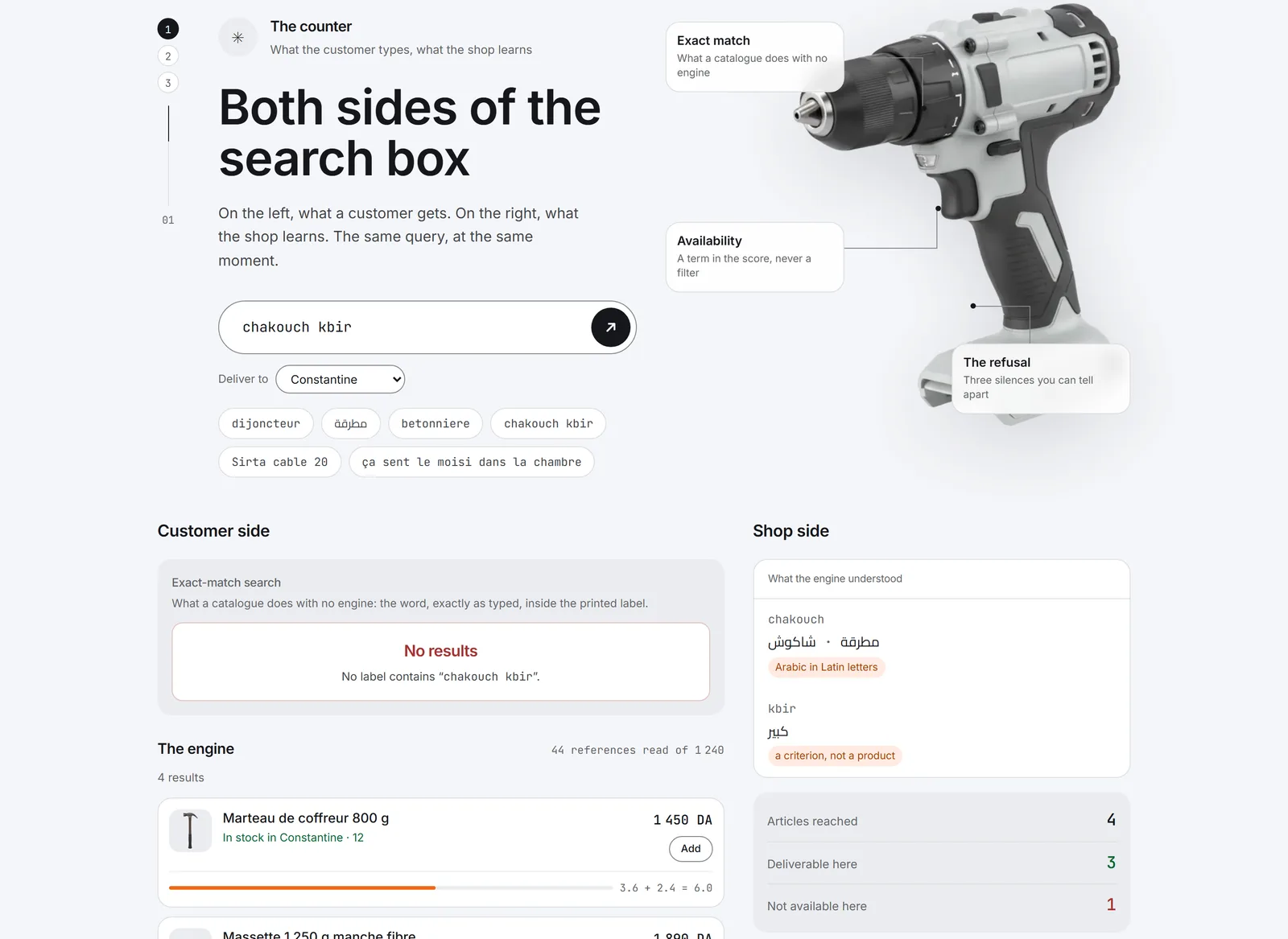
One search, from the customer’s side and the shopkeeper’s.
An imaginary hardware shop in Constantine, and its search box shown from both sides at once: on the left what a customer gets out of a typo or a word in Arabic, on the right what the shop learns from it.
See the demonstration (El Kantara Hardware)The catalogue, the stock and the three months of searches that found nothing are invented. The normalisation, the ranking and the refusal to recommend on a history that is too thin are the real code.
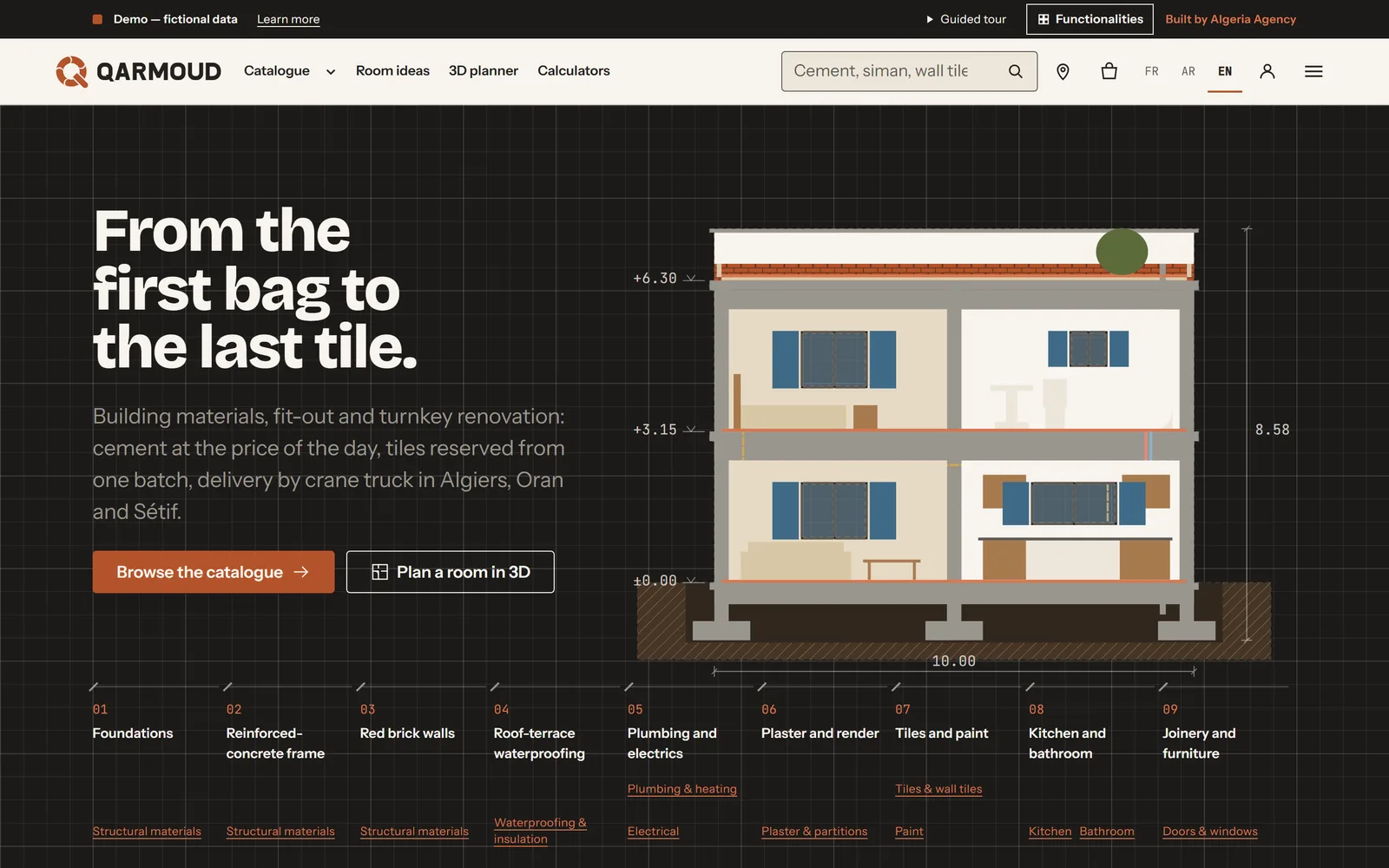
A building-materials merchant and a renovation workshop: quantity calculators, a 3D planner and delivery to site.
A building-materials merchant and a renovation workshop on one platform: a catalogue at the day’s prices, quantity calculators, a 3D planner, trade accounts with credit, the counter, the depot, delivery rounds, site tracking and management.
See the demonstration (Qarmoud)Fictional group, products with no real brand, indicative prices, simulated orders and deliveries.
The problem
What we usually find
- Your best jobs are photographed nowhere.
- You price enquiries that never had a budget.
- You are compared on price alone because nothing else is visible.
- An unhappy customer tells the story of their job and you have nothing to set against it.
Fear of the overrun comes before price. Explaining how you quote, what moves a figure, and what you do when something unexpected appears is worth more than any discount.
Where we stand
What distinguishes you is facing what everybody else avoids.
In home and construction, nobody buys on a description. The customer buys on photographs of finished work, on the resemblance to what they want to do, and on the conviction that the quoted price will be the price paid.
It is a sector where distrust is justified by common experience: overruns, delays, jobs abandoned halfway. Any communication that ignores that rings false. One that meets it head-on — how you price, what makes a price vary, what happens if something unexpected appears — distinguishes immediately.
The third reality is rhythm. Enquiries arrive in waves by season and by building period, and a constant advertising budget across the year spends at the wrong moment.
So our work is to make your finished jobs the main material, make the quoting process explicit, and concentrate spend on the periods when people actually decide.
Overruns, delays, jobs abandoned midway. Silence on those sounds false.
The engine
The acquisition engine, in nine stages
Nine stages, governed here by two things advertising cannot manufacture: finished jobs you can show, and a quoting method you can explain. The rest follows a calendar — and most of that calendar is now known, because a housing programme entering delivery concentrates thousands of finishing enquiries into the same months, in wilayas known in advance.
Stage 00 — Measurement
Telephone, messaging, word of mouth
Count the enquiries you could price, not the enquiries.
A tradesman takes many calls and can quote only some: out of area, out of trade, out of budget, or too vague to assess. So the useful figure is the share that reaches a site visit, and it can be counted by hand in a fortnight.
You do
Nothing. Approve one access request.
We do
We look at what separates the two, and it is nearly always the framing.
You get
The real proportion, which is usually far lower than people think.
Stage 01 — Attention
Search, social, neighbourhood
A wave of finishing work is coming, and its date is public.
A housing programme entering delivery puts thousands of families in front of a flat to finish, at the same time, in identified wilayas. Paint, plumbing, wiring, joinery, kitchens: the demand is dated, located, and it is prepared for before the keys are handed over rather than afterwards.
You do
Nothing. Tell us once which finishing trades you cover.
We do
We prepare the pages and the advertising for those communes before the handovers.
You get
A head start on demand everybody will notice at the same moment you do.
Stage 02 — Intent
Search, social, listing
People search a trade, a commune, and proof of likeness.
Nobody searches “building firm”. They search for somebody who has already done exactly what they want doing, near them. Likeness is the argument: a job near theirs convinces more than a list of competences.
You do
Nothing. Tell us once which districts you do not work in.
We do
We write a page per type of work, with the jobs that resemble it.
You get
Calls that open with “I saw what you did at…”.
Stage 03 — The landing
Site, listing, social
The web is used to check somebody already heard of.
Word of mouth stays dominant, and the page exists to confirm it. Jobs that are dated and located do exactly that work — and it is often where the decision sets, at the moment somebody looks your name up after a family dinner.
You do
Nothing. Let us date and locate what we publish.
We do
We publish them that way, because a job with no date proves nothing.
You get
A recommendation that firms up instead of crumbling.
Stage 04 — Conversion
Site, quoting page
Explain how you quote, before anybody asks.
What moves a figure — area, the state of what is there, access, materials, timescale — and what happens if something unexpected appears mid-job. Publishing that method does not give away your price: it gives your seriousness, and it answers the only real obstacle.
You do
Nothing.
We do
We write it in plain language and put no amount in it at all.
You get
Clients who understand a quote instead of suspecting it.
Stage 05 — The reply
WhatsApp, telephone
The enquiry arrives as a message, with photographs.
A quick reply asking three precise questions — what area, what condition, what deadline — qualifies better than a form and happens in the channel people already use. The assistant asks those and never quotes: a price given without seeing the place is the leading cause of an overrun.
You do
Nothing. Go out to the jobs it has qualified.
We do
We have it ask them immediately and forbid it to name any amount.
You get
Prepared site visits, and no price expectation created by accident.
Stage 06 — The follow-up
WhatsApp, telephone
A quote with no follow-up is not a refusal. It is a delay.
Work is often decided months after the first quote, when the money is there or the season allows. A reminder at three months, without reopening the price, recovers jobs the tradesman had written off — and it costs one message.
You do
Nothing.
We do
We schedule a simple re-contact, with no new offer attached.
You get
Jobs signed long after the quote, which is this trade’s normal rhythm.
Stage 07 — Reputation
Reviews, listing, word of mouth
Reputation is decided at the end of a job, not at the start.
Reviews in this sector are about sticking to the quote, holding the timescale, and the finish. Those three are settled in execution — and the only contribution possible beforehand is having written down what would happen if one of them slipped.
You do
Nothing. Let us ask for a review on handover day.
We do
We build the ask into that moment and answer whatever arrives.
You get
Reviews written by people who have just watched you finish.
Stage 08 — Proof
Site, social, listing
Proof is a finished job, dated, and nearby.
No catalogue image, no render, no job that is not yours: in this trade likeness is the argument, and a borrowed photograph is exposed at the first meeting. Three real jobs are worth more than thirty images, provided people know where and when.
You do
Read one page a month. Make one decision.
We do
We publish what is yours and nothing else, with the date and the commune.
You get
Proof that holds up in front of somebody who knows the neighbourhood.
What we do
What you get
Job photography
Before, during, after. The during matters: it shows method, and it is what nobody publishes.
Work types framed
What you do and what you do not, stated clearly so the filter happens before the quote.
Quoting process explained
How you price, what makes it vary, what happens when something unexpected appears. Rare, and decisive.
Coverage area
The municipalities you cover, so you do not pay for enquiries out of reach.
Reputation watched
A job dispute is visible and durable. It is handled by replying, not by waiting.
Who arrives
Who is looking for you, and where they pass
Five arrivals, and the largest of the year carries a date: it lands with the handovers.
Who arrives
A family that has just taken a flat needing finishing
First
The trade and commune page
Then
Message with photographs
Why
Thousands more decide the same month, and the ground is bought before then.
Who arrives
Somebody checking a name a relative gave them
First
Jobs, dated and located
Then
Call
Why
The recommendation brought them; here the decision sets or comes apart.
Who arrives
Somebody whose real fear is the overrun
First
The page explaining how you quote
Then
Site visit
Why
Price is not their obstacle, and nobody writes down what happens when it slips.
Who arrives
Somebody you quoted for in February
First
A message with no new offer
Then
The job
Why
They did not say no: they were waiting for money or the season, and forgot to come back.
Who arrives
Somebody whose enquiry cannot be priced
First
The framing on the page
Then
Nothing, and that is the point
Why
Travelling for an impossible enquiry costs a day nobody pays for.
On the ground
How is a building tradesperson chosen in Algeria?
Recommendation remains dominant, and the web is used mainly to verify somebody already heard about. A page with dated, located jobs confirms what the recommendation claimed, and that is often where the decision sets.
Fear of overrun is the first obstacle, ahead even of price. Explaining how you price, what can make it vary, and what you do when something unexpected appears is worth more than any discount announced.
Enquiries arrive almost entirely by phone or messaging, with photographs attached. A fast reply with a precise question — what area, what condition, what deadline — qualifies better than a form, and it is the channel to organise first.
Getting started
How we work
Gather the jobs
Existing photographs sorted, and a simple instruction for photographing the next ones.
Frame the offer
Work types, area, order of magnitude. It is the filter that saves the most time.
Write the quoting process
The page that answers the customer’s real fear, and that almost no competitor has.
Concentrate the spend
On the periods when enquiries actually arrive, rather than at a constant budget.
Track quotes and signatures
How many enquiries, how many quotes, how many signed. That is the only chain that counts.
The result
What changes
Constant visual proof
Before and after of real jobs, which replaces every argument and cannot be copied.
Fewer wasted quotes
Clear framing of job type and order of magnitude turns away enquiries that will never convert.
Spend at the right time
Advertising concentrated on decision periods rather than spread across the year.
Who this is for
Is this the right fit for you?
We work well with
- You have finished jobs to show.
- You can respond to an enquiry within the day.
- You accept explaining how you price.
We are the wrong choice if
- You do not want to photograph your work. Without visual proof, only price is left.
- You answer enquiries once a week. The customer will have signed elsewhere.
- You want every enquiry regardless. Quoting for nothing costs more than it returns.
Questions
Frequently asked questions
Should we publish prices?
An order of magnitude is enough and does the job: it turns away out-of-budget enquiries without committing you to a precise figure.
Which photographs should we publish?
Before, during and after, of real dated jobs. The “during” is the most convincing and the least published.
How do we avoid wasted enquiries?
By stating work types, area and order of magnitude clearly. The filter costs a paragraph and saves days.
When should we spend on advertising?
In the periods when people actually commission work. A constant year-round budget spends much of it into nothing.
What do we do about a negative review?
Reply factually and quickly, without argument. The reader judges your reply more than the complaint.
Do we need a website or is a page enough?
A website earns its place as soon as you want jobs organised by type and want to be found in searches. A page alone limits both.
Let's talk
How to start
Send us photographs of three finished jobs and tell us your area and your work types.
We come back with the selection to publish, the framing that will turn away unquotable enquiries, and the periods to concentrate spend on.
- No image that is not yours
- Area and work type stated upfront
- The chain tracked to signature