How we see you
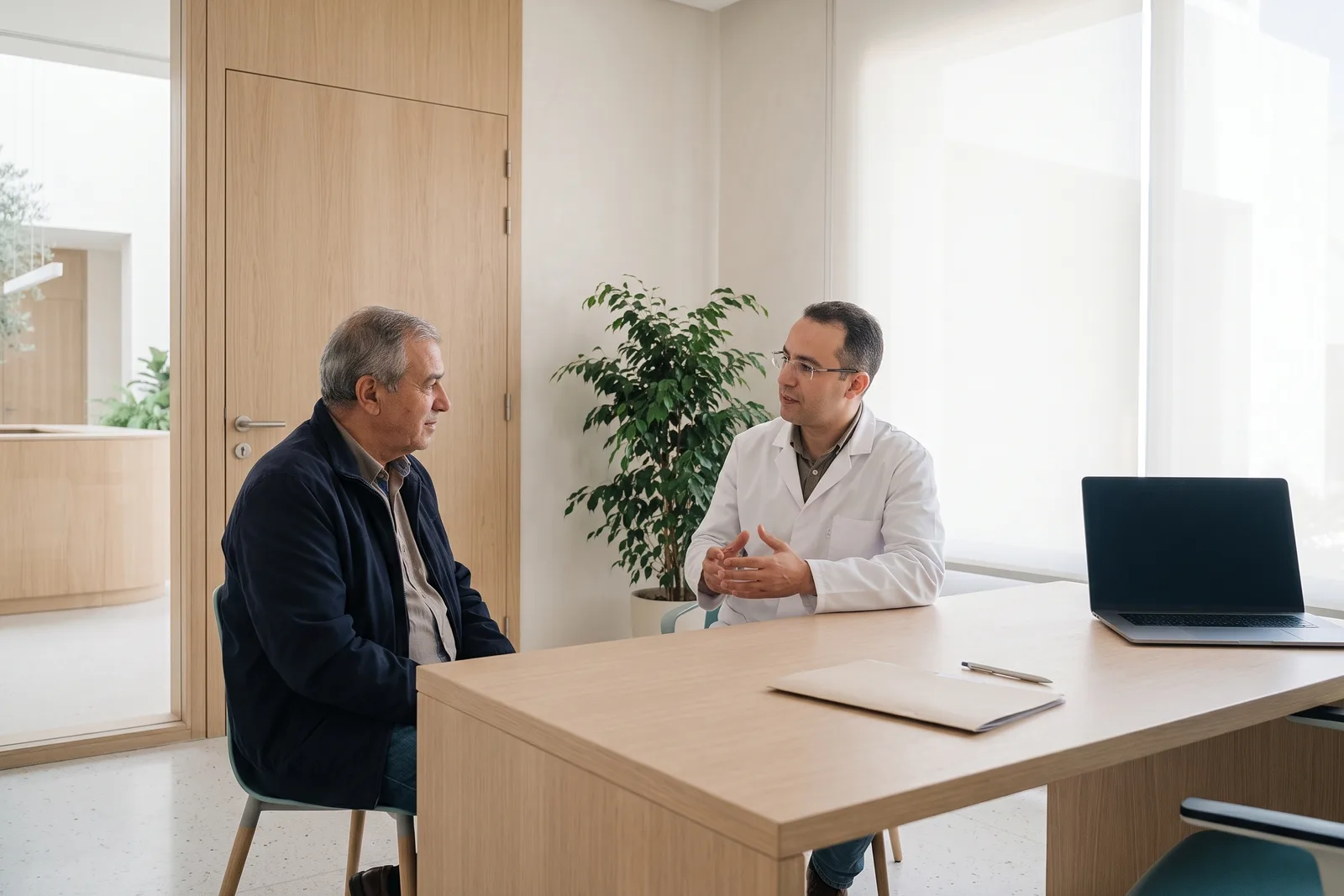
People often wait too long before seeing a urologist, out of embarrassment more than neglect. The consultation takes place in a closed room on the first floor of wing B, with a doctor who is used to these questions and asks them plainly: how often you go, whether you get up at night, how strong the flow is, any pain, any blood. You can come alone or with someone, as you prefer.
The clinical examination is the heart of the consultation, and it is always explained before it happens. A kidney and bladder ultrasound is often done the same day on the ground floor; it needs a full bladder, and you are told in advance how to drink so that it is. Urine and blood tests are done in the laboratory next door.
Part of urology is surgical: a stone to remove, a prostate operation, a circumcision. In that case the urologist explains the options, then the anaesthesia consultation and the procedure are arranged on the second floor, where the operating block is. Each step leaves a report in your patient space.
People often come for…
A few common reasons, put the way patients put them. They help you find the right door; they say nothing about what you have.
- Needing to pass water often
- Kidney stones
- Prostate follow-up
- Repeated urinary infections
- Blood in the urine
- Circumcision
What we examine and take care of
Every situation is different: the consultation, and only the consultation, decides what comes next.
Urinary symptoms
Needing to go often or urgently, getting up at night, a weak flow or the feeling that the bladder has not emptied.
Stones
A past bout of renal colic or a stone seen on ultrasound, and what should be watched or considered next.
The prostate
Follow-up of a prostate that causes trouble, and the regular checks your doctor has asked for, backed by tests.
Infections and blood in the urine
Urinary infections that keep coming back, or visible blood in the urine, whose cause always needs looking for.
Circumcision and urological surgery
The consultation before a circumcision or an operation, to explain how it goes and to prepare the anaesthesia.
Tests, on site
The tests this specialty asks for most often are done here, without changing address.
Laboratory
A first consultation, step by step
Arrival
You check in at the ground-floor reception, then go to the first floor, wing B. If an ultrasound is planned for the same day, you are told when to start drinking.
Questions
The doctor asks about your symptoms, your history, past operations and treatments, plainly and without judgement.
Examination
The doctor examines you, explaining each step; it is brief, and you can ask to pause at any moment.
Next steps
Ultrasound, urine or blood tests are done on site, and a written report is added to your patient space.
What to bring
- Previous ultrasounds, CT scans and urology reports
- Your latest results, especially urine tests, and a PSA test if you have had one
- Your current prescriptions, or the boxes of your medicines
- If you can, a record of when and how much you pass water over a day or two
Where to find us
Consultations take place on the first floor, wing B.
fourth floor — not on your routethird floor — not on your routesecond floor — not on your route
- From
- Main entrance
- To
- Room 131 — urology
About 89 m on footFloors on the way: ground floor, first floor
The steps, in order
- Starting point: Main entrance.
- Carry on straight for about 50 m.
- Take lift A to the first floor.
- Carry on straight for about 5 m.
- Turn left.
- Carry on straight for about 30 m.
- Room 131 — urology is on your right.
The doctors
Each doctor’s next free slot, worked out just now. Book the one that suits you directly.
2 doctors available
Looking for appointments…
On site only
By teleconsultation
Urology is seen on site only: the clinical examination and, often, the bladder ultrasound are part of the consultation itself, and neither can be done at a distance.
Common questions
Do I need to come with a full bladder?
Only if a bladder ultrasound is booked. In that case you are asked to drink a litre of water in the hour before and not to empty your bladder; the exact instruction is on your appointment notice. The consultation on its own needs no preparation.
I find this embarrassing to talk about. What happens?
That is common, and urologists are used to it. The consultation takes place behind a closed door; the doctor asks precise questions, but you answer at your own pace. You can choose your doctor from the profiles below, and come alone or with someone.
My son is to be circumcised: how is it arranged?
First comes a urology consultation to examine the child and answer your questions. The procedure is then booked in the operating block on the second floor, after an anaesthesia consultation, and the child usually goes home the same day. Instructions for the following days are given to you in writing.
Do I need a letter from my GP?
No, you can book directly. If your doctor refers you, bring their letter and the tests they asked for. The clinic gives you the feuille de soins, the claim form for your fund; reimbursement then depends on your scheme and any top-up insurance.