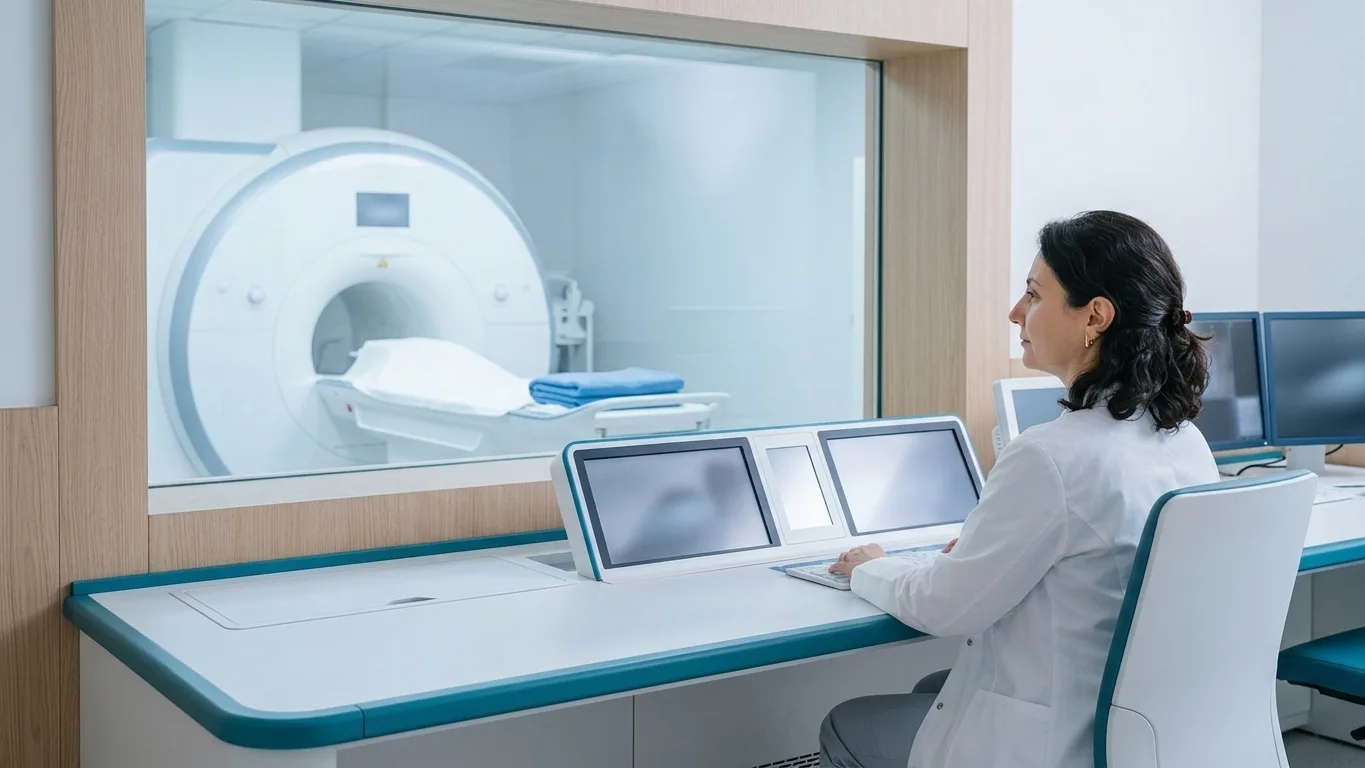
The equipment
Recent machines, set to the lowest dose that gives a useful image, and serviced on a published schedule.
1.5 T MRI
A wide, well-lit bore, music through headphones and a call button in your hand for the whole exam.
Open 08:00 to 19:00
MRI
64-slice CT scanner
A scan that takes seconds, and access kept for emergencies day and night.
Open 08:00 to 18:00
CT scanner
Ultrasound
Two ultrasound rooms: abdomen, pelvis, thyroid, urinary tract and pregnancy scans.
Open 08:00 to 17:00
Ultrasound 1
Digital X-ray
Digital images, visible to your doctor as soon as they are taken.
Open 08:00 to 18:00
X-ray
Digital mammography unit
Compression adjusted by a trained radiographer, and the screening read by the radiologist the same day.
Open 08:00 to 16:00
Mammography
Echocardiography unit
Heart ultrasound, on the first floor next to the cardiology rooms.
Open 08:30 to 16:30
Room 103 — echocardiography and ECG
ECG machine
The resting electrocardiogram, in a few minutes.
Open 08:00 to 17:00
Room 103 — echocardiography and ECG
Exercise test ergometer
The exercise test on a bike, watched throughout by a cardiologist.
Open 08:30 to 14:00
Room 104 — stress test and Holter
Holter recorders
A small recorder worn for twenty-four hours and returned the next day.
Open 08:30 to 15:00
Room 104 — stress test and Holter
Every exam, its length, its preparation
Open an exam to read what to do before you come. The same instructions are sent with your booking confirmation.
MRI
Knee MRI
30 minBefore the exam
- Bring your doctor’s prescription or referral letter.
- Remove jewellery, watch, belt and any metal object before the exam.
- Tell us about a pacemaker, valve, implant or metal fragment: MRI may not be possible.
- Bring your previous imaging and reports for comparison.
Brain MRI
40 minBefore the exam
- Bring your doctor’s prescription or referral letter.
- Remove jewellery, watch, belt and any metal object before the exam.
- Tell us about a pacemaker, valve, implant or metal fragment: MRI may not be possible.
- Bring a creatinine test less than three months old: it is required before any contrast agent.
- Tell the desk about any known allergy, especially to iodinated contrast.
- Bring your previous imaging and reports for comparison.
Lumbar spine MRI
35 minBefore the exam
- Bring your doctor’s prescription or referral letter.
- Remove jewellery, watch, belt and any metal object before the exam.
- Tell us about a pacemaker, valve, implant or metal fragment: MRI may not be possible.
- Bring your previous imaging and reports for comparison.
CT
Chest and abdomen CT
20 minBefore the exam
- Bring your doctor’s prescription or referral letter.
- Come having fasted for 4 hours: no food and no sweet drinks; plain water is fine.
- Bring a creatinine test less than three months old: it is required before any contrast agent.
- Tell the desk about any known allergy, especially to iodinated contrast.
- If you are or might be pregnant, tell us before the exam.
- Bring your previous imaging and reports for comparison.
Head CT
15 minBefore the exam
- Bring your doctor’s prescription or referral letter.
- If you are or might be pregnant, tell us before the exam.
- Remove jewellery, watch, belt and any metal object before the exam.
- Bring your previous imaging and reports for comparison.
Ultrasound
Abdominal ultrasound
20 minBefore the exam
- Come having fasted for 6 hours: no food and no sweet drinks; plain water is fine.
- Bring your previous imaging and reports for comparison.
Pelvic ultrasound
20 minBefore the exam
- Drink a litre of water in the hour before and do not empty your bladder: it needs to be full.
- Bring your previous imaging and reports for comparison.
First-trimester pregnancy scan
30 minBefore the exam
- Drink a litre of water in the hour before and do not empty your bladder: it needs to be full.
- Bring your pregnancy record and previous scans.
Second-trimester pregnancy scan
40 minBefore the exam
- Bring your pregnancy record and previous scans.
Third-trimester pregnancy scan
30 minBefore the exam
- Bring your pregnancy record and previous scans.
Thyroid ultrasound
15 minBefore the exam
- Bring your previous imaging and reports for comparison.
Kidney and bladder ultrasound
20 minBefore the exam
- Drink a litre of water in the hour before and do not empty your bladder: it needs to be full.
- Bring your previous imaging and reports for comparison.
X-ray
Chest X-ray
10 minBefore the exam
- If you are or might be pregnant, tell us before the exam.
- Remove jewellery, watch, belt and any metal object before the exam.
Knee X-ray
10 minBefore the exam
- If you are or might be pregnant, tell us before the exam.
Spine X-ray
15 minBefore the exam
- If you are or might be pregnant, tell us before the exam.
- Remove jewellery, watch, belt and any metal object before the exam.
Mammography
Mammogram
20 minBefore the exam
- Do not put deodorant, talc or cream on your chest or underarms on the day.
- Bring your previous imaging and reports for comparison.
Heart tests
Echocardiogram
30 minBefore the exam
- Bring your previous imaging and reports for comparison.
Electrocardiogram (ECG)
10 minBefore the exam
- Avoid cream or body lotion on your chest: the electrodes stick better to clean skin.
Exercise stress test
45 minBefore the exam
- Bring your doctor’s prescription or referral letter.
- Have a light meal at least two hours before; avoid coffee and tea that day.
- Wear sports clothes and shoes suitable for walking.
- Avoid cream or body lotion on your chest: the electrodes stick better to clean skin.
24-hour Holter ECG
15 minBefore the exam
- Bring your doctor’s prescription or referral letter.
- Avoid cream or body lotion on your chest: the electrodes stick better to clean skin.
- The recorder is worn for twenty-four hours: plan to come back the next day at the same time to return it.
During Ramadan
During Ramadan, fasting exams are booked in the morning, so the overnight fast is enough. For any current treatment, ask your doctor.
Your images and the report, online
The report is signed by the radiologist, then published in your patient space, with the images to browse.
The exam
The radiographer settles you in, explains each step and stays in touch with you.
The reading
The radiologist reviews the images, compares them with earlier ones and writes the report.
Publication
You get a message as soon as the report is validated: the same day for most exams.
With your doctor
Your doctor sees the same images and report, and talks them through with you in consultation.
Your safety comes first
- We ask about a pacemaker, a valve or any implant before every MRI.
- Creatinine is checked before any contrast agent.
- A possible pregnancy is always raised before a CT scan or an X-ray.
- A parent can stay with a child during the exam, protected if needed.
Common questions
Do I need a prescription?
For MRI, CT, ultrasound and mammography, yes: bring the prescription or your doctor’s letter. A clinic doctor can also request an ECG or a chest X-ray during a consultation.
Is the MRI noisy?
It makes a steady knocking sound. You are offered headphones with music, and you hold a call bulb to speak to the radiographer at any moment.
When will I get my report?
The same day for most exams, once the radiologist has read and signed it. A message tells you as soon as it is in your patient space.
Can I have my images?
Yes: you can view them online, and a CD can be handed over at the imaging desk on request, for a doctor outside the clinic.