Laboratory · ground floor
A blood test in the morning, results explained
Samples are taken without an appointment every morning, or at a booked time if you would rather not wait. Every result is validated by a clinical biologist before it is published in your patient space, with what each test measures.
Opening hours
- Sampling, Saturday to Thursday
- 07:30 – 11:30
- Urine sample drop-off
- 07:30 – 12:00
- Laboratory desk
- 07:30 – 16:00
- Friday
- Closed
For emergencies, the laboratory answers at any hour, at the emergency physician’s request.
Coming fasted, when it is needed
Not every test needs you to fast. When one does, you are told how long when you book and on each test’s card.
- Fasting means no food and no sweet drinks; plain water is allowed and even encouraged.
- Take your usual treatments unless your doctor has told you otherwise.
- Avoid smoking and hard exercise on the morning of the test.
- For a child, bring a snack to give straight after the blood test.
From sample to result
Nobody reads a result before it is validated, and you always know where it stands.
The sample
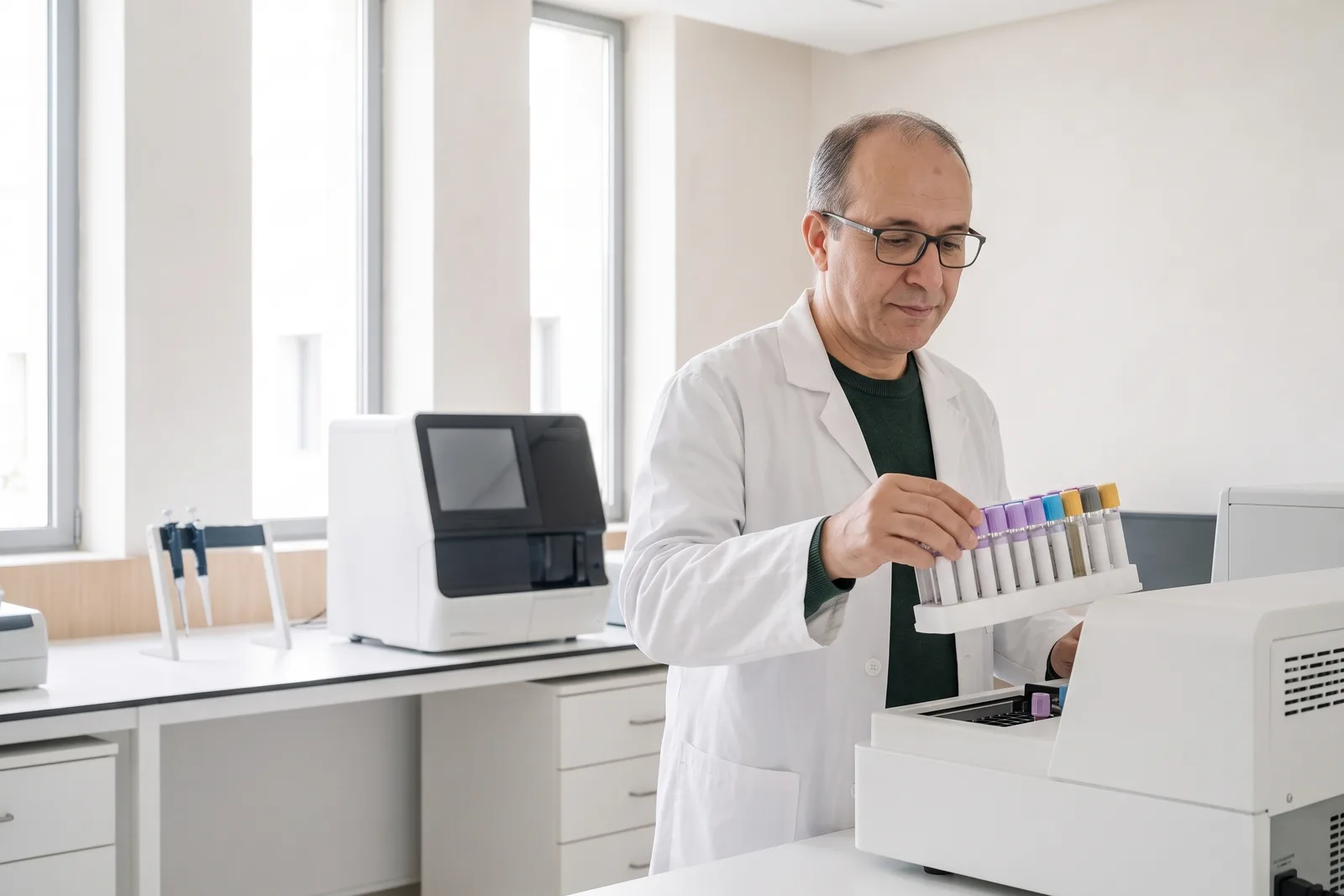
A nurse settles you comfortably; it takes a few minutes. The tubes are labelled in front of you.
The analysis
Samples run on the laboratory’s analysers, checked every morning before the first batch.
Validation
The biologist checks every result, compares it with earlier ones and may ask for a repeat.
Publication
The validated result appears in your patient space, and your doctor is told at the same moment.
How a result is read
Every value is placed on its reference range, with a word to say where it sits: normal, to watch or out of range. Never colour alone.
The tests, and what they measure
Each test says what it measures, whether you need to fast, and how long the result usually takes.
Fasting glucose
- Fast 8 h
- Result in 4 h
- Blood sample
- Fasting blood glucoseThe amount of sugar in the blood after a night without eating.
HbA1c
- No fasting
- Result in 24 h
- Blood sample
- Glycated haemoglobin (HbA1c)The average blood sugar over the last two to three months.
Full blood count
- No fasting
- Result in 4 h
- Blood sample
- HaemoglobinThe protein in red blood cells that carries oxygen.
- White blood cellsThe number of cells that defend the body against infection.
- PlateletsThe cells that help the blood to clot.
Lipid profile
- Fast 12 h
- Result in 6 h
- Blood sample
- Total cholesterolAll the cholesterol-type fats carried in the blood.
- HDL cholesterolThe part of the cholesterol the blood carries back to the liver.
- LDL cholesterolThe part of the cholesterol the blood carries to the tissues.
- TriglyceridesThe blood fats the body uses as an energy store.
Creatinine and eGFR
- No fasting
- Result in 4 h
- Blood sample
- CreatinineA waste product of the muscles that the kidneys clear; it reflects how well they filter.
- Estimated glomerular filtration rate (eGFR)An estimate, calculated from creatinine, of how much the kidneys filter.
Urea
- No fasting
- Result in 4 h
- Blood sample
- A waste product of proteins cleared by the kidneys.
Electrolytes
- No fasting
- Result in 4 h
- Blood sample
- SodiumThe salt in the blood, which governs how water is shared out in the body.
- PotassiumA mineral the muscles and the heart need to work.
- ChlorideA mineral that works with sodium to balance water.
TSH
- No fasting
- Result in 24 h
- Blood sample
- The hormone through which the brain directs the thyroid.
Free T4
- No fasting
- Result in 24 h
- Blood sample
- The hormone the thyroid makes, in its active form in the blood.
CRP
- No fasting
- Result in 4 h
- Blood sample
- C-reactive protein (CRP)A protein whose level rises with inflammation.
Ferritin
- No fasting
- Result in 24 h
- Blood sample
- The body’s store of iron.
Liver function tests
- No fasting
- Result in 6 h
- Blood sample
- AST (transaminase)An enzyme of the liver and muscles, measured to follow the liver.
- ALT (transaminase)An enzyme found mainly in the liver.
- Gamma-GTAn enzyme of the liver and the bile ducts.
Vitamin D
- No fasting
- Result in 2 days
- Blood sample
- Vitamin D (25-OH)The store of vitamin D, which the bones and muscles use.
βhCG
- No fasting
- Result in 4 h
- Blood sample
- The hormone produced during pregnancy.
Blood grouping
- No fasting
- Result in 6 h
- Blood sample
- Blood group and rhesusThe blood group (A, B, AB or O) and the rhesus factor.
Antenatal serology
- No fasting
- Result in 2 days
- Blood sample
- Toxoplasmosis serologyWhether the body has already met the toxoplasmosis parasite.
- Rubella serologyWhether the body is protected against rubella.
- HBs antigen (hepatitis B)Whether the hepatitis B virus is present in the blood.
- HIV serologyWhether antibodies to HIV are present.
- Syphilis serology (TPHA-VDRL)Whether antibodies to the syphilis bacterium are present.
Urine culture
- No fasting
- Result in 2 days
- Urine sample
- Whether bacteria or cells are present in the urine.
PSA
- No fasting
- Result in 24 h
- Blood sample
- Total PSAA protein made by the prostate.
INR
- No fasting
- Result in 4 h
- Blood sample
- How long the blood takes to clot, expressed so that laboratories can be compared.
Common questions
Do I need a prescription?
Yes, most tests are done on a doctor’s prescription, from the clinic or elsewhere. Bring it to the sampling room, or show it on your phone.
Do I need an appointment?
No: samples are taken without an appointment in the morning. Booking a slot simply saves you waiting, especially early in the week.
When will I get my results?
It depends on the test: a few hours for a blood count or a glucose, two days for a urine culture. A message tells you as soon as they are published.
What if a result is very abnormal?
The biologist calls the prescribing doctor directly, without waiting for online publication. That is the rule for every critical value.