 Fictional character
How we see you
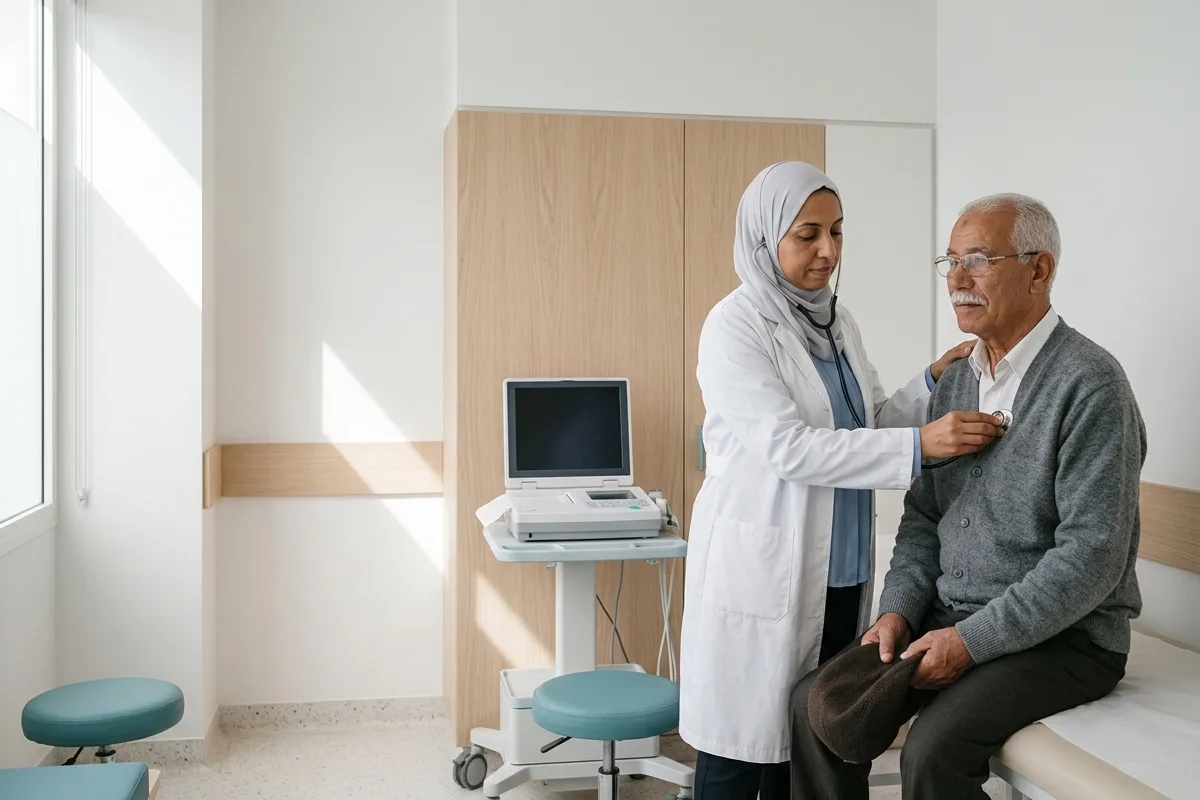
A cardiology appointment starts with time to talk: your history, the treatments you take, heart conditions in your family and what you notice from day to day. The cardiologist then takes your blood pressure in both arms, listens to your heart and the arteries in your neck, and usually records an ECG during the same visit. It all happens on the first floor, wing A, where the consulting rooms and the test rooms face each other.
If a further test would help, you do not need to go anywhere else: echocardiograms and ECGs are done in room 103, exercise tests and Holter fitting in room 104, a few steps from the consulting room. Blood tests such as cholesterol or kidney function are taken at the ground-floor laboratory. The doctor who asked for the test is the one who goes through the result with you, in plain words.
Follow-up matters as much as the first assessment. After each appointment a written summary is added to your patient space, with the results and the next steps agreed together. You can read it again before your next visit or pass it on to your GP, and some follow-up appointments take place by video when the cardiologist feels it is appropriate.
People often come for…
A few common reasons, put the way patients put them. They help you find the right door; they say nothing about what you have.
- High blood pressure
- Palpitations
- Breathlessness on exertion
- Check-up before returning to sport
- Cholesterol to keep an eye on
- Follow-up after a heart event
What we examine and take care of
Every situation is different: the consultation, and only the consultation, decides what comes next.
Blood pressure
Readings in clinic, a look at the ones you take at home, and treatment follow-up over time.
Heart rhythm
Palpitations, a heart that races or slows: an ECG and, where needed, a 24-hour Holter record what is actually happening.
The heart under effort
Breathlessness, discomfort on the stairs or a check before returning to sport, with an exercise test on site if it is indicated.
Risk factors
Cholesterol, diabetes, smoking and family history: an overall assessment of what deserves keeping an eye on.
Long-term follow-up
After a heart event or a procedure, regular reviews coordinated with the other doctors who look after you.
Tests, on site
The tests this specialty asks for most often are done here, without changing address.
A first consultation, step by step
Arrival and observations
At the first-floor reception we check your file, then a nurse takes your weight, blood pressure and pulse before you see the doctor.
Your history
The cardiologist asks what brings you in, about your current treatments, your lifestyle and heart conditions in your family.
Examination and ECG
Listening to the heart, blood pressure in both arms, a look at your legs and pulses, then an ECG that takes a few minutes and does not hurt.
Next steps, in writing
If a further test is useful, it is offered on site; the summary and the date of your next appointment arrive in your patient space.
What to bring
- Previous cardiology reports, ECGs and scans
- A list of your current treatments, or your latest prescriptions
- Your home blood pressure readings, if you take them
- Recent blood test results
Where to find us
Consultations take place on the first floor, wing A.
fourth floor — not on your routethird floor — not on your routesecond floor — not on your route
- From
- Main entrance
- To
- Room 101 — cardiology
About 97 m on footFloors on the way: ground floor, first floor
The steps, in order
- Starting point: Main entrance.
- Carry on straight for about 50 m.
- Take lift A to the first floor.
- Carry on straight for about 5 m.
- Turn right.
- Carry on straight for about 40 m.
- Room 101 — cardiology is on your right.
The doctors
Each doctor’s next free slot, worked out just now. Book the one that suits you directly.
3 doctors available
Looking for appointments…
- Fictional character
Available by video
By teleconsultation
Follow-up can be done by video: going through results together, reviewing your blood pressure readings and revisiting the follow-up plan if the cardiologist judges it possible. A first assessment, examining the heart, the ECG and the scans all need you here in person.
Common questions
Do I need a referral letter?
No, you can book directly. A letter from your GP is still helpful, as it sums up your history and what they would like to know, and the summary can be sent back to them if you wish. Some tests, such as the exercise test, are booked on a doctor’s request.
Is the exercise test hard?
You pedal a bike or walk on a treadmill while the effort rises in stages, watched throughout by a cardiologist and a nurse. The test stops whenever it needs to. Come in sportswear, after a light meal, with no cream on your chest.
Should I come fasting?
Not for the consultation or the ECG. If a blood test is planned for the same day, the laboratory tells you when you book whether it needs fasting. Before an exercise test, on the contrary, have a light meal.
Is the consultation reimbursed by CNAS?
The clinic gives you a claim form and the supporting documents after every consultation and test. Reimbursement then depends on your own scheme, whether CNAS, CASNOS or a mutual insurer; the admissions office can help you put the file together.