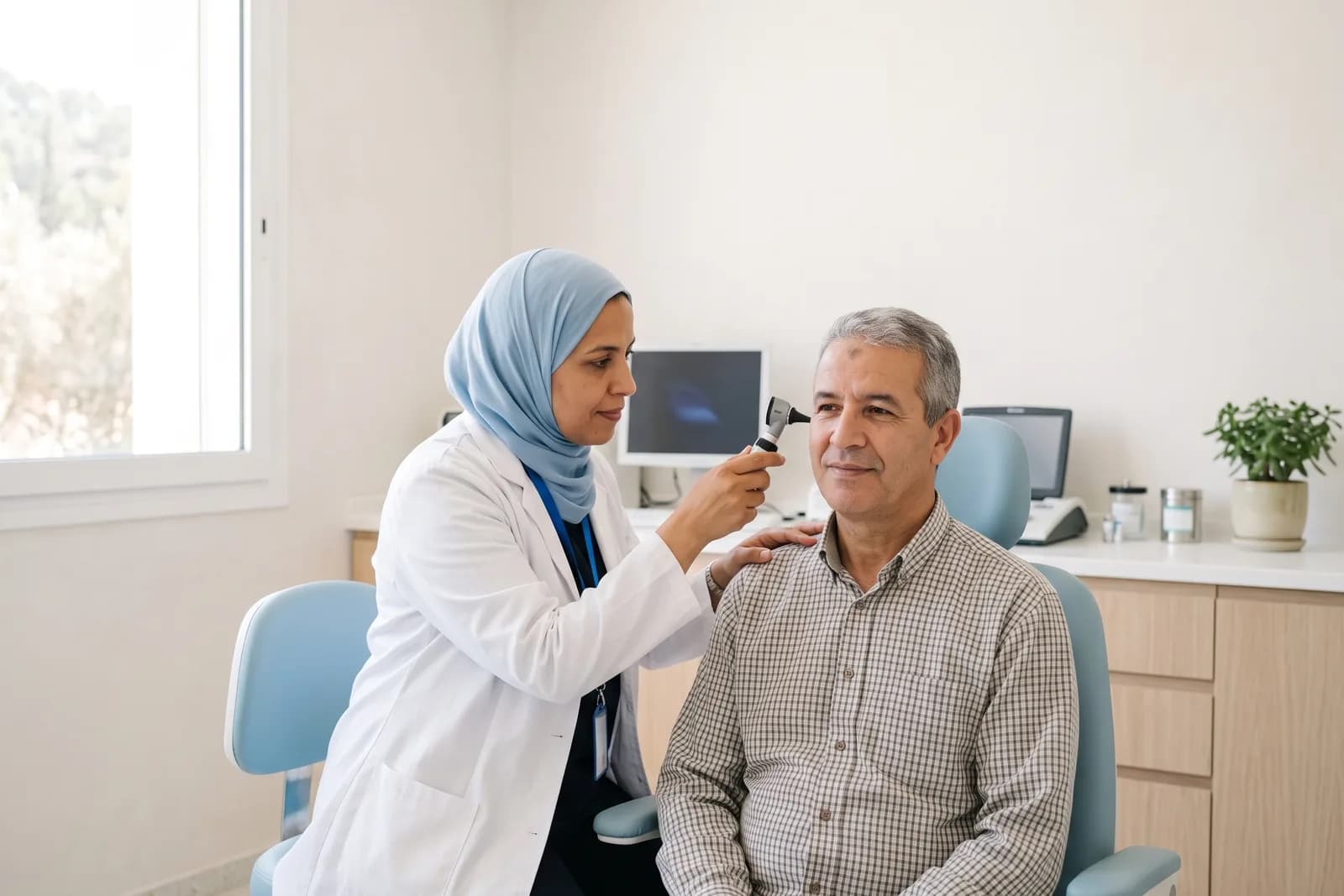
How we see you
ENT appointments take place on the first floor, in wing B, in a consulting room equipped for most of the tests you may need. The doctor looks at the eardrum under a microscope, examines the nose and throat with a thin flexible camera when it helps, and can test your hearing in a soundproof booth during the same visit. Most people leave with a clear explanation, without having to come back for a first test.
Many of our patients are children: repeated sore throats, ear infections, snoring, enlarged adenoids. The ENT room sits next to the paediatricians’ rooms, and the two teams talk to each other, which makes it easier to follow a child seen by one and then the other. In adults, dizziness, hearing loss or sinusitis that drags on often call for several appointments, planned in advance.
After each appointment, the report, your hearing test result and any blood tests requested from the ground-floor laboratory are gathered in your patient space. If an operation is suggested, for tonsils or adenoids for example, it takes place in the second-floor operating theatres, often as a day case, after an anaesthetic assessment.
People often come for…
A few common reasons, put the way patients put them. They help you find the right door; they say nothing about what you have.
- Repeated sore throats
- Sinusitis
- Hearing loss
- Ringing in the ears
- Snoring
- Dizziness
What we examine and take care of
Every situation is different: the consultation, and only the consultation, decides what comes next.
Hearing
Hearing loss, a blocked ear, recurring ear infections: an eardrum examination and a hearing test in the room.
Tinnitus and dizziness
An examination of the ear and of balance to understand where these sensations come from.
Nose and sinuses
A blocked or runny nose, or sinusitis that lingers, examined with the flexible camera if needed.
Throat and voice
Repeated sore throats, a hoarse voice, difficulty swallowing: a careful examination of the throat and larynx.
Sleep and snoring
Snoring and noisy breathing at night, in children as well as adults.
Tests, on site
The tests this specialty asks for most often are done here, without changing address.
Laboratory
A first consultation, step by step
Arrival
At the wing B reception we check your file and any tests you have already had.
Talking it through
The doctor asks how long the problem has lasted, what makes it worse and what you have already tried.
The examination
Ears under the microscope, nose and throat with a light or the flexible camera: a few seconds of mild discomfort at most, always explained first.
Hearing test and next steps
If your hearing is in question, a test is done in the booth; the report and follow-up plan are added to your patient space.
What to bring
- Previous hearing tests and ENT reports
- Any sinus CT scans or other imaging already done
- A list of your current treatments, including nasal sprays
- The child health book, for a child
Where to find us
Consultations take place on the first floor, wing B.
fourth floor — not on your routethird floor — not on your routesecond floor — not on your route
- From
- Main entrance
- To
- Room 127 — ENT
About 65 m on footFloors on the way: ground floor, first floor
The steps, in order
- Starting point: Main entrance.
- Carry on straight for about 50 m.
- Take lift A to the first floor.
- Carry on straight for about 5 m.
- Turn left.
- Carry on straight for about 10 m.
- Room 127 — ENT is on your right.
The doctors
Each doctor’s next free slot, worked out just now. Book the one that suits you directly.
2 doctors available
Looking for appointments…
On site only
By teleconsultation
ENT is seen on site only: examining an ear, nose or throat needs the microscope, the lighting and the instruments in the room, and hearing is measured in the booth. Your reports remain available remotely in your patient space.
Common questions
Does the camera examination hurt?
No. The flexible camera is very thin and stays in the nose for only a few seconds; it feels unusual rather than painful. The doctor tells you before each step, and in children it is only done when it genuinely adds something.
Should I bring my child in for snoring?
It is one of the common reasons for an appointment. Before coming, note whether they snore every night, seem to pause in their breathing or wake up tired: these observations count as much as the examination. A short video of them asleep can help the doctor.
Do I need a referral for the hearing test?
No. It is part of the consultation whenever the ENT doctor finds it useful, and is done during the same visit. The result is explained to you, then published in your patient space, from where you can share it with a hearing aid specialist if needed.
Is the consultation reimbursed by CNAS?
The clinic gives you a claim form and the supporting documents for every procedure, whether a consultation or a hearing test. Reimbursement depends on your own scheme, whether CNAS, CASNOS or a mutual insurer; the admissions office can tell you which documents to provide.