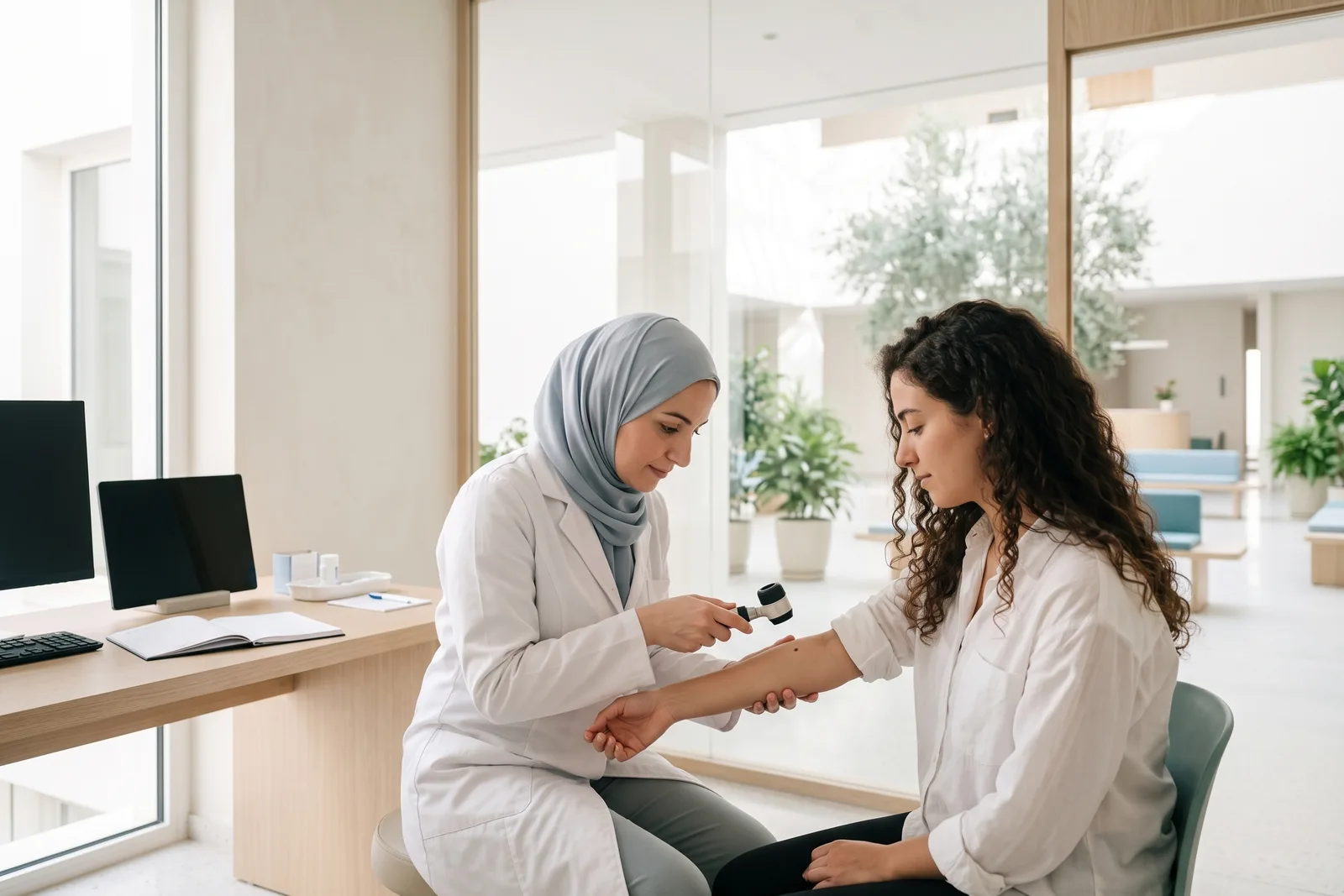
How we see you
In dermatology almost everything depends on looking, and light matters. The consulting room on the first floor of wing B has proper lighting and a dermatoscope, an illuminated magnifier that shows what lies beneath the surface of a mole. For a mole check, the dermatologist examines all of your skin, from the scalp to the soles of your feet, not just the spot that worries you.
Many skin conditions come in flare-ups: acne, eczema, psoriasis. The doctor asks how yours behaves with the seasons, with stress or with the products you use, then explains the care to apply, in what order and for how long. Dated photos taken at home often help more than a long description.
Follow-up is built in your patient space: the report of each consultation, photos of a mole under watch so it can be compared from one visit to the next, written instructions. When the skin reflects something else, such as the thyroid, low iron or an allergy, the dermatologist asks for the relevant tests, done in the ground-floor laboratory, and talks to the doctor concerned.
People often come for…
A few common reasons, put the way patients put them. They help you find the right door; they say nothing about what you have.
- Acne
- Eczema or itching
- Mole check
- Hair loss
- Psoriasis
- Marks on the skin
What we examine and take care of
Every situation is different: the consultation, and only the consultation, decides what comes next.
Moles
A full skin check under good light, and follow-up of a mole that is changing in size, shape or colour.
Acne
Teenage or adult acne, the marks it leaves, and care suited to your skin type.
Eczema and itching
Dry, itchy skin, eczema that keeps returning, or a reaction to a product, a metal or a fabric.
Psoriasis
Patches that come back, how widespread they are, what triggers them, and long-term follow-up of the condition.
Hair, nails and marks
Hair loss, nails that change in appearance, or marks that appear or darken on the skin.
A first consultation, step by step
Arrival
After the ground-floor reception you are seen on the first floor, wing B. If you can, come without make-up or nail varnish on the areas to be shown.
Your story
The doctor asks how long it has been there, how it has changed, what you have already tried, and whether skin conditions run in your family.
Examination
Your skin is examined under proper lighting, with the dermatoscope if needed, and you are only asked to uncover what is necessary at each moment.
Instructions
You leave with care instructions in writing, sometimes reference photos, and the report in your patient space.
What to bring
- Dated photos of the area, taken a few weeks apart, if the problem changes over time
- The products, creams or treatments you have already used, or their names and prescriptions
- Any related reports and tests, including a previous allergy test
Where to find us
Consultations take place on the first floor, wing B.
fourth floor — not on your routethird floor — not on your routesecond floor — not on your route
- From
- Main entrance
- To
- Room 125 — dermatology
About 89 m on footFloors on the way: ground floor, first floor
The steps, in order
- Starting point: Main entrance.
- Carry on straight for about 50 m.
- Take lift A to the first floor.
- Carry on straight for about 5 m.
- Turn left.
- Carry on straight for about 30 m.
- Room 125 — dermatology is on your left.
The doctors
Each doctor’s next free slot, worked out just now. Book the one that suits you directly.
2 doctors available
Looking for appointments…
Available by video
By teleconsultation
Follow-up of a known skin condition such as acne, eczema or psoriasis can be done by video, with good photos taken in daylight. A mole check, and any first consultation, takes place at the clinic, under the room’s lighting and the dermatoscope.
Common questions
Should I come without make-up?
Yes, if the area to be examined is your face, and without nail varnish if the consultation is about your nails. Avoid putting cream on the area on the morning of your visit, too: the doctor then sees your skin as it is, and the photos taken for your follow-up can be compared from one visit to the next.
My child has eczema: dermatologist or paediatrician?
The paediatrician is usually the first door, and knows childhood eczema well. If the eczema does not settle, spreads or keeps returning, they can refer you to the clinic’s dermatologist, who also sees children. Both doctors then share the same record.
How long is the wait for an appointment?
Each dermatologist’s next free slot is shown on this page, worked out at the moment you read it. If a mole has changed quickly, say so when you book or at reception: the desk will then look for an earlier slot.
Is the consultation reimbursed?
The clinic gives you the feuille de soins to send to your fund. Reimbursement depends on your scheme, CNAS or CASNOS, and on any top-up insurance; your fund is the only one that can confirm what is covered.