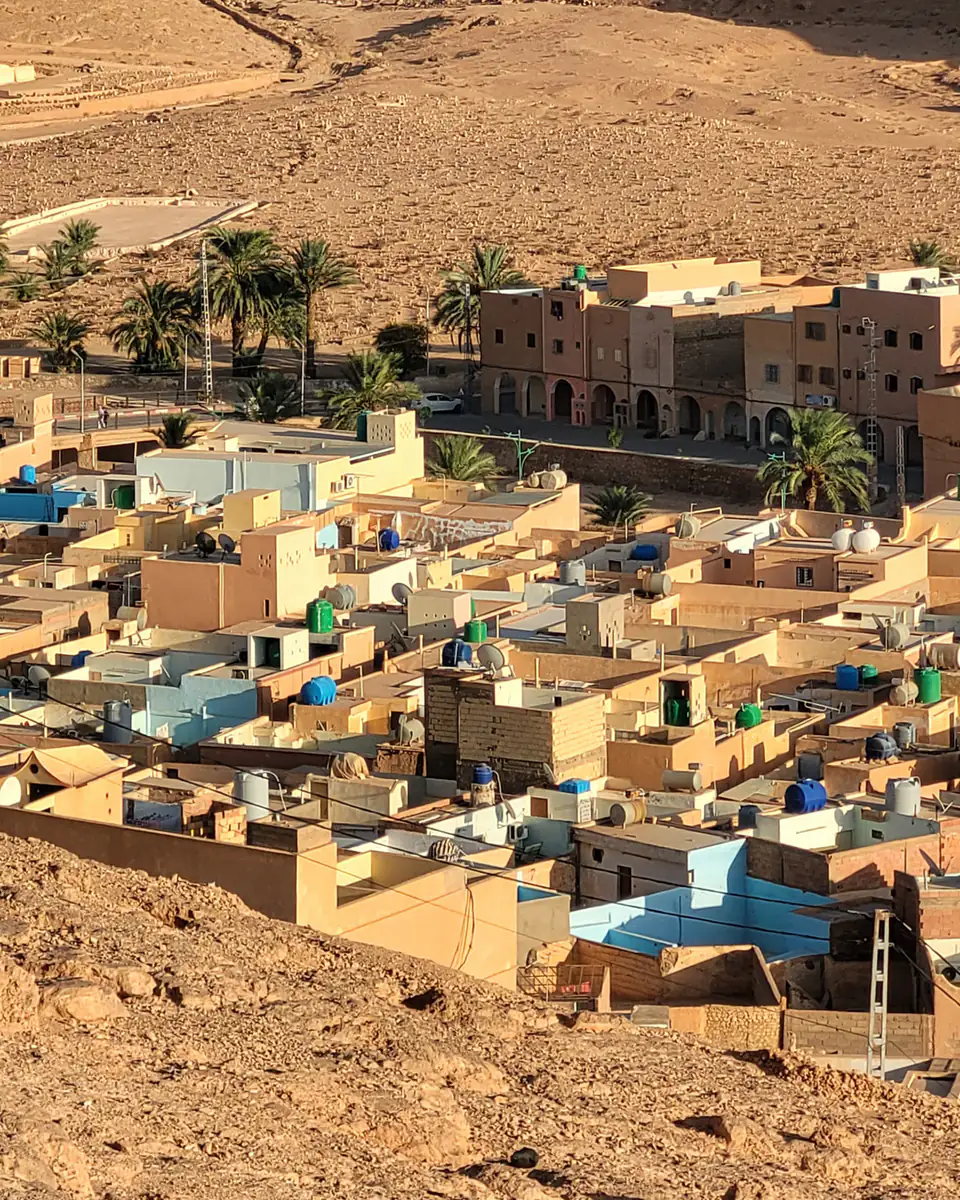
The M’zab valley, some six hundred kilometres south of Algiers, holds five ksour founded from the eleventh century onwards: El Atteuf, Bounoura, Melika, Ghardaïa and Beni Isguen. Inscribed on UNESCO’s World Heritage List in 1982, it is often cited as an example of town planning in tune with its setting. Visitors first see a harmony of forms and colours, before they grasp the logic behind it.
Each ksar follows a similar plan. The mosque crowns the hilltop, its minaret serving as both landmark and lookout, and the houses descend in rings to the foot of the hill, where the market and the ramparts stand. The arrangement reflects a society in which religious life, domestic life and trade each have their place.
The houses follow principles of restraint and equality. Façades are plain and of similar height, and none seeks to rise above its neighbours. Inside, rooms are arranged around an open courtyard that brings in light and air, and the roof terraces serve as living space in the evening and as a place to sleep in summer.
The architecture answers the climate with great precision. Thick walls of stone and local plaster soften the swings in temperature, narrow lanes, roofed in places, keep the shade, and openings onto the street stay small. Many twentieth-century architects saw in these forms a source of inspiration for modern, economical building.
Water is the valley’s other key. The wadis flow only a few days a year, and a network of dams, channels and wells shares the floodwater between the palm groves according to old and precise rules. The palm groves were also once home to the summer residences, cooler than the ksour.
Some ksour, Beni Isguen in particular, are visited with a local guide and according to rules the inhabitants are keen to preserve. Visitors dress modestly, avoid photographing people and respect the hours when visitors are received. These rules, which may change, are part of what the valley has to teach.
Ghardaïa’s market, on its arcaded square, is still a lively place of trade, with rugs woven in the region, copperware and produce from the palm groves. In spring and autumn, when the heat is bearable, two or three days are enough to visit all five ksour without hurrying.
Our stays in the M’zab combine guided visits, a night in a restored traditional house and free time at the market. We can also link the valley with Timimoun or El Menia for a longer circuit in the south.
Visa, health and entry rules change without notice: check them with the consulate or the official portal before you travel.