DemonstrationGouraya Optical is a fictional eyewear shop in Béjaïa. Nothing here can be bought: an order exists only in your browser, for this visit, and no payment is taken.The same for your business

Your basket

The basket is empty.

Journal

What an optician explains at the counter.

Three pieces written once so they need not be repeated twenty times a week. They sell nothing: they let you choose without us.

Three more since: face shapes, lens index and looking after acetate.

An ink-blue rectangular acetate frame on an open notebook, beside a sketch of a round face.

Guide3 min read

Which frame for a round face?

The useful rule is one sentence: look for contrast. An angular frame gives a round face structure; a round frame doubles it. The rest is proportion, and thirty seconds in front of a mirror settles it.

A round face is as wide as it is long, with full cheeks and few angles. A frame with straight lines gives it the structure it lacks; a round frame repeats its curve and rounds it further.

Look for a frame slightly wider than the cheekbones, with a clear bridge and lenses wider than they are tall. The mirror test: if the frame disappears into the face, it is too round or too small.

What we do
We have you try two opposite shapes side by side, so the contrast shows.
What we refuse
We do not tell you a shape is “forbidden”: the rule helps you choose, it does not decide.

Back to the contents

Five frames of different shapes laid in a row on linen paper, in daylight.

How-to4 min read

Four face shapes, and the frame that answers each.

The round face has its own piece above. Here are the three other shapes we see most at the counter, with what suits them and the frames from the catalogue to try.

Three measurements are enough: the width of the forehead, of the cheekbones, of the jaw. The widest decides the shape, and the frame comes in as the counterweight.

  • Round

    Angles: a square or cat-eye frame gives the cheeks structure.

    To try

  • Square

    Curves: a round or aviator frame softens a strong jaw.

    To try

  • Oval

    Almost anything suits it; keep the frame as wide as the face, no wider.

    To try

  • Heart

    A wide forehead and a narrow chin: a frame light at the top, round or aviator.

    To try

What we do
We look at your face from the front and in profile before we bring out the first frame.
What we refuse
We put nobody in a box: many faces sit between two shapes, and the mirror settles it.

Back to the contents

Two lenses held up against a window over the sea: the left one throws back white reflections, the right one is almost invisible.

Workshop3 min read

What an anti-reflective coating actually does

It protects you from nothing. It increases the light that passes through the lens instead of bouncing off it — which makes your eyes visible to other people and tires them less in the evening. It is not a filter, and nobody should sell it to you as one.

A bare lens sends back part of the light at each of its two surfaces. What bounces off never reaches you: it is light lost, and a reflection the person facing you sees instead of your eyes.

The coating is a stack of very thin layers that cancel those reflections by interference. A faint green or violet glint remains at certain angles: it is what shows in photographs, and it is normal.

Uncoated: a 1.60 lens throws back about a tenth of the light, and a pale veil sits in front of whatever you look at.

A drawing of the effect, not a measurement.
What we do
We put it on every prescription lens we cut, and we show you the difference at the window.
What we refuse
We sell it neither as protection nor as a filter: it is neither.

Back to the contents

A blank prescription form, a fountain pen, a metal-rimmed trial lens and a pair of reading glasses on linen.

Guide4 min read

Reading a prescription: sphere, cylinder, axis

Three numbers per eye, and a fourth once you are past forty-five. Knowing how to read them keeps you from accepting a quotation whose most expensive line you cannot check.

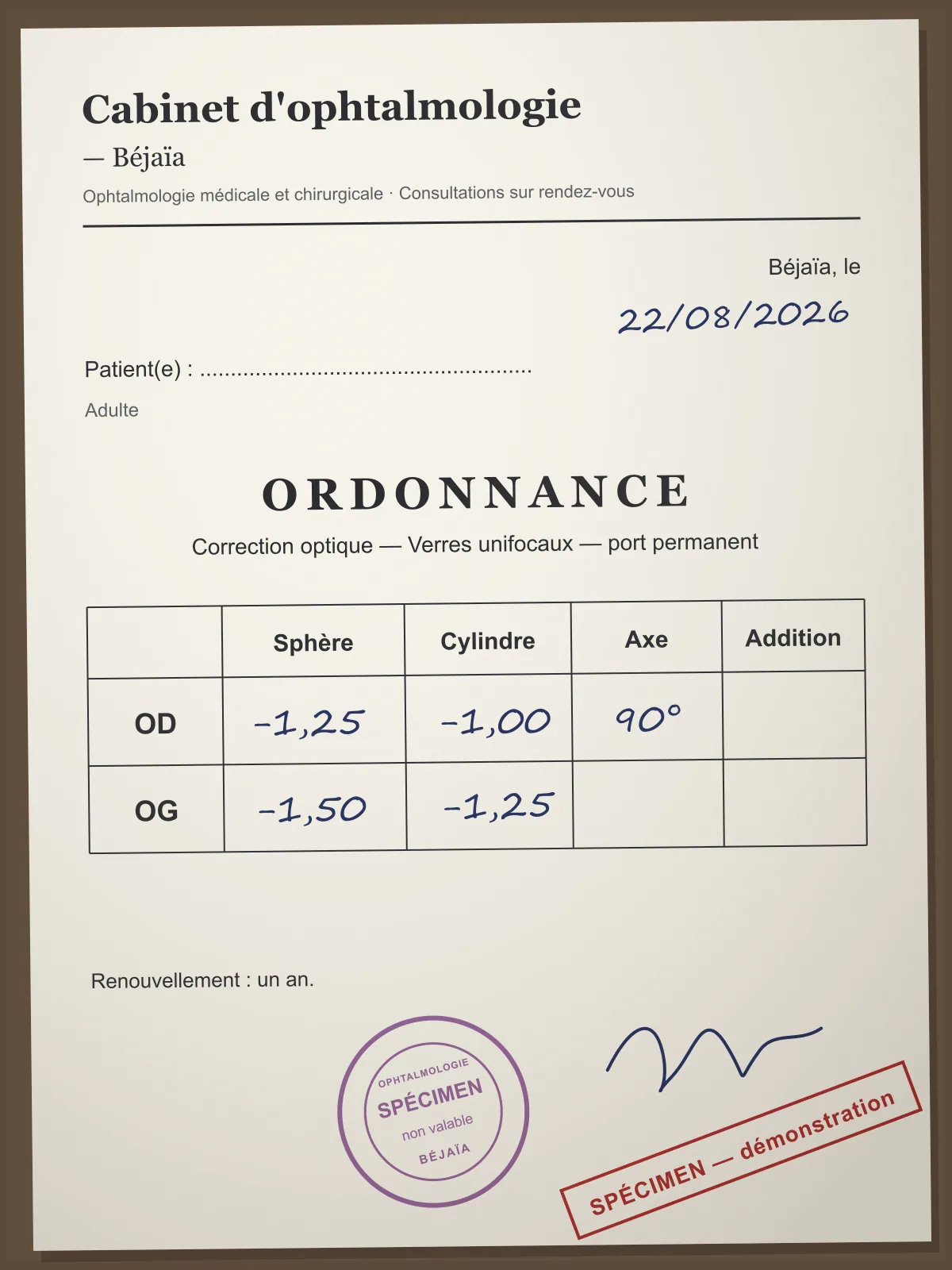
A prescription fits in a small table: one row per eye, one column per value. The example below is invented for the demonstration; touch a marker to read what it means.

An empty box is not a zero: an empty cylinder means “no astigmatism”, an empty axis beside a cylinder means something is missing.

Hover, tap or tab through the markers placed on the prescription.

An example prescription, annotated · A prescription invented for the demonstration.
What we do
We read every prescription before ordering a lens, and we tell you back what we read.
What we refuse
We never complete a prescription on behalf of whoever wrote it.

Back to the contents

Two cut lenses standing on edge side by side on dark slate.

Lenses3 min read

1.60 or 1.67: what the index actually buys.

A higher index bends light harder, so it needs less material for the same correction. The question is not “which is better” but “how many millimetres for how many dinars”.

The simulator below draws the edge of both lenses at your power, to the same scale. It is an estimate of the shape: the real thickness also depends on the frame, and we compute it when you order.

−4.00
  • Index 1.60Edge: 3.9 mm

  • Index 1.67Edge: 3.7 mm

Thinner at the thickest point by 0.2 mmfor +4 200 DA

An estimate of the shape, over a fifty-millimetre lens. The workshop works out the real thickness from your frame and your prescription.

What we do
We show you the difference in millimetres before we offer you the supplement.
What we refuse
We do not sell a 1.67 for a weak correction: it would thin almost nothing.

Back to the contents

A honey acetate frame being cleaned with a linen cloth, beside a bowl of lukewarm soapy water.

Care2 min read

Acetate wants lukewarm water, not sunshine.

Acetate is a plant-based material, cut from a block and polished by hand. It lasts for years on two conditions: lukewarm water rather than alcohol, and never any heat.

  1. Rinse the pair in lukewarm water, never hot.

  2. A drop of mild soap on your fingertips, rubbed over the lenses and the frame.

  3. Rinse again, then dry with a clean cloth, never rubbing it dry.

  4. Put it away in its case, lenses facing up.

  5. No alcohol, no acetone, no dashboard in summer: acetate dulls and warps.

What we do
We repolish and readjust a frame we mounted, free of charge.
What we refuse
We sell no miracle product: water, soap and a cloth are enough.

Back to the contents

Try-on

We measure how this site is used with Google Analytics, to learn which pages actually help. You can stop that measurement at any time from the footer.We measure our audience. Cookie policyCookies