In summer, a house built of concrete slabs and hollow brick behaves like a storage heater: it soaks up heat all day and gives it back all night. The air conditioner makes up the difference, at a price you read on the electricity bill and hear in the compressor.
It can be done better, and often without major works. The rule is simple: stop the heat before it gets in, rather than chase it out afterwards. It comes in three ways, in this order of importance.
The roof first: up to half the heat
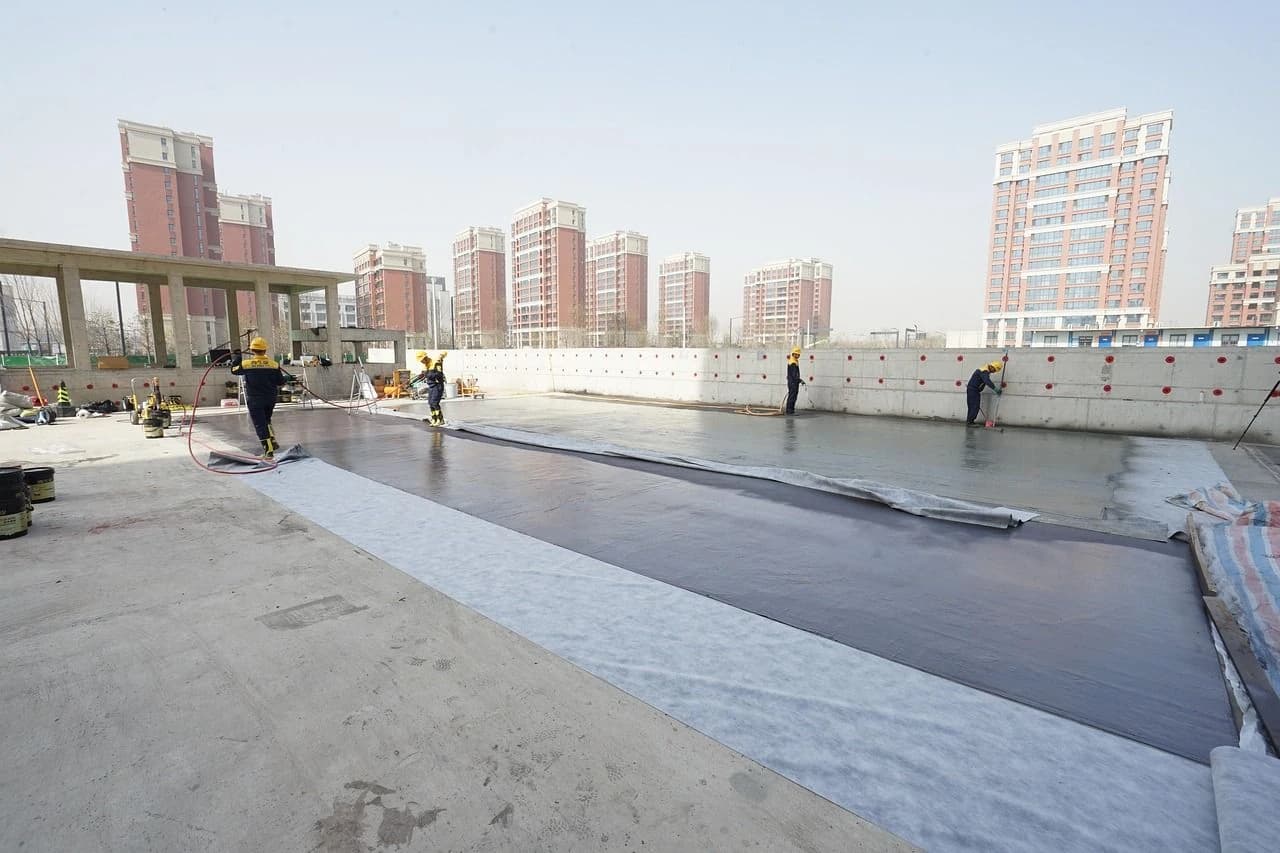
A flat roof in full sun goes past fifty degrees at the surface. Without insulation, the 16 cm slab passes that heat to the top-floor ceiling a few hours later — just when you want to sleep. This is where every dinar spent pays back most.
Two measures work together. The first is to send the sun back: a white, reflective acrylic resin over the waterproofing lowers the surface temperature dramatically and shields the membrane from ultraviolet. The second is to insulate: extruded polystyrene boards laid on the waterproofing, under a heavy protection (pedestal slabs or gravel) — the so-called inverted roof. Extruded polystyrene withstands water and crushing; ordinary expanded polystyrene must not go there.
Then the windows: stop the sun outside
Sunlight that passes through glazing is heat trapped indoors. An external shade — a louvred shutter or a roller shutter — works far better than a curtain, because it stops the radiation before the glass. An aluminium louvred shutter, with tilting blades, lets air through at night while the house stays shut.
South- and west-facing walls deserve attention first. An overhang or canopy above a south window blocks the high summer sun and lets in the low winter sun.
The walls: the air gap and the mass
A double brick wall — a 15 cm leaf, an air gap, a 10 cm leaf — already insulates better than a single wall, provided the gap is not filled with rubble during the build. In a new house, sliding insulation into that gap is the cheapest time it will ever be done.
In an existing home, an inner lining on the most exposed wall, with rock wool behind plasterboard, gains the room several degrees for the price of a few centimetres of floor.
A false ceiling under a flat roof
When the roof itself cannot be touched, a plasterboard false ceiling with 10 cm of rock wool laid on top cuts much of the heat coming down. A vapour barrier on the room side stops the house’s moisture wetting the insulation in winter.
Ventilate at night, close by day
The simplest measure costs nothing: close the shutters on the sunny side from the morning, and open wide in the evening, with a through-draught between two opposite walls. A well-insulated house ventilated at night keeps the night’s cool until mid-afternoon.
So, in order: the reflective resin and the roof insulation, external shading on the exposed windows, then the walls. It is also the order in which the comfort shows fastest.